My Husband Came Home from the War. But Something Else Came With Him.
The night Daniel came home, I made his favorite meal. Pot roast, mashed potatoes, the good rolls from the bakery on Clover Street. I set the table with candles. I wore the green dress he always said made my eyes look like sea glass.
Fourteen months. That’s how long I’d slept with his pillow on his side of the bed, just to fill the space. Fourteen months of newscasts I could barely watch. Of jumping every time my phone buzzed. Of praying in a way I hadn’t prayed since I was a little girl at my grandmother’s kitchen table.
He came through the front door at 6:47 PM on a Tuesday in November. Thinner than I remembered. A scar above his left eyebrow I hadn’t seen on the video calls. But his smile — God, his smile was exactly the same. He held me for so long we were both shaking.
He’s home, I kept thinking. He’s finally home. We’re okay now.
For two weeks, I believed that.
* * *
The changes were small at first. The kind you could explain away if you wanted to badly enough — and I wanted to badly enough.
He stopped drinking coffee. Nine years, two cups every morning without fail, and suddenly the smell of it made him leave the kitchen. He started sleeping with the window cracked, even as November turned bitter. He’d go quiet in the middle of conversations — not distracted quiet, but gone quiet, eyes fixed on something just past my shoulder that wasn’t there when I turned around.
I told myself it was adjustment. The VA pamphlets said as much. Reintegration takes time. Be patient. Be present. Don’t push.
I was patient. I was present. I didn’t push.
Then came the third week.
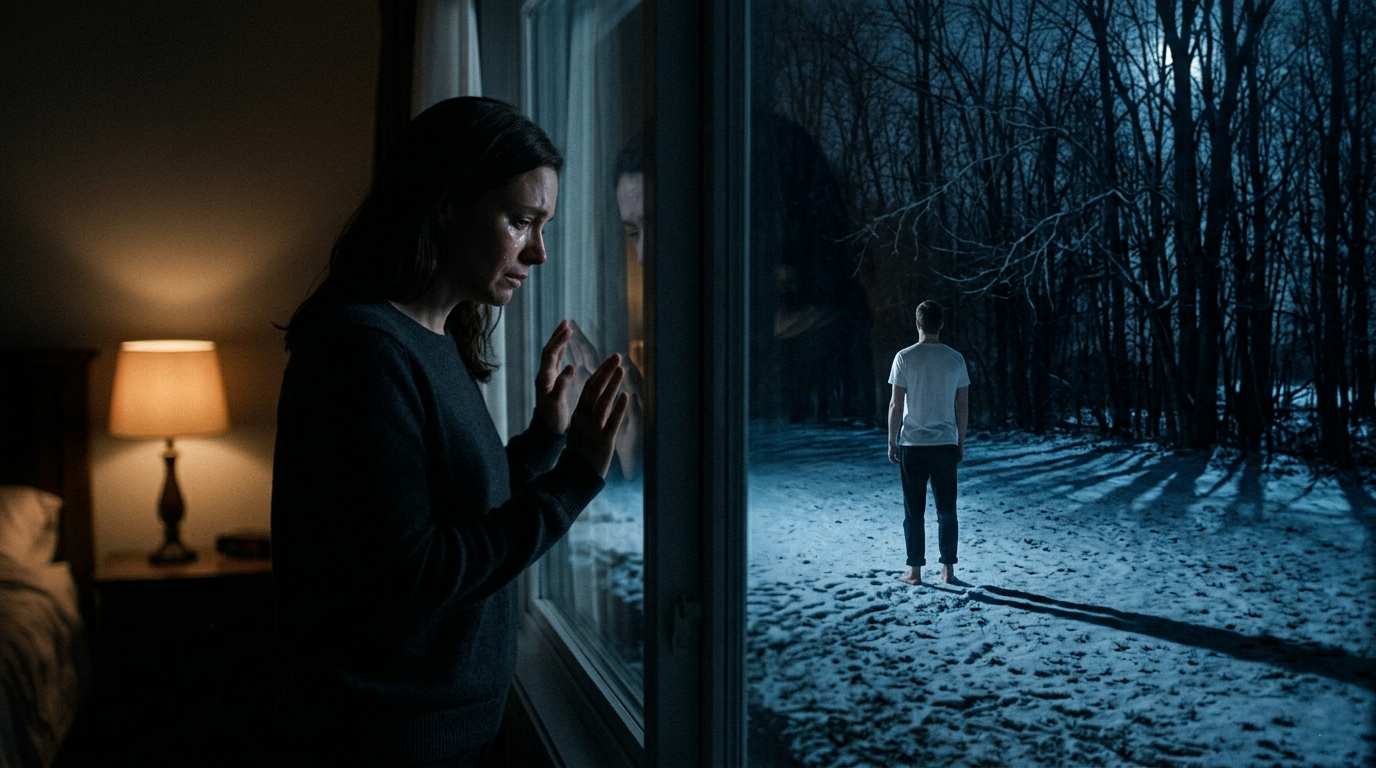
I woke at 2:14 AM to an empty bed. Not unusual — Daniel had been struggling with sleep since he got back. But something made me go to the window instead of the hallway. Some instinct I still can’t name.
He was standing in the backyard. Stone still. No coat, no shoes, in 38-degree weather. Facing the tree line at the edge of our property — forty yards of frozen November dark, the old oaks stripped bare, the fence we’d always meant to repaint.
And he was whispering.
I pressed my face to the cold glass, trying to see. Trying to hear. His lips were moving in a slow, steady rhythm. The name he kept repeating — soft, deliberate, like a prayer or a warning — was a name I had never heard before in nine years of marriage.
It wasn’t mine.
* * *
I didn’t say anything that night. I went back to bed and lay there staring at the ceiling until I heard him come back inside, heard him wash his hands at the kitchen sink, heard him ease carefully back into bed as though he didn’t want to wake me.
“You okay?” I whispered.
“Bad dream,” he said. “Go back to sleep.”
I didn’t sleep.
It happened again four nights later. And again the week after that. Always the same time — sometime between two and three in the morning. Always the same spot in the yard, facing the same tree line. Always whispering that name.
Reza.
I finally heard it clearly on the fourth night, standing just inside the back door with it cracked open two inches, cold air pouring over my feet. He said it over and over, low and even, the way you’d speak to a frightened animal. Or maybe the way you’d speak to someone you were trying very hard to convince to stay away.
The next morning, while Daniel was in the shower, I sat down at the kitchen table with my laptop and typed the name into Google alongside his unit number and deployment region. I don’t know exactly what I was looking for. Proof that I was being ridiculous, maybe. A reasonable explanation I could fold up and put in my pocket.
What I found was a news article from eight months earlier. A small one, the kind that gets three paragraphs and disappears. A local interpreter — a young man named Reza Ahmadi, twenty-six years old — had been killed in a roadside explosion while embedded with an American unit in a southern province. He had a wife. A daughter who was four years old. The article said he had been described by the soldiers he worked with as, and I remember this word for word: the bravest man any of us had ever known.
I sat with that for a long time.
* * *
I brought it up that evening. Gently. I told him I hadn’t been sleeping well, that I’d seen him in the yard a few times, that I wasn’t upset — I just wanted to understand.
Daniel set down his fork. He didn’t look at me right away. He looked at his hands the way he sometimes did now, like they belonged to someone he was still getting acquainted with.
“You heard me,” he said. It wasn’t a question.
“Yes.”
He was quiet for so long I thought he wasn’t going to answer. Then he said, “He used to stand watch with me. Night shifts. We’d just talk — about nothing, about everything. His daughter’s name, what he wanted to be when he was a kid, whether he believed in God.” He paused. “He saved my life twice in fourteen months. The second time it cost him his.”
I reached across the table and took his hand.
“I keep thinking he followed me home,” Daniel said, and his voice was so matter-of-fact that it took me a moment to understand what he meant. “Not in a scary way. More like—” He stopped. Started again. “More like he just wants to make sure I’m okay before he goes.”
My throat was very tight. “And is he? Gone yet?”
Daniel looked out the kitchen window at the dark backyard. At the tree line. At whatever was or wasn’t out there in the old November oaks.
“Getting there,” he said quietly. “I think he almost believes I’m going to be alright.”
* * *
He stood in the yard two more times after that night. Then it stopped.
We found a therapist who specialized in combat veterans — a quiet, serious woman named Dr. Okafor who had served herself and didn’t flinch at anything Daniel said. He started sleeping better. The coffee came back — just one cup now, but still. The faraway looks in the middle of conversations began to shorten, and then to fade.
The following spring, Daniel contacted Reza’s family through a military support organization. It took three months of paperwork and two translators, but eventually we were connected with his wife, Nasrin. We exchanged letters — actual letters, written on paper, which felt right somehow. She sent a photograph of her daughter, now five, standing in front of a window with afternoon light falling across her face. On the back, Nasrin had written: She has his eyes. She will know who her father was.
Daniel pinned it to the inside of his closet door, where he sees it every morning when he gets dressed.
I used to lie awake wondering what came home from the war with my husband. Wondering whether to be afraid of it.
Now I know. What came home with him was grief that hadn’t finished saying goodbye. Guilt that needed somewhere to put itself. Love for a man he couldn’t save, standing watch one last time at the edge of our yard in the cold November dark.
Not a ghost. Not a haunting.
Just a debt being honored — the only way the living ever really can.
-END-