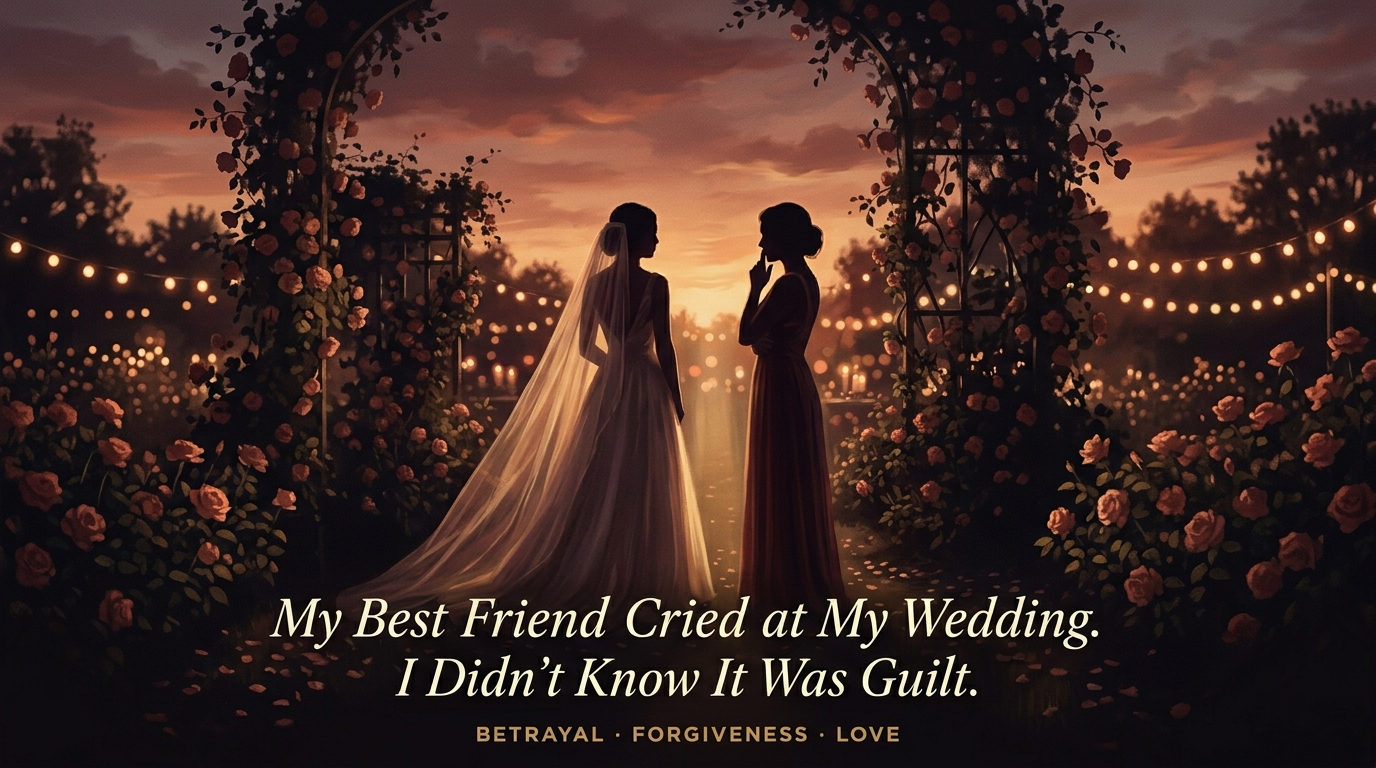
My Best Friend Cried at My Wedding. I Didn’t Know It Was Guilt.
✦
Part one
The Photograph
There is a photograph from my wedding that I used to love.
In it, my best friend Mara stands just behind me during the ceremony, one hand pressed to her lips, her eyes red and glassy. Around her, guests smile. My new husband holds both my hands. And Mara — who has known me since we were seventeen, who helped me pick out my dress, who gave a toast the night before that made the entire rehearsal dinner laugh and then cry in equal measure — stands there undone.
I used to show people that photo. Look how moved she was, I would say. That’s love. That’s what twenty years of friendship looks like.
I know better now.
Part two
What I Knew Then
Mara and I met during our junior year of high school, assigned to the same AP Literature class. She borrowed my pen on the first day and never returned it. I decided that was the foundation of a friendship. She agreed.
We were different in the ways that make close friendships interesting and occasionally exhausting. Mara was brilliant and impulsive, prone to grand declarations and late-night phone calls. I was steadier — or so I thought — a person who made lists and stuck to them. She was the story; I was the one writing it down.
Through college, through bad relationships and job changes and the deaths of both our fathers within eighteen months of each other, we remained. She was the maid of honor at my wedding without question. There was no other candidate.
“She was the maid of honor at my wedding without question. There was no other candidate.”
My husband, Daniel, I had met three years before the wedding at a mutual friend’s dinner party. He was quiet and careful with words, which I found calming after years of Mara’s electric intensity. He was the kind of man who remembered your coffee order and fixed things around the house without being asked. Mara said she liked him. She said this with the particular evenness of someone choosing their words.
I didn’t hear what was underneath it.
Part three
The Wedding Day
The ceremony was small — sixty people in a garden on a September afternoon, the kind of day that feels specifically designed to make you feel that the universe endorses your choices. We’d rented a property outside the city, all overgrown roses and warm stone. The light was gold by four o’clock.
Mara had been helpful all morning. She pinned my veil and brought me tea and told me I looked extraordinary, which she said in a way that sounded almost like an accusation — warmly, but with some force behind it, as though she wanted to make absolutely certain I believed her.
During the ceremony I could not see much beyond Daniel and the officiant. But I heard my mother sob early, and my aunt murmur something to her husband, and later someone told me they’d spotted Mara crying before my father’s name was even mentioned in the reading.
I assumed it was grief. We both still carried it. Weddings crack open the containers where you keep the people who should be there.
That night she danced with everyone. She gave a toast that was funny and warm and careful — nothing like the free, sprawling love she’d offered the night before. I noticed the difference in pitch without understanding its source. I filed it away under exhaustion. We had all been running on nerves and champagne for days.
She hugged me goodbye at midnight with a ferocity that surprised me.
“I love you so much,” she said into my shoulder. “I’m so sorry.”
I thought she was apologizing for crying so much. I pulled back and laughed and told her not to be ridiculous.
She smiled. She let me go. She went home.
Part four
Seven Months Later
The marriage was not what I expected. Not badly — just differently. Daniel and I were learning each other in the specific, unglamorous way that cohabitation demands. The romance of the wedding gave way to the project of a shared life, and we were both, I think, surprised by how much work a project can be when you love the other person but haven’t yet learned their silences.
In February, about seven months after the wedding, Mara asked if we could have dinner. Just the two of us. I noticed she didn’t suggest somewhere loud or fun; she picked a quiet Italian place we’d gone to after her father’s funeral. The kind of restaurant you choose when you need to be heard.
We ordered. We talked for a while about nothing — her job, my work, a book she was reading. I could feel her edging toward something. I let her edge. This was the rhythm of us: she arrived at hard things on her own schedule, and I had learned not to rush her.
Finally, she set down her fork. She looked at the tablecloth. She said:
“Before your wedding. Before — a few months before. Daniel and I had a conversation.”
I waited.
“It was one conversation. One evening. I need you to know that.”
The room did not change. The noise continued. Someone at the next table laughed at something. I looked at my best friend and watched her face do the things faces do when a person is forcing themselves to say a true and terrible thing.
She told me that six months before our wedding, she and Daniel had had dinner alone — she said it was an accident, a crossed wire of plans — and that during that dinner, something had been said between them that shouldn’t have been. Not an action. She was clear on this, almost urgent. Nothing happened. But something was said.
Daniel had told her that there were moments he wasn’t sure. That he was scared. That she — Mara — was someone he could imagine a life with.
She had told him to go home. She had not told me.
She had stood at my wedding and cried.
Part five
What You Do With a Thing Like That
I did not throw my wine glass. I did not leave the restaurant. I sat very still, which is what I do when something is too large to immediately process, and I looked at my best friend, and I thought: I have known you for twenty years and I am meeting you for the first time.
She was crying again. Not the photogenic wedding kind — messy, exhausted crying, the kind that has been waiting a long time.
I asked her why she was telling me now. She said she couldn’t hold it anymore. That it was sitting in her chest like a stone and she had decided that carrying it was worse than releasing it. That I deserved to know what I had almost not had — and what she had almost done, simply by staying silent.
“I looked at my best friend and thought: I have known you for twenty years and I am meeting you for the first time.”
I asked if she had feelings for Daniel.
She was a long time answering. Then she said: Not the kind that matter now.
I paid the bill. I don’t remember doing it. We stood outside on the sidewalk in February, our breath visible, and she asked me if I hated her. I told her I didn’t know yet. I told her that was honest. She said she understood.
I went home to my husband.
Part six
Daniel
I told him that night. I sat on the end of our bed and repeated what Mara had said almost verbatim, the way you do when you’re trying to hand a thing to someone else so you can watch them hold it.
He didn’t deny it. He sat with his elbows on his knees and looked at the floor and said he was sorry. He said it had been fear, that he had been terrified in the months before the wedding — not of me, but of the permanence of it, the irrevocability. He said Mara had been there when he was afraid and he had said something he should have said to me, or to no one at all.
He said he had never considered not marrying me.
I asked him why he’d said it to her of all people. He didn’t have a clean answer. Neither of us did.
We talked for a long time. It was one of the harder conversations of our marriage, which is saying something because we have not always been easy with each other. But there is a kind of conversation that only happens when both people decide they would rather survive something together than alone, and this was that kind.
We survived it.
Part seven
Mara and Me
That part was harder.
I didn’t speak to her for three months. Not a deliberate freeze — more like an inability to locate the door back in. I would think of her and feel a complicated mix of grief and fury that I hadn’t learned to separate yet. She had not done something. But she had known something and kept it, and then put on a yellow bridesmaid dress and stood at the front of a garden and wept with guilt while I promised myself to a man who had, in a moment of fear, chosen her as his confessor.
I thought about what she could have done differently. Told me immediately. Told me never. Refused to be in the wedding. Any of those would have been a different kind of damage. I couldn’t decide which version would have been easier to hold.
In May, she left a voicemail. She said she was not calling to ask for anything. She said she understood if I needed more time, or forever. She said: You are the person I would call if something like this happened to me. I know that means nothing right now but I needed to say it.
I listened to it four times.
The fifth time I called her back.
We met at a park — neutral ground, open air. We walked for two hours without sitting down. I said everything I had needed to say. She listened without defending herself, which was the right choice, and also the hardest thing I have ever watched someone do.
I told her I forgave her. I meant it partially, which is where all real forgiveness starts.
Epilogue
What I Know Now
That was two years ago. Mara and I are still friends, though we are different friends than we were. There is a transparency between us now that feels both harder and more honest — like a window that had been fogged for years and has finally been cleaned. I can see her more clearly. I think she can see me too.
Daniel and I are fine. More than fine. The conversation we had that night in February, as devastating as its occasion was, opened something between us that needed opening. He talks to me now when he’s afraid. That seems worth noting.
I still have the photograph. I don’t show it to people the way I used to. But I haven’t thrown it away, either.
I look at it sometimes and try to find the guilt in Mara’s face, now that I know to look for it. And what I see is something more complicated than I expected — someone who loved me enough to stand there, and was too afraid to do anything else. Someone who was human in a way I hadn’t made room for.
I’ve made room now.
“I’ve learned that sometimes the tears we think are for us belong to something else entirely — and that knowing the difference changes everything, and nothing, all at once.”
People ask me sometimes what I’ve learned from all of it. I find the question hard to answer tidily. Something about how the people who love us best are also the people most capable of keeping secrets from us, because they love us too much, or too little, or in the wrong direction. Something about how forgiveness is not an event but a practice — you have to choose it over and over, especially in the moments when it’s inconvenient.
And something about photographs. About how an image can hold a truth you’re not ready to see. About how sometimes you have to learn what a moment really was before you can decide what it means.
I’ve learned to look again at the things I thought I understood.
I’m still looking.
— End —