
I Walked Into My Surprise Party and Found My Husband Kissing My Best Friend
Part 1 ·
I Walked Into My Surprise Party and Found My Husband Kissing My Best Friend
They told me we were going to dinner. Just the two of us — Marcus and me — to celebrate my thirty-fifth birthday the quiet way I always preferred. No fuss, no crowd, no balloons. He even texted me that afternoon: “Wear the blue dress. I have a reservation at Auberge.” I remember smiling at my phone like a fool.
I should have noticed the silence when we pulled into our neighborhood. No cars on the street. No lights in the windows of our house. I told myself Marcus had asked the neighbors to keep it low-key. He was thoughtful like that — or so I believed.
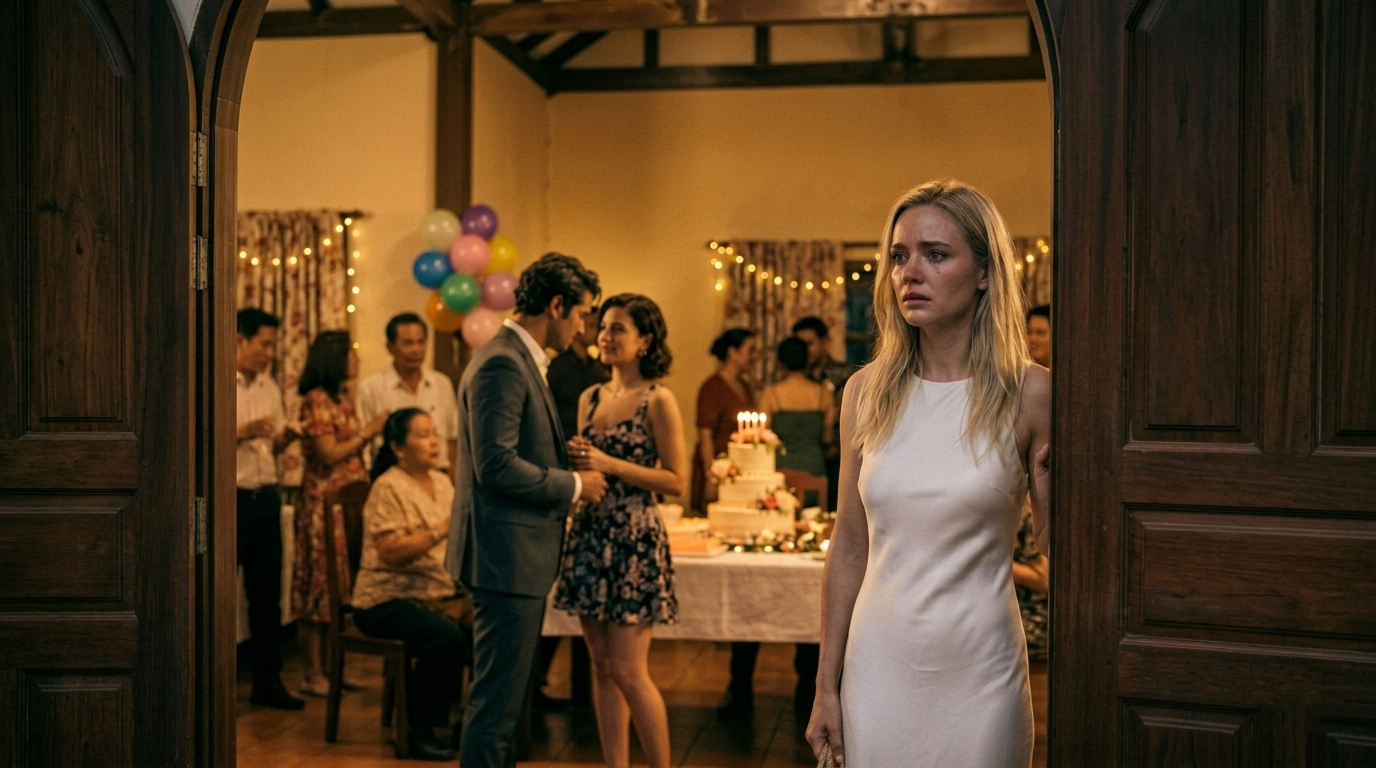
He held my hand walking up the porch steps. He squeezed my fingers when he pushed the door open. The lights exploded on. Thirty people screamed “Surprise!” and I screamed back, genuinely startled, genuinely happy. Champagne glasses raised. My mother was crying already. My sister was holding a cake with too many candles on it.
And then I saw them.
In the hallway — past the crowd, past the streamers, past my mother’s happy tears — my husband had his hands on my best friend Diane’s face. Her eyes were closed. His lips were on hers. Not a peck. Not a mistake. The kind of kiss that holds history in it. The kind that has a beginning you weren’t there for.
“It lasted only three seconds. But I’ve been living inside those three seconds for the last four months.”
Nobody else saw it. Everyone was looking at me — the birthday girl — laughing, clapping, pulling out their phones to capture the moment. Marcus and Diane broke apart the instant the lights came on. She smoothed her hair. He turned toward me with a smile so practiced it made my stomach turn.
“Happy birthday, baby,” he said, and crossed the room to kiss me on the cheek.
I smiled. I hugged people. I blew out the candles. I cut the cake with the same knife I later realized Marcus had bought at Diane’s recommendation — because of course she had been in our home, in our kitchen, in our marriage in ways I was only beginning to understand.
That night I laughed the loudest I had in years. Because what else do you do when the floor disappears beneath you and thirty people are watching?
What no one tells you about betrayal is this: the first thing you lose isn’t trust. It’s your own memory. Every sweet thing he ever said to me started rewriting itself in my mind — was that real? Was that a performance? Was I always the audience, never the story?
I went to bed that night beside my husband, staring at the ceiling, counting the years. Eleven. Eleven years of marriage. Two miscarriages. One adoption that fell through. A business we built together, a life that looked, from the outside, like something people envied.
And Diane. Twenty-two years of friendship. She was the maid of honor at my wedding. She held my hand after each miscarriage. She called me every Sunday morning without fail.
· · ·
I didn’t confront either of them that night. Or the next day. Or the day after that.
Because I needed to know the full truth before I burned anything down. And what I found — when I started looking — was so much worse than a kiss.
Part 2 ·
What I Found When I Started Looking
I am not a detective. I am a fourth-grade teacher who drives a sensible car and keeps her pantry alphabetically organized. I am not the kind of woman who goes through her husband’s phone while he sleeps. Or so I thought, until the morning after my birthday party, when Marcus left his phone on the bathroom counter and walked into the shower, and I picked it up without thinking, the way you reach for something you already know will hurt.
His passcode was our wedding anniversary. It had always been our wedding anniversary. I typed it in like muscle memory and the screen opened and the first thing I saw was a message from Diane that said: “Last night was too close. We need to be more careful.”
I put the phone down. I walked to the kitchen. I made coffee. I poured it out. I sat on the floor between the refrigerator and the island — the same spot where I used to sit when our children’s room was still just a spare room full of boxes and hope — and I let myself understand what I was dealing with.
Not a moment of weakness. Not a one-time thing. We need to be more careful is not the language of accident. It is the language of system. Of protocol. Of something that has been running in the background of my life long enough to develop its own rules.
I did not cry. I think I was too far past the crying stage without knowing it.
“I went back through the last four years of my life like a woman reading a book she thought she knew — and finding, on every other page, a different story written in invisible ink.”
The business trip to Portland, March two years ago — Diane had been at a “conference” the same week. I remembered being happy for her, telling Marcus, and him saying, neutrally, “Oh, that’s nice.” The charity gala I couldn’t attend because I had parent-teacher conferences — Marcus took Diane as his plus-one because, he said, it would be awkward to go alone. The Sunday morning calls Diane never missed — I now wondered if she was calling from her own car, parked somewhere close to wherever Marcus was.
I hired a private investigator on a Thursday. I gave him three weeks. He came back in nine days.
It had been going on for four years. Four years and three months, to be precise — the investigator was precise. It had started the week Marcus and I lost the second pregnancy, when I was in the hospital and Diane came to sit with me and Marcus stepped out to get coffee and the two of them were alone in the hallway for twenty minutes and something shifted between them in my worst moment of grief.
I read the report twice. Then I called my sister.
“I need you to come over,” I said. “And I need you to not react when I tell you what I’m about to tell you, because I need to stay calm right now.”
She was at my door in fourteen minutes.
What happened next is the part people always want to know — the confrontation, the screaming, the dramatic moment. But that is not how it went. I am a woman who alphabetizes her pantry. I do not do things without a plan.
I called my lawyer first. Then my accountant. I learned that Marcus and I had a joint business account that he had been drawing from — not dramatically, not enough to trigger alarm, but steadily — for almost two years. Small transfers to a personal savings account I didn’t know existed. Forty-two thousand dollars, accumulated in increments of five hundred here, eight hundred there, the way you pack a bag slowly when you’re planning to leave and don’t want anyone to notice.
He was building an exit. And Diane knew.
I gave myself ten days to get everything in order. I moved the documents I needed. I transferred my portion of the business accounts into a separate account my lawyer helped me open. I had the locks rekeyed on a Tuesday while Marcus was at work. I had his belongings — neatly boxed, labeled, organized, because I am who I am — placed in the garage.
And then I called Diane.
“Can you come over?” I said. “I need to talk to you about something. It’s important.”
She came. Of course she came. She always came when I called. That was the cruelest part of her — she still showed up, still played the role, still looked at me with those familiar eyes and said “of course, honey, I’ll be right there.”
Marcus was already home when she arrived. I had asked him to be there. I told him I had something to show both of them. He looked mildly curious. He was not worried. Why would he be? He had been careful. They had been careful.
I sat them both down at the dining room table — the same table where we’d had a hundred dinners, celebrated a hundred small victories — and I placed two envelopes in front of them. One for each.
“I know,” I said. “I’ve known for four months. I have everything documented. My lawyer has copies of everything.” I looked at Marcus. “The divorce papers are in your envelope. I’d like you to be gone by Friday.” I looked at Diane. “Yours is a letter. You don’t have to read it now. But I want you to know — I wrote it without anger. Just truth.”
The silence in that room was the loudest thing I have ever heard.
Marcus started to speak. I held up one hand and he stopped. Twenty-two years of knowing Diane meant I could see exactly what was happening on her face — the relief, the shame, the grief, the strange complicated love she still had for me that had somehow coexisted with everything else she had done. I understood it, in a clinical way, and I hated that I understood it.
“I’m not going to yell,” I said. “I’m not going to beg. I’m not going to ask why, because I’ve spent four months imagining every possible answer and none of them give me back what I lost.”
I stood up. I walked to my bedroom. I closed the door.
I heard them leave about twenty minutes later. I don’t know what they said to each other. I don’t want to know.
“People keep asking me if I’m okay. I tell them I’m not — and then I tell them that ‘not okay’ is actually fine. Not okay means I’m still honest. Not okay means I haven’t started pretending again.”
It’s been seven months now. The divorce finalized last month. I kept the house and my half of the business. Marcus is renting an apartment across town. Diane moved to Phoenix — I heard this from my sister, not from Diane herself. The Sunday morning calls have stopped, which is the absence I feel most on quiet mornings when the coffee is done and the house is still.
I adopted a dog named Clementine. She sleeps at the foot of my bed and does not know anything about betrayal or four years or invisible ink, and I find her company extraordinary.
My fourth graders made me a birthday card last month. Twenty-two of them, in their lopsided handwriting: Happy Birthday Miss Claire. You are our favorite. You always tell us the truth.
I taped it to the refrigerator. Right at eye level. Right where I can see it every morning when I make my coffee and begin again.
Some mornings, that is enough.
Most mornings, it is more than enough.
And on the hard mornings — the ones where I almost reach for my phone to call someone who no longer answers — I look at those twenty-two crooked signatures and I remember that I am still standing, still teaching people the truth, still here.
That is not nothing.
That is, in fact, everything.