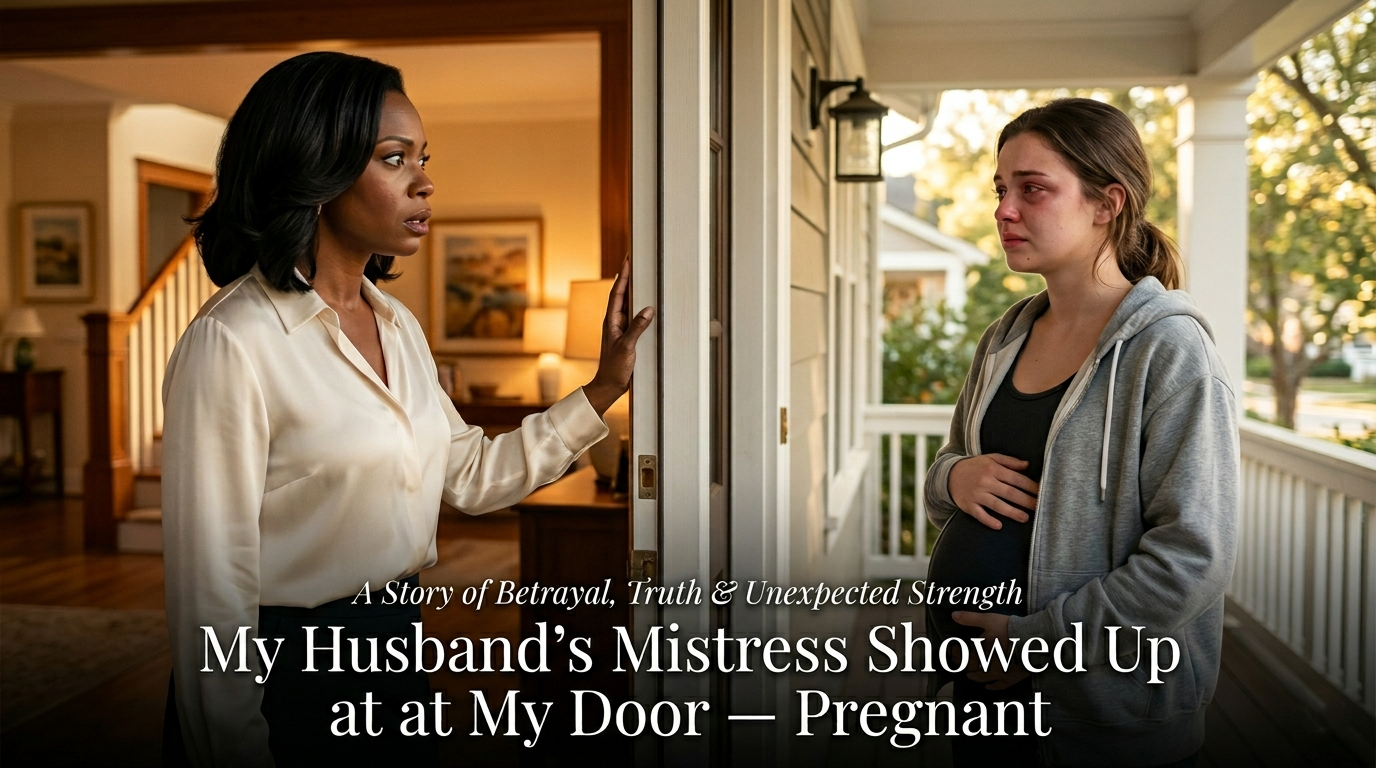
My Husband’s Mistress Showed Up at My Door — Pregnant
*A Romance & Drama Story*
—
## Part 1 — The Knock I Never Expected
—
I was folding laundry on a Tuesday afternoon when I heard the knock.
It wasn’t urgent. Just three quiet taps, the kind you make when you’re not sure you should be there at all.
I dropped a shirt on the bed, walked downstairs, and opened the door expecting a delivery. A package. Maybe my neighbor returning the dish I’d lent her last month.
Instead, I found a young woman standing on my porch. Barely 24. Dark circles under her eyes like she hadn’t slept in days. Pretty in the way that made my stomach drop without knowing why. She was wearing a gray hoodie — unzipped over a baby bump she was cradling with both hands, the way you do when you’re protecting something and terrified at the same time.
She looked at me like she recognized me. I had never seen her in my life.
“Is this Marcus Walker’s house?” she asked.
My husband’s name.
The afternoon went very quiet.
“Yes,” I said. And I heard my own voice like it was coming from somewhere far away. “Who are you?”
She pressed her lips together. Her eyes filled. And she said four words that rearranged everything I thought I knew about my life.
“I’m having his baby.”
I stood there for a moment — one hand still on the door, the laundry still warm upstairs, dinner still planned for six-thirty.
Then I stepped aside. And I let her in.
—
### Part 2 — Her Name Was Simone
She sat at my kitchen table like she was waiting to be arrested.
Both hands wrapped around the mug of tea I had made — because making tea was the only thing I could think to do, the only action that made any sense in a moment where nothing made sense at all. She hadn’t asked for it. I had just made it. And she had accepted it with a quiet “thank you” that almost broke me.
Her name was Simone. Simone Ayres. She was twenty-three years old, not twenty-four like I’d guessed. She worked at the firm downtown — not Marcus’s firm, a competing one — and they had met at a conference in Charlotte fourteen months ago.
She told me all of this slowly, in the careful measured voice of someone who had rehearsed this conversation many times. Who had probably sat on the floor of her bathroom at two in the morning going over every word.
I sat across from her and I listened. I did not cry. I don’t know why — I think some part of me had gone somewhere quiet and still, the way you do when the shock is too big for tears.
“How far along?” I asked.
“Twenty-six weeks.”
Six and a half months.
For six and a half months, my husband had known there was a baby. And he had come home every evening, kissed me on the cheek, asked about my day, eaten at my table, slept beside me in our bed.
Six and a half months.
“Does he know you’re here?” I asked.
She shook her head. “I told him I was coming. He told me not to.” She looked down at her mug. “I came anyway.”
I looked at this young woman — this girl, really — sitting in my kitchen with my husband’s child growing inside her, terrified and exhausted and brave in a way I wasn’t sure I could have been at her age.
“Why?” I asked. “Why did you come?”
She looked up at me then, and her voice was very steady when she answered.
“Because he told me you didn’t need to know. And I thought you deserved to.”
—
### Part 3 — When Marcus Came Home
I sent Simone home in an Uber two hours later. I paid for it. I’m still not entirely sure why. Maybe because she’d ridden three buses to get to my door and it seemed like the least cruel thing I could do.
I sat in the kitchen after she left.
I did not call anyone. Not my mother. Not my sister. Not my best friend Keisha, who would have been over in twelve minutes flat with wine and righteous fury. I just sat there in the yellow afternoon light, watching the shadows move across the tile floor as the sun went down.
Marcus came home at six fifty-three.
I know the exact time because I looked at the clock on the microwave the moment I heard his key in the lock. I don’t know why that detail lodged in my brain. Maybe because I needed to anchor myself to something real and specific. Six fifty-three. Tuesday. This is happening.
He came in talking — something about traffic, something about a client call that ran long. He set his bag down in the hallway and loosened his tie and walked into the kitchen and stopped when he saw my face.
The talking stopped.
He knew. I could see it the moment his eyes met mine. Not guilt exactly — more like a man who has been bracing for an impact and has finally heard the crash.
“Nicole—”
“She was here,” I said. “Simone.”
He closed his eyes.
“She sat at my kitchen table, Marcus. She drank tea in my kitchen. She told me everything.”
He opened his mouth. Closed it. He reached for the back of a chair and held it.
“How long?” I asked.
“Nicole—”
“How long.”
He looked at the floor. “Fourteen months.”
I had known him for nine years. Married him for six. I thought I knew every version of his face — his angry face, his tired face, his happy face, the one he made when he was proud of me. I had never seen this face before. This small, collapsed, sorry face.
It did not make me feel better.
“Say something,” he said quietly.
I stood up from the table. I picked up both mugs — mine and the one Simone had used — and I washed them carefully in the sink. I dried them. I put them away.
“I’m going to stay at my mother’s tonight,” I said. “Don’t call me.”
I walked past him and up the stairs and I packed a bag. He stood in the hallway the whole time. He did not try to stop me. And when I walked back past him toward the front door, he said my name one more time — just “Nicole” — in the voice of a man who knows he has no right to say anything else.
I closed the door behind me without answering.
—
### Part 4 — My Mother’s House
My mother knew something was wrong the moment she opened the door.
She is a woman of few words when it counts. She stepped aside, let me in, took my bag, and put a plate of food in front of me without asking a single question. I ate half of it. Then I told her.
She listened the way she always has — completely still, hands folded, face giving nothing away until I was finished. Then she was quiet for a long moment.
“What do you want to do?” she said.
“I don’t know.”
“That’s okay,” she said. “You don’t have to know tonight.”
I slept in my childhood bedroom that night. The same twin bed, the same blue curtains. I lay on my back staring at a ceiling I had stared at through a hundred smaller heartbreaks — failed tests, lost friendships, the ordinary wounds of growing up. Those had all eventually become stories. Things that happened and then stopped happening.
I didn’t know what category this fell into. I didn’t know if there was a category for it at all.
What I kept coming back to — and I didn’t expect this, it surprised me — was not Marcus. It was Simone.
Twenty-three years old. Three buses. A baby bump she held like she was keeping the world out.
She didn’t have to come. He had told her not to. Whatever else she was, whatever mess she had walked into or made or been swept into — she had come to my door and told me the truth. In a situation where the easier, safer thing would have been to disappear.
I lay in the dark for a long time thinking about what kind of woman does that. And what kind of situation she was in now — alone, young, pregnant, by a man who had told her to stay quiet.
—
### Part 5 — Thirty-One Days
Marcus and I did not speak for eight days.
On the ninth day he showed up at my mother’s house with flowers and a speech and eyes that were red at the edges in a way I had never seen on him before. My mother let him in and then made herself very scarce, which was its own kind of love.
He sat across from me in my mother’s living room and he talked for a long time. He told me about the conference. About how it started. About how he had told himself, early on, that it was just once, and then it wasn’t just once, and then it had gone on long enough that he didn’t know how to stop it. He told me he had panicked when Simone told him about the pregnancy. He told me he was sorry in more ways and more words than I had known a person could be sorry.
I listened. The way Simone had sat at my table, I sat at my mother’s couch. Still. Contained.
When he was done, I asked him one question.
“Did you love her?”
He took a long time with that.
“No,” he said finally. “But I wasn’t honest about that either. Not to her or to myself.”
Over the next thirty-one days, we existed in a strange suspended state. He stayed in our house. I came back after two weeks — not because I’d forgiven him, but because I needed to be in my own space, in my own life, while I figured out what I wanted that life to look like.
We were not okay. But we were talking. And somewhere in the talking, I started to understand the shape of what had broken.
It wasn’t just Marcus. Not entirely. There was something between us that had gone quiet years before Simone — a slow drift neither of us had named or tried to stop. Two people in the same house, living in parallel, comfortable and increasingly invisible to each other. He had made a devastating choice. But there had been a space for it to grow in. And that space had had two architects.
That didn’t make it okay. Nothing made it okay.
But it made it complicated. And I was tired of pretending that complicated things were simple.
—
### Part 6 — I Called Her
I called Simone on a Thursday morning. Thirty-three days after she showed up at my door.
I still don’t have a clean explanation for why. I think I needed to see her as a person — not a symbol, not a wound, not a category. Just a person. And I think I needed to ask her, directly, what she was going to do.
She answered on the second ring.
“Nicole.” Not a question. She’d saved my number.
“I just wanted to check on you,” I said. And then I stopped, because that sounded absurd, and we both knew it.
There was a pause. Then, quietly, she said: “I’m okay. I’m staying with my sister.”
“Good,” I said. “That’s good.”
Another pause.
“I’m not trying to take anything from you,” she said. “I need you to know that. I didn’t come to your door to blow up your marriage. I came because—” She stopped.
“Because you thought I deserved to know,” I said.
“Yes.”
“You were right,” I said.
I heard her exhale. Something released in it.
We talked for twenty-two minutes. Not about Marcus — or not only about him. About her. About the baby, a girl she was going to name after her grandmother. About how she was figuring out what came next. She was calm and direct and nowhere near as fragile as I’d expected.
By the end of the call, I understood something I hadn’t expected to understand.
This young woman had not destroyed my marriage. My marriage had already had fractures. She had just been the one holding the flashlight when the wall came down.
—
### Part 7 — The Decision
Marcus and I went to couples therapy starting week five. Dr. Anita Osei, recommended by a friend, who met us both in her office every Tuesday at eleven with a box of tissues and the firm patience of someone who had seen this exact story many times before and believed people could survive it.
Some days I believed that too.
Some days I sat in that beige office and looked at my husband and felt something close to the man I had married — bruised and sorry and trying, genuinely trying. Those days, I thought: maybe. Maybe this is salvageable. Maybe what we build on the other side of this is stronger precisely because it had to be rebuilt.
Other days I drove home alone and sat in the car in the driveway and felt nothing but exhausted. Tired of the work of it. Tired of deciding, every single morning, whether to stay or go.
On one of those tired days, Keisha came over and sat with me on the back porch and said, without any judgment in her voice: “What do you want, Nic? Not what you think you should want. What do you actually want?”
And I sat with that question for a long time.
What I wanted was the marriage I had thought I had. I wanted the nine years back, uncorrupted. I wanted the Tuesday dinners and the inside jokes and the version of Marcus I had believed in completely.
But wanting something back that no longer existed in the same form — that wasn’t a decision. That was grief.
A decision was looking at what remained — what was genuinely still here, between us — and choosing it. Or not.
—
### Part 8 — What Nicole Chose
I chose to stay.
Not because I had forgiven everything. Forgiveness, I was learning, was not a switch you flipped — it was something you practiced daily, imperfectly, over a long time. I was not there yet. I might not be there for a long time.
But I chose to stay because when I got quiet enough to hear myself honestly, beneath the hurt and the humiliation and the grief, there was still something real between us. Not what we’d had. Something different — more clear-eyed, more fragile, more deliberate. Something that required us both to show up differently than we ever had.
Marcus agreed to a paternity test. The result confirmed what Simone had said. He would be in his daughter’s life — not peripherally, not guiltily, but actually present. That was non-negotiable, and it came from me. That child had not asked for any of this.
The girl was born in April. Seven pounds, two ounces. Simone named her Ruby, after her grandmother.
Marcus told me the night she was born. He sat across from me at the kitchen table — the same table where Simone had sat with her mug of tea — and he told me, and we sat with that for a long time in silence.
“She’s healthy?” I asked finally.
“Yes,” he said. “She’s perfect.”
I nodded. I looked at the grain of the wood on the tabletop. I breathed in and breathed out.
“Okay,” I said.
That was not the end of the hardest part. The hardest part was every day after. Learning to build a life that held all of this — the betrayal, the forgiveness in progress, the fact of a child across town who shared my husband’s blood. Learning to be generous when I wanted to be small. Learning to let myself be angry when I wanted to perform being fine.
But here is what I know now, two years out from that Tuesday afternoon knock:
The women who knock on doors — the ones who tell the truth when the truth is costly — those women are not your enemy. Even when everything in you wants them to be.
Simone Ayres knocked on my door. She told me the truth. She gave me the chance to make a real decision about my own life, with full information, like an adult woman deserves to.
That is not nothing.
That is, in its own strange and painful way, a kind of gift.
—
### Epilogue — Two Years Later
Marcus and I are still married.
That sentence is more complicated than it looks. We are married in a way that requires more tending than we ever gave our first version of this marriage — more honesty, more discomfort, more choosing each other out loud instead of assuming.
Most days, I think we are better. Not in spite of what happened. Because of what we chose to do with it.
Ruby turned one in April. She has her father’s eyes and her mother’s stubbornness, and she is, by every account, a joyful and bewildering small person who has no idea what her existence cost everyone around her.
She doesn’t need to know. Not yet. Maybe not ever, in the way we know it.
Simone and I are not friends. I don’t think we will be. But we are something — something civil and respectful and honest that doesn’t have a clean word yet. She is a good mother. I can see it in the way Marcus talks about what he witnesses when he is there. That matters to me more than I expected it to.
I still think about that Tuesday afternoon sometimes. The folded laundry. The knock. The moment I opened the door and the whole shape of my life shifted.
I used to wish it hadn’t happened.
Now I think — if it had to happen — I’m glad it happened the way it did. With a young woman on a porch who chose honesty over self-preservation. Who looked me in the eye and told me the truth.
The least I could do with a gift like that was use it.
—
*© All rights reserved. Do not republish without permission.*