I Believed Every Lie !
PART 1:
The first lie was small. So small I almost didn’t notice it. Marcus told me he had been at the gym on a Thursday evening when I knew — because I had driven past the gym on my way home from work — that the parking lot was empty. His car was not there. I said nothing. I told myself I must have been mistaken. I told myself there were two gyms in our neighborhood, and maybe he went to the other one, and maybe I was the kind of woman who made mountains out of empty parking lots.
That is the thing about being a trusting person. It looks like love from the inside. From the outside, I know now, it can look like something else entirely.
I met Marcus eight years ago at a friend’s dinner party in Nashville. He was the kind of man who remembered your drink order and your mother’s name and the name of the book you mentioned once in passing three weeks later. He made you feel seen in a way that was so specific and so warm that you mistook it for intimacy. I mistook it for intimacy. We were engaged within fourteen months and married six months after that.
The lies, I would later understand, did not begin after the wedding. They began before it. Marcus was simply very good at them — so good that they didn’t register as lies in real time. They registered as explanations. Reasonable, detailed, slightly over-furnished explanations that I accepted the way you accept weather: not because you’re foolish, but because it doesn’t occur to you to question the sky.
The gym lie was a Thursday in February. By March, there were other Thursdays. By April, it wasn’t just Thursdays. By May, I had a list — not written down, not organized, just accumulated in the back of my mind the way debts accumulate when you stop opening the mail. Late arrivals. Muted phone calls. A weekend conference I couldn’t find any record of online. A name — Jessica — that appeared twice in conversation and then never again, with the deliberate absence of someone who has been carefully removed from the script.
I believed every explanation. Or I told myself I did.
“There is a difference, I have since learned, between believing someone and choosing not to examine the alternative. I was not naive. I was afraid. And fear, dressed up in trust, is very convincing — especially to yourself.”
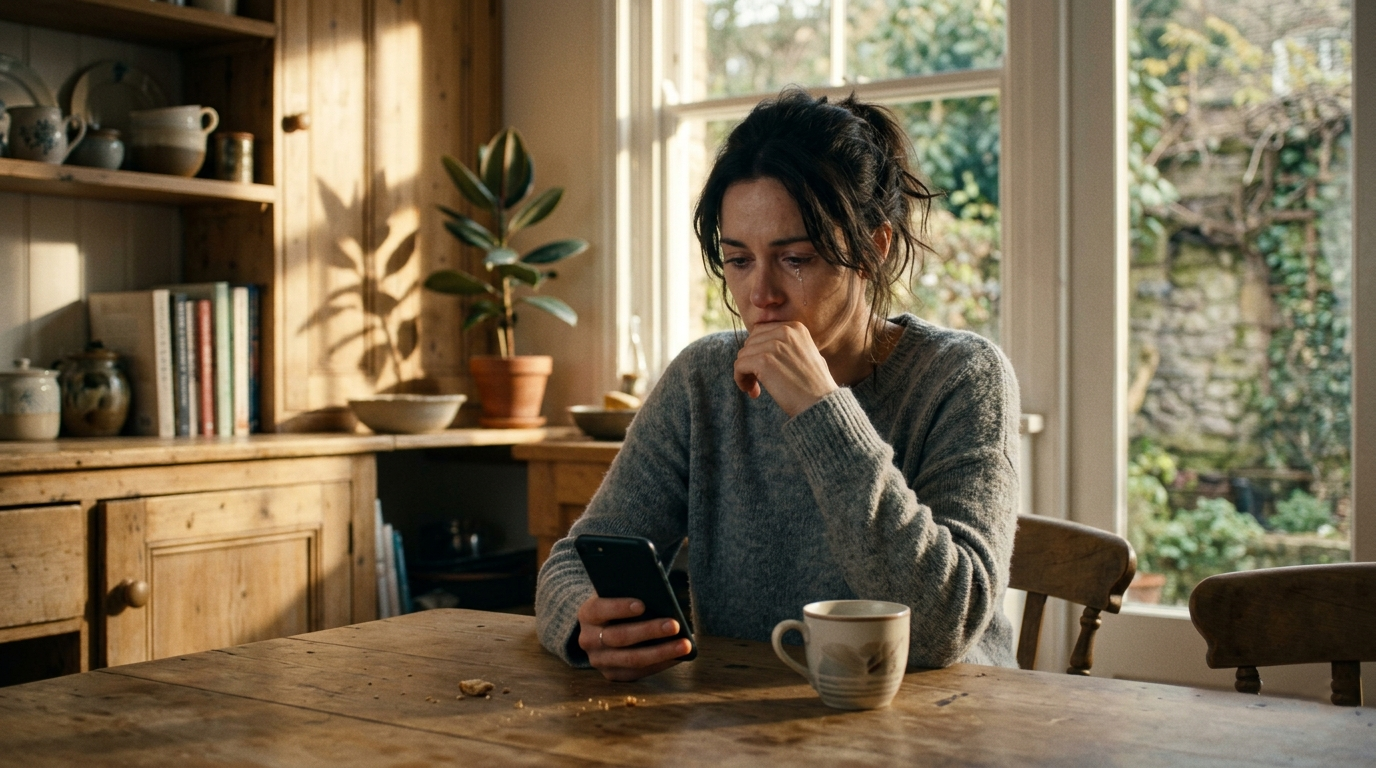
The morning everything changed was an ordinary Saturday in June. Marcus left early for what he called a client breakfast. I got up, made coffee, sat on the back porch in the early light. The kind of quiet morning that should have felt peaceful and instead felt like the moment before something.
My phone buzzed. A message from a number I didn’t recognize.
Five words: You deserve to know.
And then a photo.
I looked at it for a long time. Long enough for my coffee to go cold. Long enough for the birds in the yard to stop and start again. Long enough to understand that the parking lot had never been empty by accident. That every explanation had been constructed. That the man I had trusted completely had been, with extraordinary care and consistency, living a life I knew nothing about.
And then I did something that surprised even me.
I didn’t cry. I didn’t call anyone. I put my phone face-down on the porch table and I finished my coffee.
And then I made a plan.
PART 2:
The Photo — and Everything After
The photo was of Marcus and a woman I had never seen, sitting at a restaurant table I didn’t recognize, in the kind of easy, unguarded closeness that takes time to develop. Her hand was on his arm. He was laughing — the real laugh, the one that reached his eyes, the one I used to believe was reserved for moments with me. They looked like people who had nothing to hide, which is perhaps the most disorienting thing about it. They were not hiding. They were simply somewhere I was not.
I texted back the unknown number: Who are you?
The response came quickly. Her name was Donna. She worked with Jessica — the woman in the photo — and she had discovered, by accident, that Jessica’s boyfriend had a wife. She had found me through our joint social media. She said she was sorry. She said Jessica didn’t know, as far as she could tell. She said she had gone back and forth for weeks before sending the message and she understood if I was angry at her too.
I wasn’t angry at her. I wasn’t angry at all, which frightened me more than anger would have.
I asked Donna two questions. How long — she thought about a year, maybe more. And did she have more photos. She did. She sent seven.
I saved all of them to a folder on my phone and labeled it “Home Renovation Ideas” because I am who I am and I needed somewhere to put them that Marcus would never casually open.
“I have always been an organized person. People used to call it a personality trait. That Saturday in June I understood it was actually a coping mechanism — and a surprisingly effective one.”
Marcus came home from his client breakfast at noon. He was in a good mood, which I recognized now as the particular good mood of a man who has had a pleasant morning doing something he shouldn’t. He kissed me on the top of my head. He asked what I wanted to do with the afternoon. I said I thought we could stay in, and he said that sounded perfect, and I made lunch and we ate it on the back porch and he talked about a project at work and I listened and responded and gave absolutely nothing away.
I am not proud of those two weeks. The performance of it — the smiling, the normalcy, the careful management of my own face — took something out of me that I am still reclaiming. But I needed time. I needed to understand what I was dealing with before I decided what to do about it, and that required more information than seven photos from a woman named Donna.
I called my cousin Lena, who is a family attorney in Memphis. I did not call from my regular phone. I drove to a coffee shop three miles from our house and called from the coffee shop’s WiFi using an app Lena told me to download. She listened without interrupting, asked four specific questions, and then said: “Don’t touch the joint accounts yet. Don’t confront him yet. And get me a copy of the mortgage document.” I asked how she was so calm. She said, “Because one of us has to be, and you’re paying me to be the one.”
I spent the next ten days being very quiet and very methodical. I gathered documents the way you gather kindling — slowly, carefully, one piece at a time. The mortgage. The investment accounts I was a co-signer on. The business Marcus ran out of our home office, which I had always considered his domain and now understood I should have paid much closer attention to. Lena told me what I needed. I found it.
What I found, beyond the affair, was something that reframed the last three years entirely. Marcus had been quietly restructuring our shared finances — slowly, carefully, in ways designed not to trigger alarm — in a pattern Lena recognized immediately as preparation for departure. Not a spontaneous or emotional departure. A planned one. One that had been in progress, by the paper trail’s account, for approximately eighteen months.
He had not stumbled into something with Jessica. He had been building toward a different life, and I had been funding it, and the lie was not just about a woman in a restaurant. It was about everything.
I sat with that for one full day. I did not eat much. I did not sleep well. I walked around our house — the house I had picked, the house I had decorated, the house I had believed was the physical expression of a life we were building together — and I looked at everything with new eyes. Not sad eyes. Clear ones. The particular clarity that arrives when you have finally, fully, stopped lying to yourself.
On a Wednesday evening, I asked Marcus to sit down at the kitchen table.
I placed a folder in front of him. Inside was a single printed page — a summary Lena had prepared, clinical and precise, outlining what I knew and what I had documented. I did not summarize it for him. I let him read it.
I watched his face move through several expressions in the space of about ninety seconds. Shock. Calculation. A brief attempt at composure. Then something that collapsed under its own weight — the face of a man whose architecture has given way.
“How long have you known?” he said.
“Long enough,” I said. “My attorney has copies of everything in that folder. The divorce papers are being filed on Friday. I’d like you to be out of the house by then.”
He started to speak. I had prepared for this moment. I had rehearsed my own stillness the way you rehearse a difficult conversation — in the shower, on drives, in the quiet dark at 3 AM. I held up one hand and he stopped.
“I don’t need an explanation,” I said. “I’ve had eight years of your explanations. I’m done collecting them.”
“He left that night with two bags. He stood at the front door for a moment, like he was waiting for me to say something that would change the shape of what was happening. I didn’t. Some doors you just have to let close.”
The divorce was final four months later. Lena was extraordinary. The financial restructuring Marcus had attempted was unwound with a thoroughness that I think surprised him — he had underestimated, perhaps, what a woman who has spent eight years paying close attention to everything except the right things is capable of when she finally starts paying attention to the right things.
I kept the house. I repainted the living room a color called Dusty Sage that I had always wanted and Marcus had always vetoed. I bought a new kitchen table — not because the old one was bad, but because I wanted to sit at something that had no memory of him across from me.
Jessica, I heard through Donna, had ended things with Marcus when the truth came out. I felt something about that, briefly — not quite sympathy, not quite satisfaction, just the recognition that deception rarely lands only where it was aimed. It scatters. It always scatters.
People ask me now if I regret the eight years. I’ve thought about that question a great deal, and my honest answer is: no. Not because the betrayal didn’t hurt — it did, in ways I’m still navigating — but because I know exactly who I am now in a way I didn’t before. I know what I’m capable of. I know what I will and will not accept. I know the difference between trust and fear wearing trust’s clothing.
I know I will not mistake an empty parking lot for an error in my own memory ever again.
Last month a colleague at work asked me how I seemed so settled, so unbroken, after everything I’d been through. I thought about it for a moment. Then I said: “I believed every lie he told me. But when it mattered most, I stopped lying to myself. That’s the part that saved me.”
She nodded like she understood. I think maybe she did.
I think more people understand that than will ever say so out loud.
And if you’re one of them — if you’ve been standing in a quiet kitchen, looking at an empty parking lot, telling yourself you must be mistaken — I want you to know something.
You’re not mistaken.
You never were.
— End of Story —