She Had a Key to Our House !
PART 1:
Ifound out on a Wednesday afternoon in October, the way you find out about most things that were hiding in plain sight — by accident, and all at once. I had come home early from work. A migraine, the kind that starts behind the left eye and spreads like a slow tide. I had texted Nathan to let him know, but the message showed one gray checkmark, which meant his phone was off or dead, which was not unusual for Nathan when he was deep in a project at the studio.
I pulled into our driveway. There was a car parked at the curb I didn’t recognize — a silver Honda, no parking sticker, Nashville plates. I noticed it the way you notice something slightly out of place in a familiar picture, registered it, and let it go. Our street had visitors. People parked on streets.
I unlocked the front door. I stepped inside. I called Nathan’s name out of habit, even knowing he wouldn’t be home for hours. The house answered with that particular silence of an empty place — except it wasn’t quite silent. There was music playing softly from somewhere upstairs. The playlist Nathan used when he worked from home. The one I knew every song on.
I stood at the bottom of the stairs and listened. And then I heard something that wasn’t music. A voice. A woman’s voice, low and familiar in the way voices are when they belong to someone completely at ease in a space. Not startled. Not careful. Simply — at home.
I climbed the stairs slowly. My migraine had disappeared entirely, replaced by something sharper and cleaner — the specific alertness of a person who understands, without yet knowing the details, that they are about to learn something that will divide their life into before and after.
The voice was coming from our bedroom.
I pushed the door open. A woman was standing at Nathan’s side of the closet in a oversized shirt I recognized as Nathan’s favorite — the faded blue one from his college years that he refused to throw away. She had her back to me. She was going through his closet with the easy, proprietary confidence of someone who had done it many times before. Her phone was on the nightstand — our nightstand, my nightstand — playing Nathan’s playlist through its speaker.
She turned when she heard the door. We looked at each other for a long, extraordinary moment. She was younger than me by several years, pretty in an uncomplicated way, with the expression of someone whose mind is cycling very quickly through very limited options.
“What I remember most is not the shock of seeing her. It is the shock of seeing how comfortable she was. She was not hiding. She was not afraid. She was standing in my bedroom like a woman who belonged there — because, I would soon understand, she had been made to feel that she did.”
“You must be Natalie,” she said. Her voice was steady. Almost gentle.
I had not told her my name. Which meant Nathan had. Which meant she was not a stranger who had wandered into my home. She was someone my husband had talked about me to — had described me to, had placed inside his other life so thoroughly that she knew my name before I knew hers.
“I’m going to need you to leave,” I said. My voice came out very calm. I was surprised by it.
She left without argument. She took her phone from my nightstand. She left Nathan’s shirt on the bed, folded — which struck me then and strikes me still as one of the strangest details, that she folded it — and she walked past me in the hallway with her eyes down and her car keys already in her hand.
I heard the front door close. I sat on the edge of the bed. Nathan’s shirt was folded beside me.
And then I looked at the nightstand — really looked at it — and I saw something I had somehow missed in the first shock of it all.
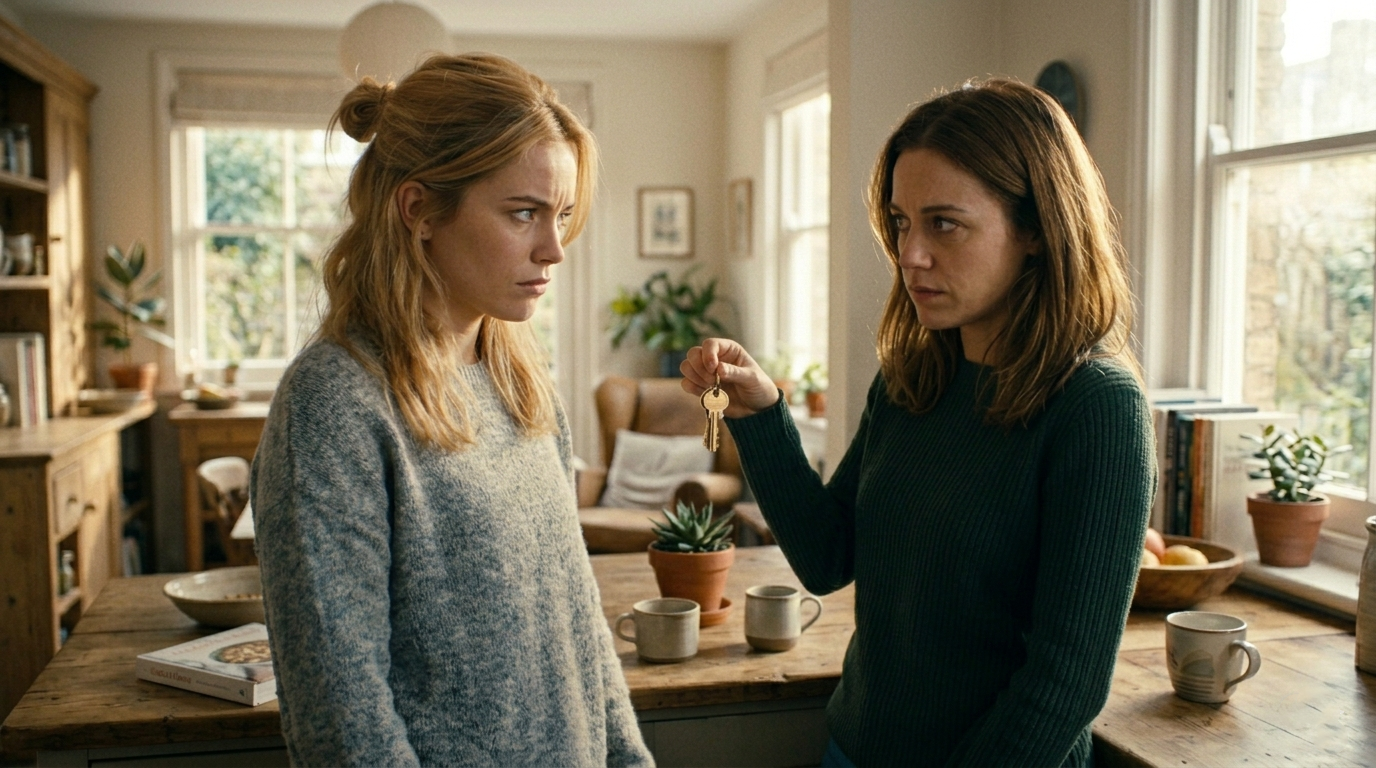
A house key. Our house key. On a small keyring I had never seen before, sitting next to the lamp as naturally as if it had always lived there.
She had not broken in. She had not borrowed Nathan’s key. She had her own. A copy made specifically for her. Which meant this was not an accident, not a moment of weakness, not a single lapse in an otherwise faithful marriage.
This was a system. And I had been living inside it without knowing.
· · ·
I picked up the key. I held it in my palm. Such a small, ordinary thing — the kind you get cut at a hardware store in five minutes for three dollars.
It told me everything about how little my home had actually been mine.
When Nathan walked through the door two hours later, I was sitting at the kitchen table with that key in front of me. He saw it before he saw my face. And in the second before he composed himself, I saw everything I needed to see.
What happened next — and what I discovered about how deep this truly went — is the part of this story that changes everything you think you know about it.
PART 2: The Key — and Every Door It Opened
Nathan’s name for her was Brooke. I learned this in the first thirty seconds of what turned out to be the longest conversation of our marriage — though calling it a conversation feels generous. A conversation implies two people exchanging things of roughly equal weight. What happened at our kitchen table that Wednesday night was more like a controlled demolition. Nathan talked. I listened. And with every sentence, another wall came down.
Brooke was a musician. She used the same recording studio Nathan managed — which explained how they had met, and which meant that the studio, a place Nathan had talked about with passion and pride for the entire four years of our marriage, had also been the geography of something else entirely. I thought about every time I had visited him there, every time I had waved hello to colleagues whose names I half-knew, every ordinary Tuesday I had packed him a lunch and kissed him goodbye and sent him off to a place that was keeping secrets I hadn’t known to look for.
It had been going on for fourteen months.
Fourteen months. Our fourth wedding anniversary had fallen inside those fourteen months. The weekend trip to Savannah we had taken in the spring, which I had described to my sister as the best trip of our marriage — that had fallen inside those fourteen months too. I sat with the arithmetic of it, turning it over, measuring it against my own memory of the same period and finding, over and over, that the two versions did not match.
“He had given her a key four months ago. He said it was because she needed somewhere to store equipment. I looked at him across the table and I understood that I was not angry at him for lying to me. I was angry at him for thinking that particular lie would be sufficient.”
I asked him one question: “Did she know about me?”
He hesitated for exactly one second too long.
“She knew I was married,” he said.
I nodded. I stood up. I picked up the house key from the table and I put it in my pocket. Then I told Nathan I needed him to sleep somewhere else that night — his choice where, I didn’t need to know — and that I would be calling my sister in the morning and my attorney shortly after.
He said my name. I shook my head once. He left.
I called my sister that night instead of waiting until morning, because it turned out I could not be alone in that house with the quiet and the folded shirt and the indentation on my nightstand where a stranger’s phone had rested on my side of the room. My sister drove forty minutes without asking a single question until she was sitting beside me on the couch, and then she asked all of them, and I answered all of them, and somewhere around midnight I started to cry and she let me do it for as long as it needed to take.
In the days that followed, I did what I had learned, from four years of watching the women in my family navigate hard things, that you do: you move. Not away from the pain — through it, methodically, one practical thing at a time. I called a locksmith first. The locks were changed within twenty-four hours, which was its own kind of statement — the house was mine, had always been mine, and its boundaries were mine to set. I called my attorney second. I began gathering documents third.
What I found when I began gathering documents was a surprise I had not anticipated. Our finances, which I had largely left to Nathan because he was detail-oriented and I was not — a trust I now recognized as a significant error — were not in the shape I had believed them to be. Nothing catastrophic, nothing criminal, but a pattern of expenditure over the previous fourteen months that told, in numbers, the same story Nathan had told me in words at the kitchen table. Dinners. Hotel stays. Two concert tickets in March that I had believed were client entertainment. The ordinary spending of a man maintaining a second life, recorded faithfully by credit card statements that I had never thought to look at.
I looked at them now. I looked at all of it now.
My attorney was a woman named Patricia who had the demeanor of someone who has heard every version of every story and is surprised by none of them but sympathetic to all of them. She said I had a clean case. She said the process would take several months. She said the most important thing I could do in the meantime was take care of myself, which is advice that sounds simple and is in practice very difficult when you are simultaneously dismantling a marriage and rebuilding your understanding of the last four years of your own life.
I took the advice anyway. Or I tried to.
I started seeing a therapist — Dr. Anita Reeves, a woman with a calm office and a gift for asking the question that cuts precisely to the thing you have been avoiding. In our third session she asked me what I was most afraid of, and I said I was afraid that I had missed something I should have seen. That the signs had been visible and I had looked away from them. That being a trusting person was indistinguishable, from a certain angle, from being foolish.
She said: “There is a version of this story where you blame yourself for being deceived. And there is a version where you recognize that the person responsible for the deception is the person who chose to deceive. Which version of this story do you want to live in?”
“I thought about that for a long time. I am still thinking about it. But I think, slowly, I am learning to live in the second version — the one where I am not the variable that failed, but the person who, when given the truth at last, handled it with more steadiness than anyone, including me, expected.”
Nathan and I do not speak often now. When we do, it is through our attorneys, about practical things — the house, the accounts, the careful unwinding of a shared life. He has texted me twice outside of that channel. Once to say he was sorry. Once to say he hoped I was okay. I read both messages and did not respond to either, not out of anger but because I had said everything I needed to say at the kitchen table, and there was nothing left that required his participation.
Brooke, I heard through a mutual acquaintance, no longer uses the studio. I don’t know where she went or what she makes of all of it. I find, to my own surprise, that I hold no particular feeling about her. She was not the architect of this. She was simply someone who was given a key and used it — and the person who cut that key, who handed it across and said here, this is yours, this place is yours to walk into — that was Nathan. That was always Nathan.
The divorce will be final in two months. I have repainted two rooms and bought a new nightstand — a small, practical act of reclamation that felt, when I assembled it at eleven PM on a Tuesday night with the wrong size screwdriver, like one of the most important things I had done in years.
My house is mine now. Fully, completely, unambiguously mine. I lock the door every night with the new key — the one I chose, the one I had cut, the one that only I have a copy of — and I stand for a moment in the hallway and I feel the particular quiet of a space that belongs to you and only you.
It took losing something to find that feeling. I won’t pretend that’s a fair trade.
But I will say this: I know my own house now in a way I didn’t before. I know every room of it. I know what belongs in it and what doesn’t. I know the sound it makes when it’s really, truly empty — and I know the sound it makes when it’s full of only the right things.
That knowledge is mine. Nobody gave it to me. Nobody can take it back.
And no one — not ever again — will have a key to it that I didn’t cut myself.
— End of Story —