
He Forgot I Was Still There !
PART 1:
It did not happen all at once. That is the thing nobody tells you about being forgotten by someone who is still living in your house, still sleeping in your bed, still eating the dinners you cook and watching the shows you put on and answering your questions with single syllables that technically count as conversation. It is not a dramatic vanishing. It is a slow one. The kind that happens so gradually you keep adjusting your eyes, telling yourself the light has simply changed, not that something is gone.
Thomas and I had been married for nine years when I first said it out loud — not to him, but to my friend Carol, on a phone call that started as small talk and somewhere in the middle became the most honest conversation I had managed in months. I said: “I think Thomas has forgotten I exist.” Carol laughed, gently, assuming I meant the ordinary forgetting — the anniversary almost missed, the errand left undone. I laughed too. I let her assume. Because saying the real version out loud — the version where I meant it seriously, completely, as a statement of fact — would have made it too real to put back.
The real version was this: I would walk into a room where Thomas was sitting and he would not look up. Not distracted-not-looking-up — the kind where you register someone’s presence even through focus. Simply not looking up, the way you don’t look up when no one has entered. I would say his name and he would answer, but the answer came from somewhere behind his eyes, from a place where I was an interruption rather than a person. I would tell him something — about my day, about a neighbor, about a small and ordinary thing that had made me laugh — and he would nod with his eyes still on the screen, and later that same evening, when someone else mentioned the same topic, he would say he hadn’t heard anything about it.
He had heard. He simply had not listened. And after a while I understood that the difference between those two things was the distance between the marriage I thought I had and the one I was actually living in.
I started testing it. Not cruelly — I am not a cruel person. But quietly. I stopped reminding him about things I had told him before to see how long before he noticed the absence of the reminder. I stopped filling the silences at dinner to see if he would fill them. I wore a dress he had once called his favorite — wine red, fitted, the one he had looked at me in like someone noticing for the first time — and he poured himself a glass of water and asked if I had seen the remote.
I had not seen the remote. I found it under the couch cushion. I handed it to him without a word.
“That was the moment I stopped grieving the marriage quietly and started asking myself a question I had been avoiding for a very long time: at what point does being invisible in your own home stop being a phase and become simply your life?”
The answer came on a Friday night in November. Thomas was on a work call in the study — the door open, which was his habit, which I had always taken as a sign of nothing to hide. I walked past to get a book from the shelf. He didn’t see me. I stayed for a moment, half behind the doorframe, listening — not to spy, just the way you listen when voices are already in the room you’re walking through.
His voice was different on this call. Warmer. Lighter. The voice of a man who is fully present, who is engaged, who is paying attention to every word the person on the other end is saying. He laughed — the real laugh, the full one, the one I had not heard directed at me in so long I had stopped registering its absence.
He said: “I know. I know. You have no idea how much I look forward to these calls.”
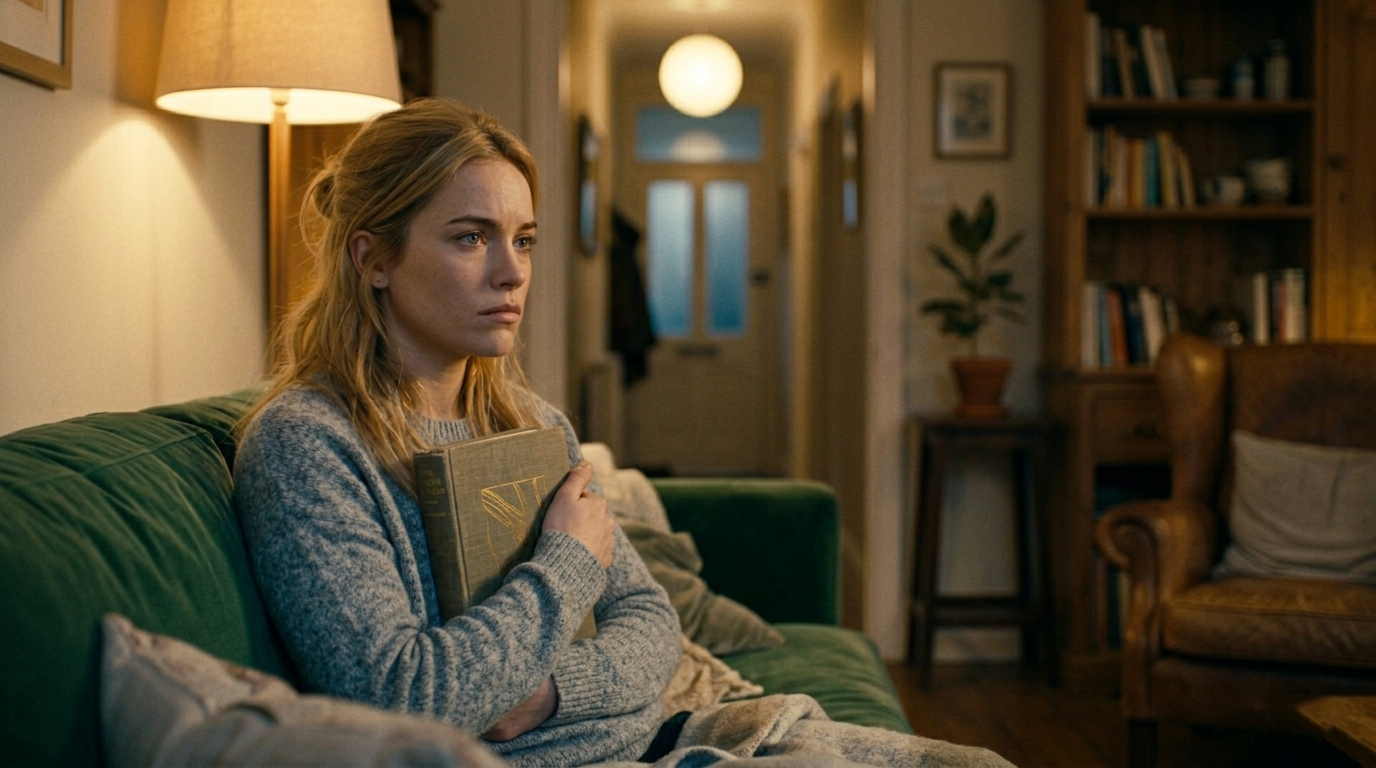
I stood in the hallway. I did not move. I held my book against my chest and I stood very still and I listened to my husband talk to someone I could not see with a warmth and presence and attention I could not remember him turning toward me in longer than I was ready to count.
I went to bed before he finished the call. I lay in the dark and I did not cry. I just thought — slowly, clearly, with a steadiness that surprised me — about what I was going to do next.
Because I had decided something, there in the hallway. I was done being invisible. Done being the woman in the background of her own marriage. Done waiting to be remembered by someone who had, without fanfare or announcement, simply moved on in his heart while staying in my house.
What I did next — and what I found out about Thomas and those phone calls — changed absolutely everything. Including something about myself I had forgotten long before he forgot me.
· · ·
PART 2:
The Woman on the Other End — and the One in the Mirror !
Her name was Renee. I found this out not through any dramatic investigation but through the most mundane possible means: Thomas left his laptop open on the kitchen counter on a Saturday morning while he made coffee, and a message notification appeared on the screen while I was standing right there, and I read it the way you read something that is directly in front of your face before your conscience has time to intervene. Just her name, just a few words, just enough to confirm what I had been standing in the hallway understanding for the past two weeks.
I closed the laptop carefully. I went for a walk. I walked for an hour through our neighborhood in the November cold without a jacket because I had left without thinking and I didn’t go back for one, and by the time I came home my hands were numb and I was clearer than I had been in months, maybe years.
Thomas was still in the kitchen. He looked up when I came in — actually looked up, which I noted with a bitterness I allowed myself briefly and then set aside. He said my hands were cold. He took them in both of his and rubbed them, the way he used to, the automatic gesture of a man who once knew all my habits and tended to them. I let him. I looked at his face while he looked at my hands and I thought: I know you. I know every version of you. And that is exactly why this hurts the way it does.
“I need to tell you something,” I said.
He looked up. For the second time in a morning. I noticed.
“I know about Renee,” I said. “I’m not going to ask you for details. I just need you to know that I know, and that we need to decide what happens next.”
“The thing about saying the true thing out loud, after so long of not saying it, is that it takes up the right amount of space. Not too large, not too small. Just exactly as large as it is. I had forgotten what that felt like — saying something and having it land with its real weight.”
Thomas did not deny it. I had expected denial — had steeled myself for the particular exhaustion of watching someone construct an explanation in real time. Instead he sat down at the kitchen table and put his face in his hands and stayed there for a long moment while I stood across from him and waited.
When he looked up, he looked older than I was used to. Not in an unpleasant way — in the way of someone whose face has stopped performing and is just being a face. He said: “How long have you known something was wrong?”
I said: “Longer than you’d be comfortable knowing.”
He nodded. He asked me what I wanted to do. And that question — so simple, so direct, so different from the months of managed distance and not-quite-conversation — broke something open in me that I had thought was sealed shut.
I said: “I want to know when you stopped seeing me. I want to know the specific moment, if you can identify it, when I became furniture. Because I have been trying to locate it for a long time and I can’t find it from my side.”
He was quiet for a while. Then he said something I had not expected. He said he didn’t think it was a moment. He said he thought it was a direction — that he had been moving away from everything in his life for years, from work and friends and himself, and that I had been the person closest to him and therefore the person most affected by a withdrawal that was not, at its origin, about me at all. He said Renee was someone he talked to because talking to her had no history, no weight, no accumulated silence. He said he understood that was not a justification. He said it was the most honest explanation he had.
I sat with that for a long time. Part of me wanted to reject it — wanted the cleaner story, the simpler betrayal, the version where someone is purely villain and someone is purely wronged. That version is easier to act on. It has clear directions.
But I have never been a woman who chooses the easier version of a true thing just because it is easier. That has always been both my greatest quality and my most inconvenient one.
I told Thomas I needed space to think. Two weeks — not a trial separation, not a punishment, just room to hear my own thoughts without the static of a shared house and a marriage in crisis. He went to stay with his brother. He did not argue. I think, on some level, he was relieved to have been found — to have the long performance of invisible distance finally, mercifully, end.
In those two weeks I did something I had not done in years: I paid attention to myself. Not in a grand or dramatic way. Just in the ordinary way of a woman rediscovering her own preferences — what she likes to eat when no one else’s tastes are a factor, what she watches when the remote is entirely hers, how she sleeps when she stops sleeping around someone else’s schedule. Small things. Revelatory things.
I called Carol and told her the real version this time — not the laughing version, but the true one. She listened for a long time and then she said: “You know what I’ve always noticed about you? You make everyone around you feel so seen. I wonder when the last time was that someone did that for you.” I didn’t have an answer. That absence of an answer told me everything I needed to know about how far I had drifted from the center of my own life.
I started writing again. I had kept a journal in my twenties and stopped when life filled up the space that writing had occupied. I bought a new notebook — green, cloth-covered, nothing special — and I wrote in it every morning at the kitchen table with my coffee, just the ordinary thoughts of a woman sorting through a complicated season. I filled thirty pages in two weeks. Not literature. Just truth, accumulated daily, which turns out to be its own kind of medicine.
“I had spent nine years making sure Thomas felt known, felt tended to, felt at home in our life together. Somewhere in the doing of that, I had forgotten to make sure the same was true for me. That was not his failure alone. That was mine too, and owning that part of it was the most freeing thing I did in those two weeks.”
Thomas came back on a Sunday. We sat at the kitchen table — it is always the kitchen table, I have decided this is where real marriages actually live, not in the romantic moments but at the ordinary table with the coffee cups and the morning light — and we talked for six hours. The kind of talking that is not defending or explaining but simply telling the truth and letting the other person hold it without having to do anything with it immediately.
We talked about the years of drift. About the ways we had both gone quiet in different directions. About Renee — not at length, not dwelling, but honestly, which is the only way to move through something like that without leaving it buried where it will grow. About what we each needed, separately and together, and whether together was still a place we both wanted to be.
It was not a resolution. It was a beginning — a real one, the kind that requires both people to choose it with full knowledge rather than habit or inertia. We began couples therapy the following week with a counselor named Dr. Marcus Webb who had the gift of asking the question that redirects the entire conversation toward the thing you had been talking around for twenty minutes.
We are still in it. Still choosing, week by week, to be in the same room with the truth rather than in separate rooms with comfortable versions of it. Some weeks are harder than others. Some mornings I still catch the old ghost of the invisible feeling — the sense of being present and unregistered — and I name it now instead of filing it away. Naming it turns out to be most of the work.
Thomas looks up now when I walk into a room. I don’t know if that is therapy or intention or simply what happens when two people stop pretending and start paying attention. Maybe it doesn’t matter. Maybe what matters is just that he does.
Last week I finished the green notebook. I bought another one. Red this time, because I felt like red, because I am a woman who has her own preferences and is learning, slowly and determinedly, to lead with them.
I wrote on the first page: I am still here.
Not as a reminder to anyone else. As a reminder to myself.
Because that — above everything — is the thing I had most needed to remember.
I was still here. I had always been here.
And now — finally — so was I.
— End of Story —