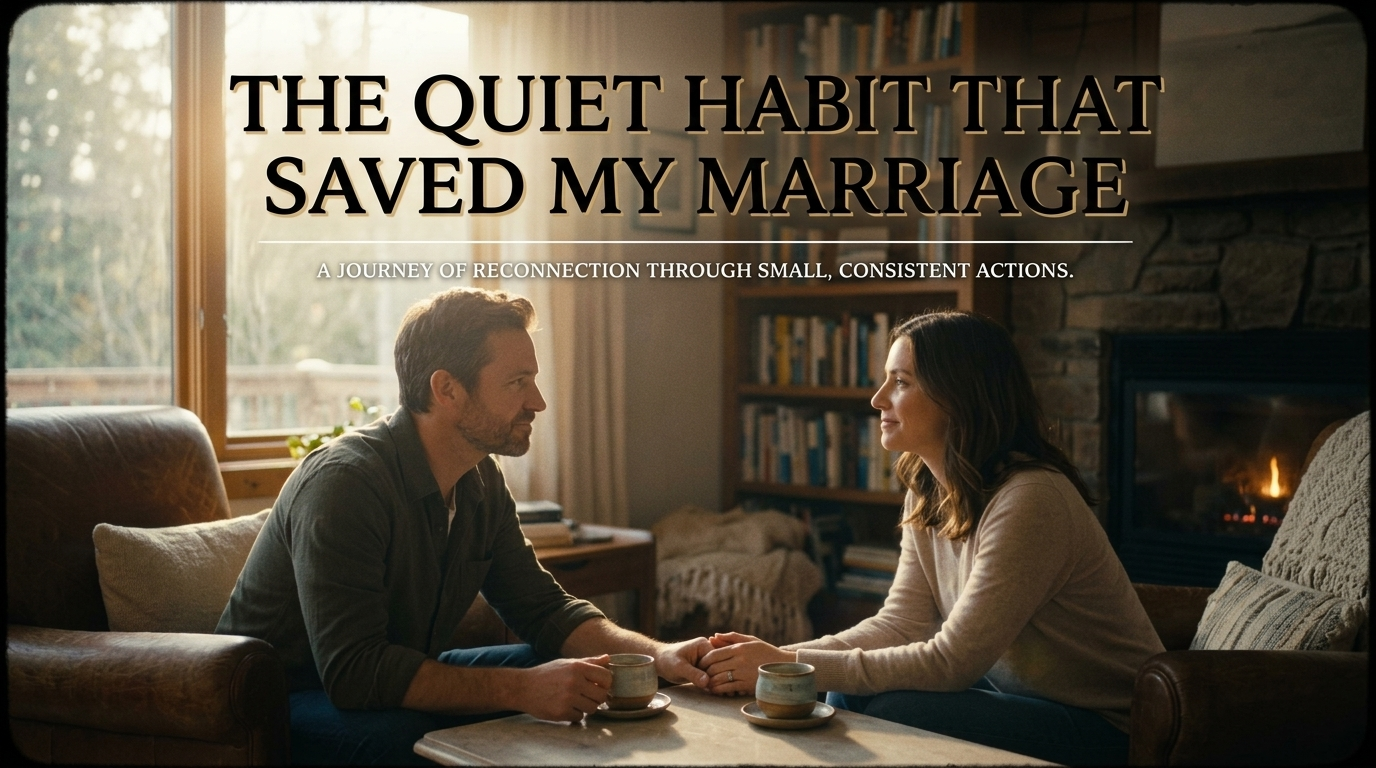
The Quiet Habit That Saved My Marriage — And My Mental Health
I need to tell you something I’ve never said out loud before.
At 38 years old, with a husband I loved and two kids who needed me and a house on a street where everyone mowed their lawns on Saturdays — I was drowning. Completely, quietly, invisibly drowning.
Not in a dramatic way. In the way that looks, from the outside, exactly like a normal life.
How we got there
Marcus and I had been married for nine years. We met when we were 26 — both broke, both laughing too loud at everything, both absolutely certain that whatever hard thing life threw at us, we’d figure it out together.
And for a long time, we did.
But then came the second kid. Then his promotion that turned into 60-hour weeks. Then my mother’s health scare. Then the pandemic, which locked us in the same 1,400 square feet and somehow made us feel further apart than ever.
We stopped having conversations and started having logistics. Who’s picking up Ella? Did you call the insurance company? There’s nothing in the fridge.
We stopped laughing. Not all at once — that’s the cruel thing about it. Slowly. So slowly you don’t even notice until one night you’re sitting across from each other at dinner and you genuinely cannot remember the last time he made you laugh, and you realize with a cold, sinking feeling: I don’t know who this person is anymore.
And worse — I don’t think he knows who I am, either.
What I was hiding
What Marcus didn’t know — what I hadn’t told anyone — was that I had been struggling with anxiety for almost two years.
Not occasional worry. The kind that wakes you up at 3 a.m. with your heart pounding over nothing you can name. The kind where you’re standing in the grocery store and you suddenly need to leave right now or something terrible will happen, you’re sure of it, even though nothing is wrong.
I had built an entire architecture of performance around it. I smiled at school pickup. I answered emails quickly. I never canceled plans. Nobody knew.
But inside, I was exhausted in a way sleep couldn’t touch.
And our marriage — already strained — was becoming one more thing I was managing instead of living.
“I wasn’t a bad wife. I was a woman running on empty who had forgotten that she was allowed to need something too.”
The Tuesday that changed everything
It was a Tuesday in February. The kids were still asleep. I was at the kitchen counter, staring at my phone, already cataloging the day’s anxieties before 7 a.m.
Marcus came downstairs. I braced for the silence — the particular married silence that used to feel comfortable and now felt like a verdict.
Instead, he put a mug of coffee on the counter in front of me. Then he sat down on the stool beside me — not across, beside — and he said:
“I miss you. I don’t know how to say that better than that. I just miss you.”
I didn’t say anything for a long moment. Then I started crying. Not delicate crying — the ugly, relieved kind, where you realize you’ve been holding something for so long that the simple act of putting it down makes your whole body shake.
We sat at that counter for 47 minutes. The coffee went cold. We talked — really talked — for the first time in what felt like years.
I told him about the anxiety. He told me he’d been seeing a therapist for three months and hadn’t known how to bring it up. We told each other the truth. It was terrifying and it felt like breathing for the first time in years.
Before he left for work, he said: “Same time tomorrow?”
The habit
That was the beginning of what we now call our “6:47s.”
Every morning, before the kids wake up, before the phones come out, before the day starts assembling its demands — we sit together with coffee for 20 minutes. No agenda. No problem-solving. No phones on the table.
Sometimes we talk about something real. Sometimes we talk about a show we’re watching. Sometimes one of us is tired and quiet and the other one just sits there anyway.
The rules, if you can call them that, are simple:
No phones on the table. This was non-negotiable from day one. The moment a screen enters the room, presence leaves it. We both knew this. We needed to say it out loud anyway.
No logistics. Grocery lists, school schedules, bill reminders — none of it. We have the rest of the day for that. These 20 minutes are for us as people, not as co-managers of a household.
Show up even when you don’t feel like it. Especially when you don’t feel like it. The mornings we most wanted to skip were usually the mornings we most needed to stay.
Say the true thing. Not the easy thing. Not the thing that keeps the peace. The actual, honest, sometimes uncomfortable true thing. We agreed that honesty — even when it’s hard — is kinder than the alternative.
What it did for my mental health
Here’s what surprised me most: the 6:47s didn’t just save my marriage. They became the single most effective thing I did for my anxiety.
More than the supplements. More than the sleep tracking. More than the productivity systems I’d tried to build around my chaos.
Because what anxiety feeds on — more than anything else — is isolation. The feeling that you are carrying something alone that you were never meant to carry alone.
Having 20 minutes every morning where I was truly seen by another person — not performed for, not managed, just seen — quietly dismantled something in me that medication alone never could.
I still see a therapist. I still have hard days. But I no longer carry them in secret. And that has made all the difference.
“The loneliest I have ever felt was inside my own marriage. The safest I have ever felt was also inside my own marriage. The difference was 20 minutes and the courage to tell the truth.”
Where we are now
Marcus and I will celebrate our 12th anniversary next spring. We are not a perfect couple — we still argue, still misread each other, still have weeks where the logistics swallow everything.
But we have the 6:47s. We always come back to the 6:47s.
Our daughter Ella, who is nine now, has started asking why we always wake up before everyone else. Marcus told her we have a meeting.
“About what?” she asked.
“About us,” he said.
She thought about that for a second and said, “That’s a good meeting to have.”
She’s right. It is.
If your relationship has been running on logistics and silence — if you’ve been smiling at the school gate while quietly coming apart inside — I want you to know that the distance you’re feeling right now is not the end of the story.
Sometimes all it takes is two mugs of coffee, 20 minutes, and someone willing to say: I miss you. I don’t know how to say that better. I just miss you.
Start there. Everything else can follow.
-END-