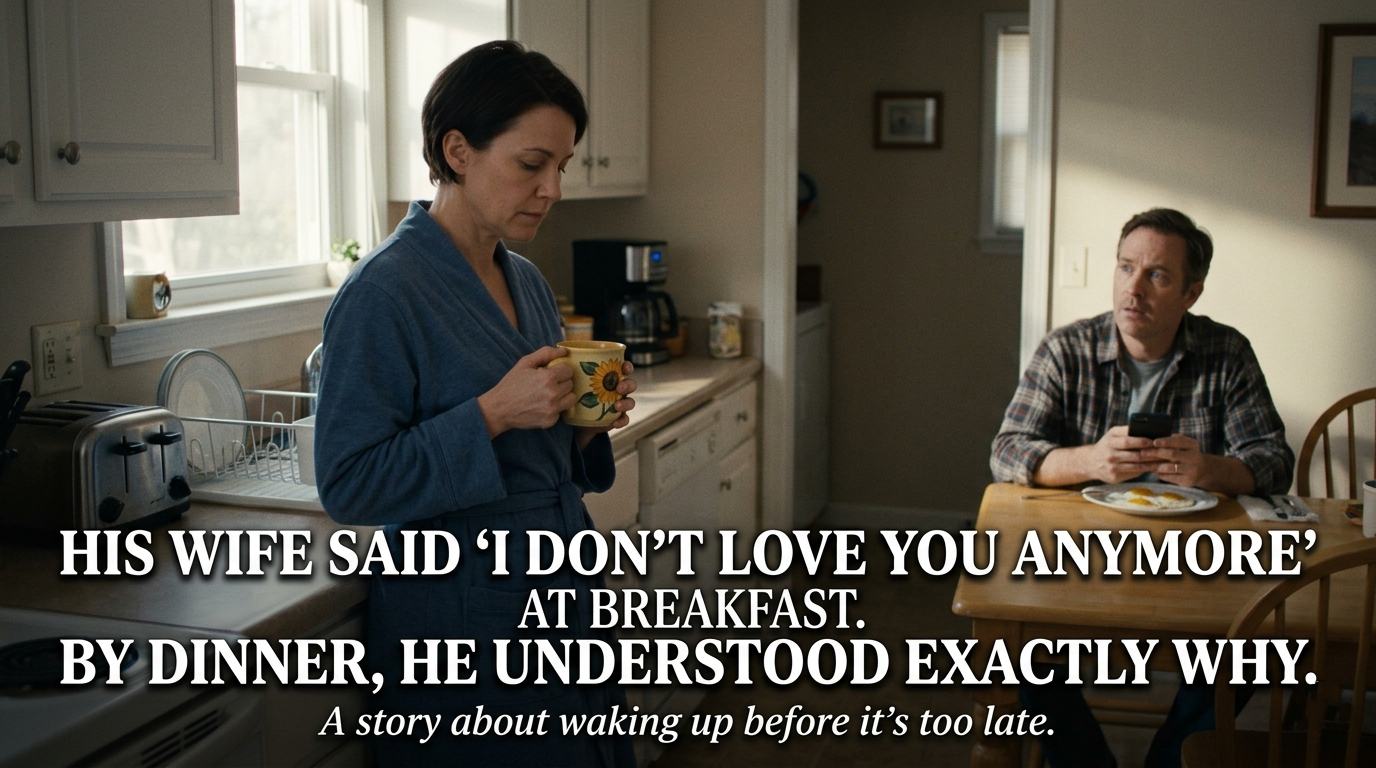
His Wife Said I Don’t Love You Anymore at Breakfast. By Dinner, He Understood Exactly Why.
The eggs were scrambled. The coffee was hot. The morning news was murmuring from the small TV on the kitchen counter the way it did every day.
Thomas Garrett, forty-four, sat down at the kitchen table the same way he had sat down at that table for sixteen years — without looking up, without saying good morning, reaching automatically for his phone to scroll through overnight emails before he’d taken his first sip.
His wife, Carolyn, stood at the counter with her back to him.
She was forty-two. She had dark hair she now wore shorter than when they’d married. She was still in her robe. There was a small chip in her coffee mug she’d never had fixed — a yellow mug with a sunflower on it that her sister had given her years ago.
Thomas did not notice the mug. He never noticed the mug.
“Tom,” she said.
“Mm.”
“I need to tell you something.”
Something in her voice made him look up. Not alarm exactly — more like the way you look up when the sound of a room changes.
She was facing him now. Both hands wrapped around her coffee. Her expression was not angry. It was not tearful. It was something he found harder to read than either of those things.
It was calm.
Resolved.
“I don’t love you anymore,” she said. “I haven’t for a while. I think you should know that.”
Thomas Garrett sat at his kitchen table with his phone in his hand and said nothing.
Carolyn held his gaze for a moment. Then she looked down at her coffee. “I’m not saying this to hurt you. I just — I can’t keep pretending everything is fine when it hasn’t been fine for a long time.”
“Carolyn — ”
“I don’t want to fight about it,” she said quietly. “Not this morning. I just needed to say it out loud.” She set her mug down on the counter. “The kids are almost ready. You should eat.”
She walked down the hall toward the bedroom.
Thomas looked at his scrambled eggs.
He ate them cold.
He drove to work on autopilot.
He was a project manager for a mid-sized logistics company — he had done it for eleven years, and the work came easily enough that his hands and his voice could do most of it while his mind was somewhere else.
His mind was at the kitchen table.
I don’t love you anymore. I haven’t for a while.
He was angry for the first twenty minutes of the drive. Who says that at breakfast? Who does that — just drops that on someone before eight in the morning and then says you should eat like nothing happened?
The anger lasted until he hit the freeway.
Then something else started.
He didn’t have a name for it yet — just a vague unease, the way you feel when you’ve forgotten something important but can’t remember what. Something she’d said kept circling the edge of his thoughts.
I can’t keep pretending everything is fine when it hasn’t been fine for a long time.
How long, he thought, was a long time?
He parked in his usual spot. Sat in the car for a moment. Went inside.
His assistant Dana asked him twice during the morning if he was okay.
He said yes both times.
He ate lunch at his desk — a sandwich he didn’t taste — and found himself doing something he hadn’t done in years. He was thinking about Carolyn. Not about the argument, not about logistics, not about what came next legally or financially. Just — thinking about her. Trying to actually see her.
When had he last asked her how she was and meant it? Not how was your day at the end of the night when they were both already half-checked-out in front of the television. Actually asked.
He sat back in his chair.
He tried to remember the last time they had eaten dinner together without the TV on.
He couldn’t.
He tried to remember the last weekend they had done something — anything — that was her idea. A walk, a drive, a restaurant she’d been wanting to try.
He got a memory. Vague. Maybe a year ago? She’d mentioned a place downtown she’d seen reviewed somewhere. He’d said sure, they’d go, and then the week had gotten away from them and they hadn’t gone and he hadn’t thought about it again.
Had she brought it up again?
He thought she might have. Once.
He’d probably said yeah, soon.
He opened his desk drawer without thinking and found, beneath a stack of folders, a card. He had no memory of putting it there — must have been years ago. A birthday card. Her handwriting on the envelope. He opened it.
To the man I chose and would choose again — every single day. Love always, Carolyn.
He stared at it for a long time.
Would choose again. Every single day.
When had she stopped feeling that way?
And the harder question, the one that settled into him slowly and heavily like water into dry ground: what had he done — or not done — that made her stop?
He left work forty minutes early.
He drove not toward home but to a grocery store three miles out of his way. He moved through the aisles slowly, thinking. He bought the ingredients for the pasta dish Carolyn had made on their third date — she had cooked for him in her tiny apartment, a little nervous, a little proud. It had become, briefly, their thing. Saturday pasta nights. They’d stopped making it sometime after the second kid. He couldn’t remember why.
He bought candles. Not romantic-gesture candles — just the small white ones she kept in the cabinet for power outages, the kind she liked. He bought her a new sunflower mug. The chip in the old one had been bothering him — in the way things bother you once you finally let yourself notice them.
He got home before she did.
He picked the kids up from his mother-in-law’s — they were there most Tuesdays. He brought them home, got them started on homework, and began cooking in the quiet kitchen while the late afternoon light came in flat and golden through the window.
He set the table. Actually set it — placemats, the good plates, the candles lit. He turned off the small TV on the counter.
He heard her car in the driveway.
The door opened. He heard her stop.
She appeared in the kitchen doorway still in her work coat, bag on her shoulder. She looked at the table. At the candles. At him standing at the stove.
“Tom — ”
“I’m not trying to talk you out of anything,” he said carefully. He turned around to face her. “I’m not making a grand gesture. I’m not — I don’t want you to think I think this fixes anything.”
She watched him.
“I’ve been thinking all day,” he said. “About what you said. And I think —” He stopped. Steadied himself. “I think I understand why. And I think I owe you more than I’ve been giving you. For a long time. And I know that’s not something pasta fixes.”
Carolyn said nothing. But she hadn’t left the doorway.
“I found this in my desk today,” he said. He had the card in his apron pocket — a thing he was still slightly embarrassed to be wearing. He held it out to her.
She crossed the kitchen slowly and took it. Looked at her own handwriting. The date on it was eleven years ago.
“I don’t know when I stopped being the man you wrote that to,” Thomas said quietly. “But I know I did. And I know it wasn’t one big thing. It was just — every morning I didn’t look up. Every dinner with the TV on. Every time you mentioned something and I said soon.” He shook his head. “I got so comfortable that I stopped actually being there. And I think that’s what you’ve been living with.”
Carolyn looked up from the card.
Her eyes were bright. Not spilling over — just bright.
“I’m not asking you to decide anything tonight,” he said. “I just wanted you to eat a hot meal and know that I finally heard you.”
She looked at him for a long moment.
Then she looked at the table. The placemats. The good plates. The small white candles.
The sunflower mug beside her place setting.
Her breath shifted slightly. She reached out and picked up the mug, turning it once in her hands.
“You noticed the chip,” she said softly.
“I noticed a lot of things today that I should have noticed a long time ago.”
They ate together that night for the first time in longer than either of them could honestly remember. The kids were loud and messy and knocked over a water glass, and Thomas cleaned it up without sighing.
They didn’t solve everything over pasta.
They didn’t fix sixteen years in one dinner.
But after the kids were in bed, they sat at the kitchen table with the candles burned low, and they talked. Really talked. Not about schedules or the mortgage or whose turn it was to call the plumber. About themselves. About what they missed. About what had quietly slipped away while they were busy being responsible and functional and fine.
It was the longest conversation they’d had in years.
It was, Carolyn would tell her sister some weeks later, the first time in a long time that she felt like he was actually in the room with her.
They went to couples counseling. It was uncomfortable at first and then it wasn’t. There were hard sessions and harder conversations at home afterward. There were nights Thomas drove around the block once before coming inside because he needed a moment to be ready to show up the right way.
He showed up anyway.
A year later, on a Saturday evening, Carolyn made the pasta. He set the table without being asked. The kids were at his mother-in-law’s.
She looked across the table at him in the candlelight.
“You know what I’ve been thinking?” she said.
“What?”
“I think I chose right.” She picked up her sunflower mug — the new one, unchipped. “The first time and the second time.”
Thomas Garrett looked at his wife across their kitchen table and felt something he hadn’t felt in years.
Chosen.
-END-
Share this if you believe it’s never too late to start paying attention to the person right in front of you.