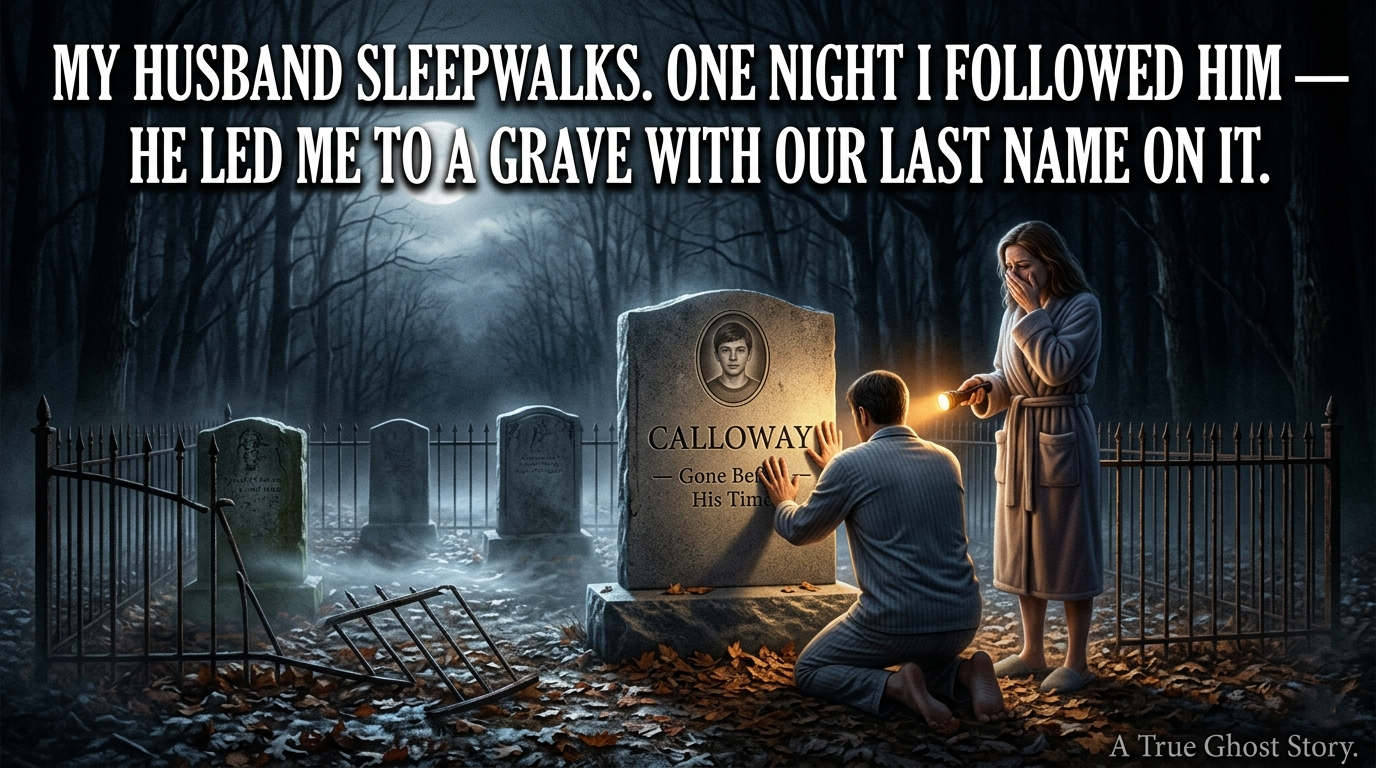
My Husband Sleepwalks. One Night I Followed Him — He Led Me to a Grave With Our Last Name on It.
A True Account from Nadine Calloway, Rural Harlan County, Kentucky
Daniel has sleepwalked his whole life.
His mother, Ruth, told me about it the first time I visited their home in Harlan County — told me the way mothers tell you the things about their sons that are non-negotiable, the things you are going to have to love alongside the rest of him. She sat across from me at the kitchen table with her hands wrapped around a coffee mug and her eyes steady on mine and said: He walks at night sometimes. Has since he was four. You don’t wake him sudden and you don’t follow him. Just take his arm easy and walk him back to bed. That’s all there is to it.
I was twenty-six and newly in love and I nodded and said of course and filed it away in the part of my brain reserved for manageable quirks.
I married Daniel Calloway eight months later in a small ceremony in his mother’s backyard, under a sky so blue it looked painted.
I kept Ruth’s rules for six years.
We moved back to Harlan County in 2018, after Daniel’s father passed and Ruth needed someone close. We bought a piece of land three miles from Ruth’s place — forty acres of eastern Kentucky hill country, mostly wooded, with a farmhouse built in the 1920s sitting at the center of a cleared field. The kind of house that lists to the left slightly, like a man who’s been working since dawn and is just starting to feel it.
The property had been sold out of the Calloway family in the 1960s and had passed through three owners before we bought it back. Daniel didn’t make much of that. He said land was land and it was good land and his grandmother had always said the holler behind the property had the best blackberries in three counties.
We didn’t explore the full property much in the first year — we were busy with the house, with Ruth, with settling. There was a tree line at the back of the field, maybe two hundred yards from the house, where the land dropped away into a wooded slope. We knew vaguely that there was something back there — old properties in Harlan County often have family burial plots on them, small private cemeteries, a handful of headstones in a clearing, the kind of thing that predates municipal graveyards by a hundred years. Daniel said he’d walked back there as a boy once and it was nothing much. We left it alone.
The sleepwalking had been quiet since we’d moved. Maybe four episodes in the first year — I’d find him standing in the kitchen or on the front porch, eyes open and glassy, somewhere far away. I’d take his arm easy, the way Ruth taught me, and walk him back to bed, and in the morning he’d remember nothing.
Then came October of 2019.
It started, as it always did, with the sound of the bedroom door.
Daniel is a still sleeper when he’s in bed — barely moves, breathes long and slow. But when the sleepwalking starts, I hear the door. Some trained part of my brain, developed over six years of marriage, surfaces out of sleep the moment the hinges move.
I sat up. The clock read 2:23 AM. The bed beside me was empty.
I pulled on my robe and took the flashlight from the nightstand — I’d started keeping one there after we moved to the country, where the nights are a different order of dark than anything I’d known growing up in Lexington — and went into the hallway.
The front door was closed and locked. I checked the kitchen. Empty.
The back door was standing open.
I stood in the doorway and looked out across the field. The October night was clear and cold and sharp, a three-quarter moon throwing everything into high contrast — silver grass, black tree line, the long rectangular shadow of the house stretching out behind me. And across the field, moving steadily through the moonlit grass, Daniel.
He was in his pajamas and bare feet. Walking at the particular pace of his sleepwalking — purposeful and unhurried, like a man who knows exactly where he’s going and is in no rush because the destination is not going anywhere.
I grabbed my boots from beside the back door and went after him.
I know Ruth said not to follow. I know that. I have turned that fact over in my mind ten thousand times in the years since, wondering if things would have been different if I had just gone back inside and waited. But I was in the dark in a field in October watching my husband walk toward a tree line with bare feet and no coat, and I followed him.
He moved through the knee-high grass without hesitating, without slowing, without once looking back or to either side. His arms hung loose at his sides. His head was up. Whatever was guiding him, it knew the way.
He reached the tree line and entered it.
I followed maybe thirty feet behind, close enough to keep him in the beam of my flashlight but far enough that I wasn’t crowding him. The trees were old growth — oak and poplar, trunks wide enough to hide behind — and the underbrush was thin on the slope, the ground covered in a thick blanket of fallen leaves that made every step loud in the cold air.
He walked downhill for maybe three minutes through the trees.
Then the slope leveled out into a small natural clearing, roughly circular, maybe forty feet across. The moon reached it cleanly — the trees fell back enough that the light came through without obstruction, and in that light I saw the headstones.
Seven of them. Arranged in two rough rows, the oldest ones tilted with age, the granite dark and mottled. A low iron fence, maybe two feet high, ran around the perimeter — one section collapsed on the left side, the iron rusted to a burnt orange.
A family plot.
Daniel walked through the gap where the fence had fallen and moved directly, without slowing, to the headstone at the far right of the back row.
The newest one.
He stopped in front of it. Stood for a moment with his head slightly bowed. Then he dropped to his knees on the leaf-covered ground and raised both hands and pressed his palms flat against the face of the stone, fingers spread wide.
I stood at the edge of the clearing for a moment, watching him, my flashlight held at my side.
Then I walked through the gap in the fence.
My boots were loud on the frozen leaves. I raised the flashlight and pointed it at the headstone my husband was kneeling in front of, both palms pressed to the granite like a man trying to pass warmth through stone.
I read the inscription.
CALLOWAY
James Eldon Calloway
March 3, 1957 — September 14, 1973
Gone Before His Time. Not Forgotten.
Our last name.
I stood very still and looked at the dates. Born 1957. Died 1973. Sixteen years old.
The same year Daniel was born.
Daniel was born September 22, 1973.
James Eldon Calloway died September 14, 1973.
Eight days apart.
I moved my flashlight to the upper portion of the headstone. Older stones in eastern Kentucky sometimes had portrait etchings — oval photographic transfers fired into the granite, faces preserved in the stone. I’d seen them in other cemeteries. Weathered things, usually, barely recognizable.
This one was clear.
A boy. Sixteen, maybe seventeen. Dark hair. A straight, serious mouth. High cheekbones.
My husband’s face. Twenty years younger than I’d ever known it, but my husband’s face — the set of the jaw, the line of the brow, the particular angle of the eyes — without question, without any margin for doubt or wishful interpretation.
My husband’s face.
On a headstone dated eight days before my husband was born.
I made a sound I don’t have a word for. Not a scream. Something quieter and more fundamental than a scream.
Daniel’s hands slipped from the stone.
He sat back on his heels in the leaves and turned his head and looked at me — and for one terrible, elongated moment I wasn’t sure he was still asleep, because his eyes were focused, present, fixed on my face with an expression I can only describe as recognition.
Then his eyes went glassy again and he swayed slightly and I went to him and took his arm easy, the way Ruth taught me, and said come on, sweetheart, let’s go home and walked him back across the field.
He remembered nothing in the morning.
I went to Ruth.
I sat at her kitchen table — the same table where she had told me the rules, six years before — and told her what I had seen. I showed her the photographs I had taken of the headstone on my phone before I followed Daniel back to the house.
Ruth looked at the photograph for a long time.
Then she set my phone on the table and folded her hands around her coffee mug and was quiet in the way that people are quiet when they are deciding how much of a true thing to say.
“James Calloway was my husband’s younger brother,” she said finally. “He died in a car accident. September of ’73. He was sixteen.” She paused. “Daniel was born eight days later. My husband always said — ” She stopped. “He always said his brother came back. That Daniel had his brother’s eyes and his brother’s hands and his brother’s way of going quiet when he was thinking.” She looked at me. “I never paid it much mind. People say things like that when they’re grieving.”
“Daniel looks exactly like him, Ruth.”
“I know,” she said quietly. “I’ve always known.”
“Does Daniel know about James?”
“No,” she said. “We never told him. We thought—” She stopped again. “We thought it would be a hard thing to carry.”
She picked up my phone and looked at the photograph one more time.
“He found him anyway,” she said. More to herself than to me.
We told Daniel that evening.
He sat at our kitchen table and looked at the photograph on my phone for a long time — his face on a headstone, his last name in granite, the dates that bracketed a life that ended eight days before his began.
He didn’t say anything for a while.
Then he said: “I’ve been dreaming about that clearing my whole life. I never knew what it was. I just knew I was supposed to go there.”
He paused.
“I just never knew why.”
We cleaned up the family plot the following weekend. Reset the fallen fence section. Cleared the leaves from around the stones. Planted bulbs that would come up in the spring.
Daniel sat in front of James’s headstone for a long time that afternoon while I worked. Not kneeling this time. Just sitting cross-legged in the leaves, elbows on his knees, looking at the stone the way you look at something you have been missing without knowing what it was you missed.
He hasn’t sleepwalked since.
Not once, in four years.
Ruth says that means he found what he was looking for.
I think she’s right.
I think James Eldon Calloway waited sixteen years in that clearing to be found, and then he came back and waited sixteen more, and finally one October night he walked his own feet through a field in the dark and found his way home.
Nadine and Daniel Calloway still live on the Harlan County property. The family plot is maintained and visited regularly. A photograph of James Eldon Calloway — found in a box of Ruth’s old belongings — now sits on the mantle in their farmhouse, next to their wedding photo. Visitors sometimes remark on how much Daniel and the boy in the old photograph look alike. Daniel always smiles and says: “He’s family.”