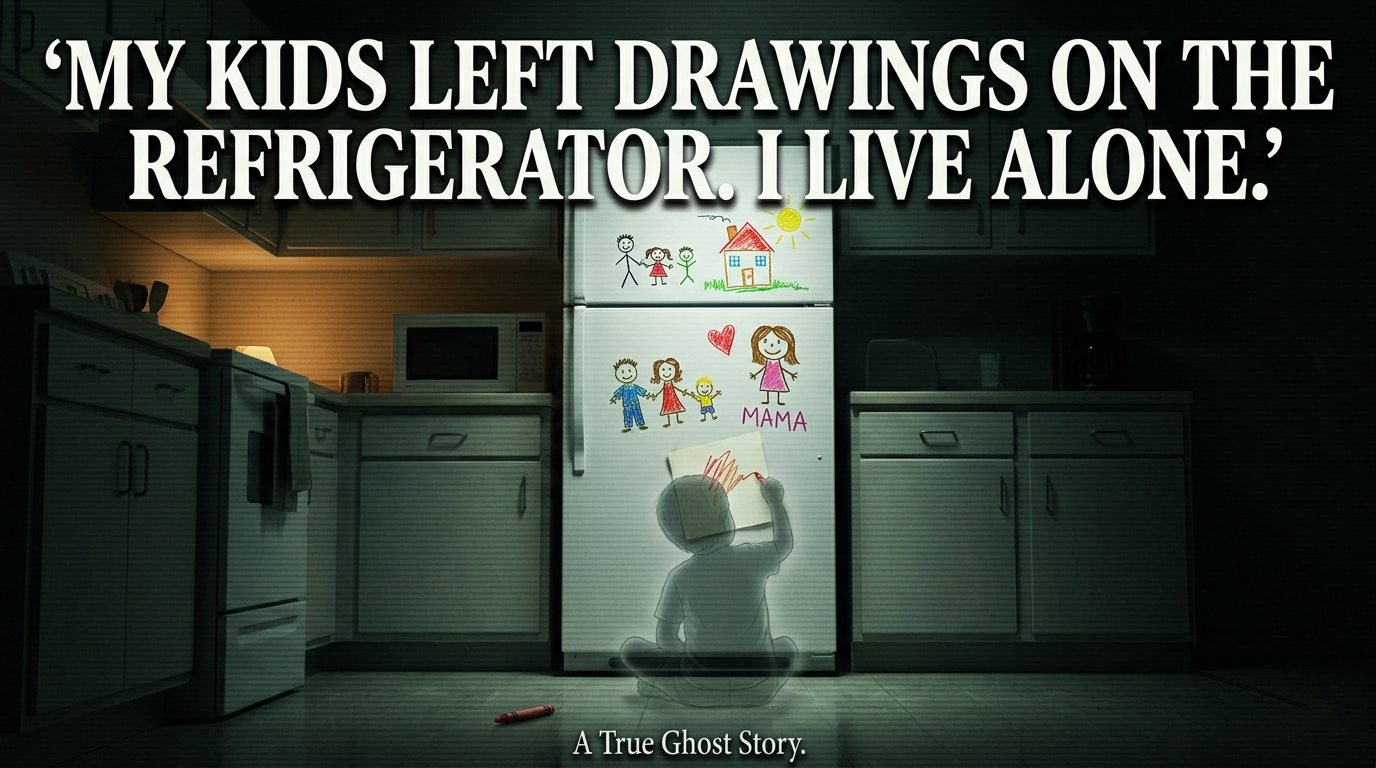
My Kids Left Drawings on the Refrigerator. I Live Alone.
A True Account from Garrett Mullen, Portland, Oregon
I want to be precise about the timeline, because the timeline is everything.
January 9th, 2023: I moved into apartment 4C at the Mercer Street building in Portland, Oregon. Thirty-four years old. Newly divorced. No children — my ex-wife and I had talked about it for years and never arrived at the right moment, which turned out to be its own kind of answer. I brought a mattress, a kitchen table, two chairs, a box of books, and the particular hollowed-out optimism of a man trying to convince himself that starting over is the same thing as starting fresh.
The apartment was small and clean and smelled of fresh paint. White walls, original hardwood floors, a galley kitchen with a refrigerator that hummed slightly louder than it should. I put a six-pack on the top shelf and a box of cereal on the counter and decided it would do.
January 17th, a Tuesday, eight days after I moved in: I walked into the kitchen at 7 AM to make coffee and found the drawing on the refrigerator.
It was done in crayon — red and yellow and green, colors so bright they looked almost aggressive against the white enamel surface of the fridge. A house. Simple, the way children draw houses: a square body, a triangular roof, four windows arranged in quadrants like a face. A yellow sun in the upper right corner with rays spiking outward. And in front of the house, three stick figures holding hands. Two tall ones on the outside. One small one in the middle.
A family.
I stood in my kitchen in my socks and stared at it for a full thirty seconds.
My first thought was that someone had been in my apartment. My second thought, following immediately, was that this made no sense — the deadbolt had been locked from the inside, the chain was on, the windows were all closed and latched against the January cold. My third thought was that I had somehow done this myself — gotten up in the night, drawn this, returned to bed, and remembered nothing. I have no history of sleepwalking or dissociation, but divorce does strange things to a person, and I was prepared to believe almost anything about myself in those first raw weeks.
I took the drawing down. Studied it. It was done on a piece of white printer paper — the standard kind I had a ream of in my desk. The crayon strokes were confident and small, the pressure light. The handwriting of a child, unmistakably. I don’t have crayons. I have never purchased crayons in my adult life.
I folded the drawing and put it in the recycling bin and went to work and spent the day constructing rational explanations.
Wednesday morning there were two more.
Same paper. Same crayon style. Different drawings.
The first: a woman with long hair and a triangle dress, standing beside what appeared to be a stove, arms extended in front of her in the universal child-art posture of a person cooking or offering something. Around her head, in careful uneven letters that a child had clearly worked hard to form: MAMA.
The second: a child. Just a child, small on the page, sitting cross-legged. No background, no context — just the child, centered, with enormous circular eyes and a straight line for a mouth. Not a smiling drawing. Not unhappy either. Just — watchful. The eyes taking up a third of the face, staring out from the paper with the particular intensity of a child who is paying very close attention to something.
I sat down on my kitchen floor.
I am not a man who frightens easily. I am not particularly superstitious or imaginative. I am a data analyst; I spend my professional life finding patterns in numbers and I have a deep, almost physical aversion to conclusions that outpace their evidence. I sat on my kitchen floor and I breathed slowly and I looked at those two drawings and I made myself go through every possible rational explanation one more time.
A neighbor with a key. A maintenance worker. A prank. My own unconscious mind. A child who had somehow entered and exited a deadbolted fourth-floor apartment with a chain lock without disturbing anything.
None of them held.
That afternoon I ordered a camera.
The camera arrived Thursday. A small indoor unit, wide-angle lens, night vision, motion activated — the same type that people use for nurseries and pet monitoring. I mounted it on the shelf above the refrigerator, angled down, covering the full face of the fridge and three feet of kitchen floor on either side. I checked the live feed from my phone. Crystal clear.
I went to bed.
Friday morning I woke up, reached for my phone, and checked the overnight footage before I even got out of bed.
The camera had triggered at 3:07 AM.
I pressed play.
The kitchen in night vision is all grey-green shadows and the flat white face of the refrigerator centered in the frame. Timestamp in the corner: 03:07:14.
Nothing happens for eleven seconds.
Then, on the surface of the refrigerator, a line appears.
Not drawn — appears. As though the paper is already there, already taped in place, but invisible, and something is making it visible one crayon stroke at a time. A curved line. Then another beside it. The unmistakable beginning of a circular shape — a head.
I watched with my phone six inches from my face, barely breathing, as a drawing assembled itself on my refrigerator in real time.
No hand. No arm. No child. No person of any kind visible in the frame.
Just the lines appearing, one after another, in the patient and deliberate rhythm of a small person drawing carefully. A head. A body. Two arms extended. Legs. The triangle dress. The hair.
MAMA. The letters appearing one by one, slightly uneven, formed with effort.
At 03:19:42 — twelve minutes and twenty-eight seconds after it began — the drawing was complete.
The camera sat quiet for eleven more seconds.
Then, at the very bottom of the frame — the extreme lower edge, where the kitchen floor met the base of the refrigerator — something moved.
I almost missed it. I rewound and played it back three times before I was sure.
A shadow. Small. The size and shape of a child crouching. There for exactly two frames — one-fifteenth of a second — and then gone.
I sat in my bed in the January dark for a long time.
Then I got dressed and went to find the building manager.
Her name was Connie Saldana, and she had managed the Mercer Street building for eleven years. She was in her sixties, practical and no-nonsense in the way of people who have seen every variety of tenant problem and solved most of them with a toolbox and a firm voice.
I showed her the footage on my phone in the building lobby.
She watched it twice. Then she handed my phone back to me and sat down in one of the lobby chairs — sat down the way a person sits when their legs have made a decision their brain hasn’t caught up to yet.
She was quiet for a moment.
“4C,” she said finally. It wasn’t a question.
“Yes.”
“I should have told you,” she said. Then she stopped and seemed to rearrange something internally. “I always mean to tell people. I never know how.”
She told me about the Yamamura family.
Kenji and Satsuki Yamamura had lived in apartment 4C for three years — 2019 to 2022. He worked in logistics. She was a graphic designer who worked from home. They had one child: a daughter named Hana, four years old, who Connie described as the most serious small person she had ever encountered — always watching, always quiet, always drawing.
“She drew everything,” Connie said. “Her parents said she went through a ream of paper a week. She was always at the refrigerator with her crayons. Covered the whole bottom half of it in drawings. Her parents would take them down every night and she’d put new ones up the next day.”
She stopped.
“Hana died in June of 2022,” she said. “Leukemia. She was four years old. The family moved out two months later. They couldn’t — ” She stopped again. “They couldn’t stay.”
I thought about the drawing I’d found my first Tuesday. The family in front of the house. The two tall figures and the small one in the middle.
“She was four,” I said.
“Four years old.”
I thought about the drawing of MAMA. The careful letters. The effort in every stroke.
“Connie,” I said. “The footage.”
She nodded slowly.
“I know,” she said. “Two tenants before you. Both of them came to me. Both of them had — ” She gestured vaguely at my phone. “Different things. But the same feeling.” She folded her hands in her lap. “One of them said she could hear humming sometimes. In the kitchen. At night.” She paused. “Hana used to hum while she drew. Her mother told me that. She said Hana always hummed the same song. A Japanese children’s song. She said Hana hummed it every single time she drew.”
The kitchen. The drawings assembling themselves at 3 AM. The shadow at the base of the refrigerator.
A small girl, cross-legged on the kitchen floor. Humming to herself. Drawing her mother.
Not haunting. Not threatening. Not the ghost story I grew up being afraid of.
Just a four-year-old child doing the thing she loved most in the world.
In the place she loved most in the world.
Because she didn’t know — or didn’t accept, or didn’t care — that the world had asked her to stop.
I kept the drawings.
All of them — the house with the three figures, the two from Wednesday morning, and every one that has appeared since. I have a folder now, thick with them, paper and crayon, the particular handwriting of a child who was serious and watchful and loved her mother and drew everything she saw.
I don’t take them down anymore. I leave them on the refrigerator until new ones appear, and then I move the old ones carefully to the folder and make room.
My apartment has never felt empty.
I leave the kitchen light on low when I go to bed.
And sometimes — not every night, but sometimes — in the space between sleeping and waking, I hear it.
Very faint. Very small.
A child humming to herself in the kitchen.
Drawing, probably.
I’ve stopped being afraid of it.
I just pull the blanket up and close my eyes and listen, and I think about a four-year-old girl named Hana who loved crayons and refrigerators and her mother and the particular satisfaction of a drawing that comes out just right.
And I think: this apartment is still hers.
I’m just the one paying rent.
Garrett Mullen continues to live in apartment 4C on Mercer Street. The drawings still appear, approximately twice a week, always between 3 and 4 AM. He has framed three of them — the house with the family, the drawing of MAMA, and the one of the watchful child — and hung them in the hallway. He reached out to the Yamamura family through Connie Saldana. Satsuki Yamamura asked to see the footage. After watching it, she said only: “That is how she held the crayon. Exactly like that.” She asked Garrett to keep the drawings safe. He promised he would.