DON’T OPEN THE DOOR
════════════════════════════════════════
PART 1 — THE CALL
════════════════════════════════════════
The night my neighbor called me at midnight, she was whispering.
“Don’t open your door,” she said. “No matter what you hear. No matter what it sounds like. Promise me.”
I laughed — a nervous, half-asleep laugh, the kind you make when you don’t yet understand that nothing is funny. Karen was seventy-two years old and sharp as a tack. Not the type to make prank calls. Not the type to call at midnight at all. In the four years we’d lived across the street from each other, I could count on one hand the number of times she’d called me after nine p.m. Twice when the power went out. Once when she saw someone suspicious near my car.
But tonight she sounded different. Hollow. Like she was reading from a script someone had handed her and she was trying very hard to remember the words.
“Karen,” I said, sitting up in bed and switching on the lamp. “What’s going on?”
Silence. A long, strange silence — not empty, but full of something. Breathing, maybe. Hers, and something else underneath it.
Then, very softly: “It knocked on my door an hour ago. It looked like my son.”
My lamp felt suddenly very small.
Her son David had been dead for three years.
He’d died on a Tuesday morning in November, on Route 9, two miles from our street. A patch of black ice, a guardrail that didn’t hold, a drop of forty feet into the creek bed below. Karen had identified him herself because there was no one else to do it. She’d told me once, sitting in my kitchen over coffee, that the hardest part wasn’t the hospital or the paperwork or the funeral. The hardest part was driving past that spot on Route 9 for the first time afterward and realizing the road didn’t care. The world just kept going. The pavement stayed right where it was.
She’d put flowers there every week since. White carnations, because those were what he’d brought her every Mother’s Day since he was twelve years old, saving up from mowing lawns and shoveling driveways, proud as anything.
“Karen,” I said carefully. “Are you sure it was—”
“It was wearing his jacket,” she said. “The dark one with the collar. The one we buried him in.”
The room felt colder.
“I told her to call the police,” I said — I don’t know why I’m narrating it that way, like I was watching myself from a distance. Maybe because that’s how it felt. “She said she already had. She said they came, walked the perimeter, shone their flashlights into the yard and the alley behind the house, found nothing, and left.”
“But it’s still out there,” she whispered. “I can hear it breathing on the porch.”
I got out of bed. My feet hit the cold floor and I walked to my living room without turning on any lights, which I cannot explain. Some instinct I didn’t know I had told me not to. I crossed to the front window and moved the curtain aside by half an inch.
Karen’s house was dark. Every window black. The porch light off.
My own porch light had been on when I went to bed.
It was off now.
I stood there in the dark, curtain pinched between two fingers, staring at my own front door.
And from somewhere just outside it — slow, patient, deliberate — came three soft knocks.
What was standing on Karen’s porch that night — and why did it come to mine next?
════════════════════════════════════════
PART 2 — THE BREATHING
════════════════════════════════════════
I didn’t open the door.
I want to be clear about that, because later — in the days that followed, when people started asking questions and some of them started implying things — I need it on record. I did not open that door. I stood in the middle of my living room in the dark, phone pressed to my ear, and I did not move toward it.
But I listened.
I listened to Karen breathe on the other end of the line — shallow, careful, like someone trying not to be heard.
And I listened to whatever was on my porch.
Because I could hear it through the wood. The door is old and solid, original to the house, but wood breathes. Wood carries sound. And what I heard on the other side of it was slow and even and utterly unhurried. In and out. In and out. Like something that had all the time in the world and knew it.
“It knows you’re there,” Karen whispered.
“Karen, who is it? Is someone doing this to us? A prank, a—”
“I told you,” she said. And there was no irritation in her voice, just exhaustion. The kind that comes from trying to explain something that language wasn’t built for. “It looks like David.”
I pressed my back against the wall beside the window. Not at the window — beside it. I didn’t want to look again.
“Karen, I need you to lock every door, close every curtain, go to your bedroom and—”
“I already did all of that.” A pause that lasted too long. “It’s talking now.”
The hairs on my arms stood up. “What is it saying?”
She was quiet for a long moment. I heard her breathing change — a small, involuntary catch in her throat, the sound a person makes when they’re trying very hard not to cry.
“It’s saying my name,” she whispered. “It’s saying… Mom.”
And then she made a sound I don’t have a word for. It wasn’t quite a sob. It wasn’t quite a gasp. It was something that lives between grief and terror, in a place that only opens up for parents — for people who have lost children and then, years later, hear their voice again in the dark.
“Karen.” My voice came out lower than I intended. “Don’t answer it. Whatever you do, don’t—”
The line went dead.
I called back. Voicemail. Called again. Voicemail. Four times, five times, the sixth time I didn’t even wait for the tone, just hung up and dialed 911.
I told the dispatcher my elderly neighbor wasn’t answering her phone, that someone was outside our houses, that I was frightened. She was calm and efficient and told me a unit would be there in twelve minutes.
Twelve minutes.
I looked at my front door.
The knocking had stopped.
And that — that quiet — was somehow worse than anything that had come before it. Because silence from something like that isn’t peace. It’s patience. It had stopped knocking because knocking was no longer necessary.
I was still staring at the door when I heard it from somewhere else entirely.
The back of the house. The hallway. The small window at the end of it that looks out over the backyard.
A voice — low and soft and almost, almost familiar: “She opened hers.”
════════════════════════════════════════
PART 3 — THE SLIPPERS
════════════════════════════════════════
The police found Karen’s front door wide open.
They told me this the next morning. Two officers standing in my kitchen while I made coffee with hands that wouldn’t stop shaking, and the older one — Officer Briggs, name worn soft on his badge — told me as carefully and gently as he could.
Karen was gone.
Not hurt. Not taken violently. There were no signs of struggle anywhere in the house. No broken locks. No overturned furniture. Her reading glasses were on the side table next to her chair. Her tea mug still held an inch of chamomile, gone cold. The television was on, volume low, playing the overnight news.
She had simply walked out.
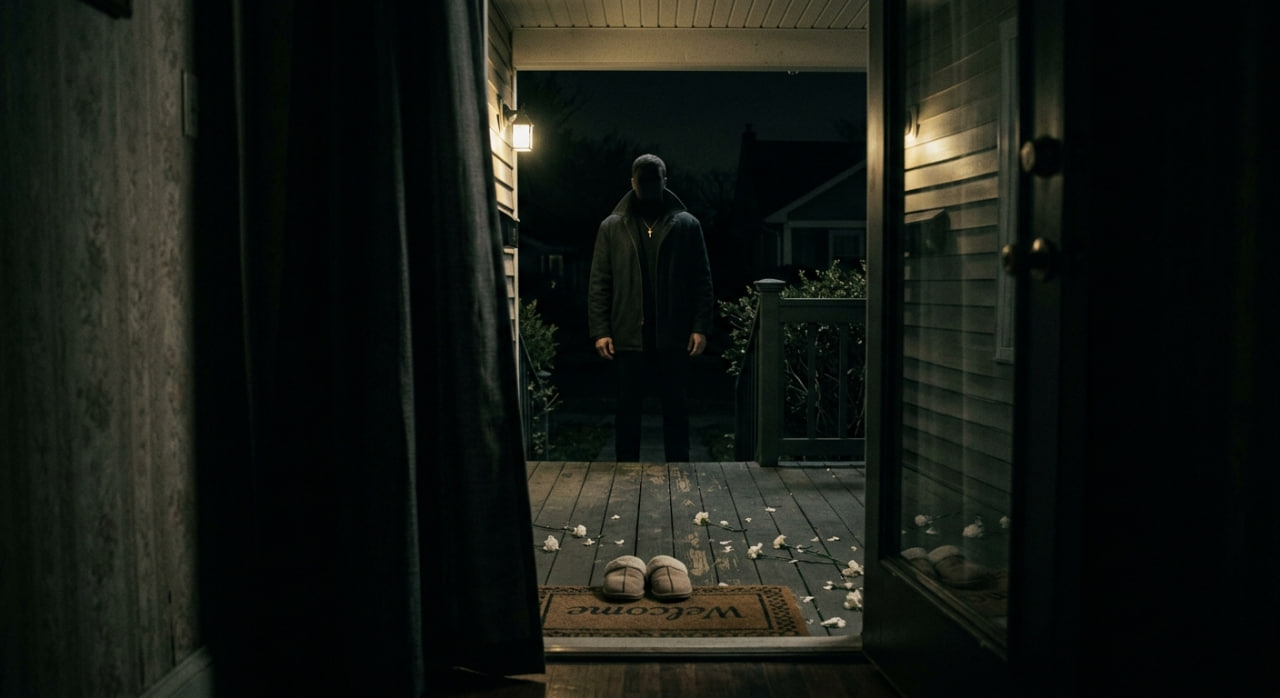
Her slippers were on the porch. Side by side. Perfectly aligned, like she’d paused at the threshold and stepped out of them deliberately. Like whatever was on the other side had a rule about shoes.
“Did she have any family we can contact?” the younger officer asked.
“Just her son,” I said. “David. He died three years ago.”
The two officers looked at each other. The kind of look that means something has connected that they’d rather it hadn’t.
“What?” I asked.
Briggs pulled out his phone. He turned it toward me slowly, like a man who wasn’t sure he should be showing me at all.
It was a traffic camera still. Timestamp: 12:08 a.m. The corner of Elm and Route 9 — two miles from our street, right at the spot where David died. The spot where Karen placed her carnations every week.
In the image: a figure walking along the road’s edge, back to the camera, heading in the direction of our neighborhood. Male. Tall. Moving steadily, without hurry.
Barefoot.
Wearing a dark jacket with a wide collar. A gray shirt underneath. And at his throat, just barely catching the camera’s light — a small gold cross on a chain.
I had seen that cross before. In photographs. In the picture Karen kept on her mantelpiece of David at his cousin’s wedding, laughing with his head thrown back, that cross glinting at his collar.
We had buried him in it. Karen told me so.
“The camera is motion-activated,” Briggs said quietly, putting his phone away. “Triggered by body heat.”
He let that sit for a moment.
“That image,” he said, “shouldn’t exist.”
════════════════════════════════════════
PART 4 — THE NOTE
════════════════════════════════════════
I didn’t sleep that night. Or the next three after it.
I kept every light in the house on — the overheads, the lamps, the bathroom nightlight, the stove hood. I told myself it was practical. That I was simply being cautious. I didn’t say out loud what I was actually thinking, which was that I didn’t want there to be any shadows. I didn’t want anything to have a place to stand where I couldn’t see it.
I double-checked every lock before dark. Windows, back door, front door, the little side door off the laundry room that I sometimes forgot about. I checked them twice. Sometimes three times. Once at 2 a.m. I got up and checked them again just because I couldn’t remember if I had, even though I knew perfectly well that I had.
Across the street, Karen’s house sat dark and still. Yellow police tape had been up for two days and then came down. The investigation was “ongoing,” which is the word they use when they have nothing. Her daughter-in-law — David’s ex-wife, estranged, living in Columbus — had been contacted. She’d made arrangements for the house. She hadn’t come herself.
Nobody came.
I called Briggs twice. He answered once, told me they were pursuing all leads, and thanked me for my patience. His voice had the particular flatness of a man who has stopped expecting things to make sense.
On the fourth night, I found the note.
I nearly missed it. I came downstairs in the morning and it was there on the entryway floor, just inside the mail slot — a single folded piece of paper, white, unaddressed. No envelope. Just slipped through the slot sometime in the night, while all my lights blazed and I lay awake upstairs listening to nothing.
I knew the handwriting the moment I unfolded it.
Karen had a very particular hand. Old-fashioned and deliberate, every letter formed completely, the way people wrote before everything became a keyboard. She’d sent me a Christmas card every year. I knew her handwriting.
It said:
“I understand now. Don’t be afraid. It isn’t what we thought it was. He only wants to bring us home. All he needs is for you to open the door. It doesn’t hurt. I promise you it doesn’t hurt. Just open it. We’re waiting.”
I read it four times.
Then I put it in a plastic bag and called Briggs.
He came within the hour. He read it standing in my entryway without touching it, hands in his pockets, face doing nothing. Then he bagged it himself, labeled it, set it aside.
“Has anyone been to your door?” he asked. “Knocked, rang the bell — anything?”
I thought about what I’d heard on the porch that first night. The breathing through the wood.
“Something has,” I said.
He nodded slowly, like this was the answer he expected and the one he’d been hoping not to get.
“I want you to go stay somewhere else,” he said. “A friend, a family member. Somewhere not on this street.”
“You believe me,” I said. It wasn’t a question.
He was quiet for a moment.
“I believe,” he said carefully, “that something is happening here that I don’t have a good explanation for. And in my experience, when that’s the case, the best thing you can do is not be where the thing is happening.”
════════════════════════════════════════
PART 5 — THE LAST NIGHT
════════════════════════════════════════
I should have left.
I know that. I’ve known it every day since. If you’re reading this and waiting for me to tell you I made a smart decision, I’m sorry — I’m not going to be able to give you that. I packed a bag. I had my keys in my hand. I was going to my sister’s place in Dayton, three hours away, and I was going to sit in her living room with her loud kids and her husband’s terrible taste in television and I was going to feel safe for the first time in a week.
I was halfway to the front door when I smelled it.
White carnations.
Not a candle. Not a product. The specific, particular smell of fresh-cut white carnations — clean and slightly sweet and cold, the way flowers smell in winter. It filled the entryway as suddenly and completely as if someone had opened a door to a florist’s walk-in cooler.
I stopped.
Karen bought white carnations every week. From the little grocery on Fifth, every Saturday morning. I had driven her there dozens of times. I knew that smell like I knew her voice.
I stood in my entryway and I breathed it in and I thought about her slippers on the porch, side by side, perfectly aligned.
I thought about the note. It doesn’t hurt. I promise you it doesn’t hurt.
I thought about the camera on Route 9, triggered by body heat, capturing an image that shouldn’t exist.
And then I thought about something I hadn’t let myself think about yet. Something small that I’d pushed down and down and down because thinking about it meant taking it seriously.
Before Karen called me that night — before any of this began — I’d had a dream. I’d been walking down a long hallway toward a door at the end of it, warm yellow light coming from underneath it, and from the other side of the door I could hear my mother’s voice. My mother, who has been gone for eleven years. She was laughing. Saying my name. And the feeling in the dream wasn’t fear — it was the most overwhelming sense of homecoming I have ever felt. Like every good thing that had ever been taken from me was on the other side of that door.
I woke up when Karen called.
I stood in my entryway with my keys in my hand and the smell of white carnations around me and I looked at my front door.
I thought: what if it really doesn’t hurt?
And then I thought: that is exactly what it wants me to think.
I left. I drove to Dayton with every window down and the radio up loud, and I didn’t look in the rearview mirror once.
════════════════════════════════════════
EPILOGUE
════════════════════════════════════════
Karen has never been found.
Briggs called me six weeks later with an update that wasn’t one — no new leads, case open, they’d be in touch. I asked him if anything else had happened on the street. He was quiet for a moment longer than he needed to be.
“The couple who moved into the house two doors down from yours,” he said. “The Petersons. They called us last week.”
I closed my eyes. “What happened?”
“Something knocked on their door,” he said. “Midnight. They didn’t open it.” He paused. “But Mrs. Peterson said she looked out the window.”
“What did she see?”
Another pause.
“She said it looked like someone she used to know,” he said. “Someone who’d been gone a long time.”
I’ve been at my sister’s ever since. I’m not going back — not to that house, not to that street. I’ve had my things picked up by a service. I’ve forwarded my mail.
But two nights ago, I woke up at midnight and the room smelled like white carnations.
And underneath my sister’s front door — slipped through the mail slot, no envelope, no postage — was a folded piece of paper.
My handwriting.
Words I have no memory of writing.
It said: *Don’t be afraid. Just open the door. We’ve been waiting such a long time.*
I haven’t slept since.
And tonight, for the first time, something is knocking.
— END —
════════════════════════════════════════