The Wrong Floor
A Mystery & Thriller Short Story
PART I — The Woman in the Elevator
Jay Lim was running four minutes late, which was not ideal for his third week at a new job.
He crossed the lobby of the Hana Tower building at a near-jog, coffee in one hand, laptop bag swinging off his shoulder, already composing the apology he would offer his manager if anyone noticed. The elevator doors were closing. He stuck his arm in. They opened again.
He stepped inside, pressed 14, and exhaled.
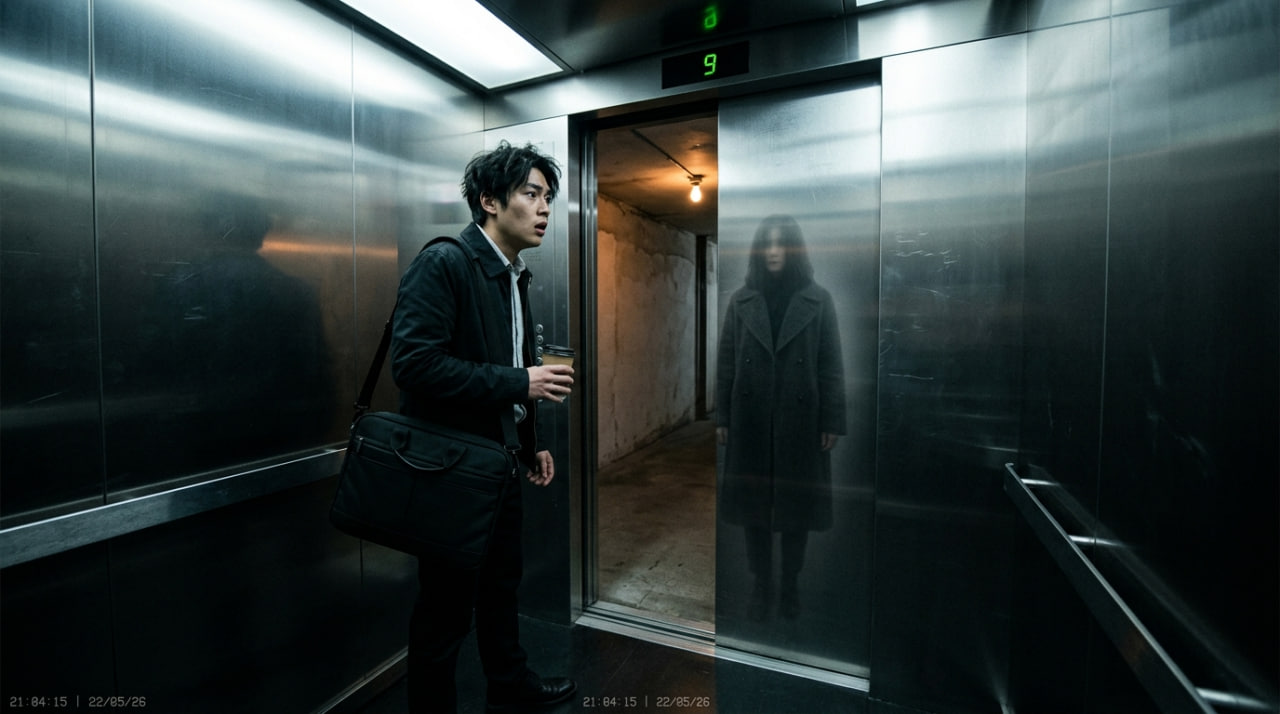
There was one other person in the elevator. A woman, standing in the back corner. Late thirties, maybe forty. Dark coat. Short hair. She was holding nothing — no bag, no phone, no coffee. She was just standing there, very still, watching the floor numbers climb.
Jay looked at his phone. Looked at the numbers. Shifted his weight.
Then the elevator stopped on the ninth floor.
The doors opened. Nobody was waiting outside. The woman didn’t move toward the doors. Jay assumed she had pressed the wrong button, which happened, and looked back at his phone.
“You need to leave the building,” the woman said.
Jay looked up. She was looking directly at him now. Her face was calm. Her voice had been quiet, but very clear.
“Sorry?”
“Get out of this building, Jay. Don’t go back to your desk. Don’t log into your computer. Just leave.”
He stared at her. “How do you know my name?”
The elevator doors closed.
The woman was gone.
Jay stood alone on the ninth floor for a full ten seconds, looking at the closed doors, coffee going warm in his hand. Then he did what most people would do in that situation.
He took the stairs to the fourteenth floor and went to his desk.
PART II — Something Wrong with the Screen
The fourteenth floor of Hana Tower was an open-plan office with low dividers, too much overhead lighting, and the particular smell of a place where people ate lunch at their desks. Jay had been here three weeks and still found it slightly overwhelming — the noise, the movement, the sense that everyone around him already understood something he hadn’t figured out yet.
He sat down, opened his laptop, and tried to shake the feeling that had been following him up the stairs.
The woman had known his name. That was the part he couldn’t explain away. He was new here. His photo wasn’t on the company website yet. His name wasn’t on his office door because he didn’t have an office door. She had looked at a stranger in an elevator and said his name like she already knew exactly who he was and exactly what she needed to tell him.
He unlocked his screen and opened his email.
There was one unread message. It had come in at 8:51 AM — nine minutes ago, while he was in the lobby — from an address he didn’t recognise. A string of random letters at a domain he had never seen. No subject line.
The body of the email had one line:
Look at the Vantage folder. Then look at the dates.
Jay’s job was in data management. He processed and organised internal reports for a company called Hana Solutions, which did financial consulting for mid-sized businesses across Seoul. He had been hired to maintain the company’s document archive system. He spent most of his day opening folders, checking metadata, filing things correctly.
He knew every folder in the system. There was no folder called Vantage.
He searched for it anyway.
It came up immediately. Sitting inside a directory he had been given access to, but had no reason to open, labelled with a project code he didn’t recognise. He clicked it.
Inside were 340 documents. Financial reports, mostly. Client records. Transfer logs. He opened the most recent one and looked at the columns of numbers and didn’t understand most of it, because he was twenty-two and his job was to file things, not to read them.
But he understood dates.
The reports were all dated within the last six months. The client names were anonymised — just codes, letters and numbers. But the transfer amounts were real. And the dates on the transfers did not match the dates on the reports that were meant to describe them. Someone had changed the numbers. Not all of them. Just enough. Small adjustments, spread across hundreds of rows, the kind of thing that would take a long time to find if you weren’t already looking.
Jay sat back in his chair.
Look at the Vantage folder, the email had said. Then look at the dates.
He looked around the office. His manager, Daniel, was on a call at his desk, leaning back, laughing at something. His boss, Mr. Kang, was in his glass-walled office at the far end of the floor, door closed, head down.
Jay closed the folder. Then he opened it again. Then he took out his phone and photographed three pages of the report, hands steadier than he expected.
Then he picked up his coffee and walked to the bathroom and stood at the sink for a while, running cold water over his wrists, thinking.
PART III — Daniel
Daniel Cho had been at Hana Solutions for six years. He was thirty years old, friendly in the easy way of someone who has decided life is better that way, and he had taken Jay under his wing in the first week with the genuine warmth of someone who remembered what it felt like to be new and lost. He brought Jay coffee sometimes without being asked. He explained the office politics in a way that was helpful without being cruel.
Jay liked him. This made what he was about to do feel worse.
He came back from the bathroom and sat down and pulled up the Vantage folder again and looked more carefully at the document structure. Each file had a creation date and a last-modified date. These were recorded automatically by the system — you couldn’t change them without system-level access.
Only two people in the office had system-level access. Mr. Kang. And Daniel.
The last-modified date on 289 of the 340 Vantage files was in the last four months. They had all been modified by the same user account.
Jay looked at the user ID. He looked at it for a long time. Then he closed the laptop very carefully, as though it might break, and sat with his hands flat on the desk.
He thought about the woman in the elevator. He thought about the fact that she had known his name. He thought about the fact that whoever had sent the email also knew his name, and his email address, and had sent it at exactly the right moment — before he sat down, before he opened his computer, before he had any of this in his head.
Someone had wanted him to find this. Someone had chosen him specifically to find it.
The question was why a person who had been here for three weeks, who knew nobody and had no history with any of this, was the person they had chosen.
He took out his phone and looked at the photographs he had taken. Then he opened his browser and searched for Hana Solutions and the words fraud and financial irregularity and investigation.
The third result was a news article from five months ago. A short piece, buried in a business section, about a former Hana Solutions employee who had filed a complaint with the Financial Intelligence Unit and subsequently resigned. The article did not use her name. It described her as a woman in her late thirties who had worked in the company’s data division.
There was no photograph. But the description was enough.
Jay put his phone face-down on the desk and stared at his screen and understood that the woman in the elevator had not appeared by accident. She had been waiting for him. She had known he would be in that elevator at that time because she had sent him the email and known he would check it on his phone in the lobby, and she had timed it perfectly, and she had tried to give him a way out before he found what she had sent him to find.
She had given him a choice first. He had made the wrong one.
Which meant now he had to make a better one.
PART IV — What Jay Did Next
He did not go to Daniel. He thought about it — turned it over several times, looking for an angle where it made sense — and each time arrived at the same answer. Daniel had system-level access and 289 recently modified files. Until Jay understood more, Daniel was not a safe choice.
He did not go to Mr. Kang, for obvious reasons.
He thought about going to the police, but he was twenty-two and had three weeks of employment history at this company and a folder of documents he didn’t fully understand and photographs he had taken on his personal phone. He thought about how that conversation would begin and how it would most likely end.
He thought about the woman.
He went back to the anonymous email. He hit reply, which he suspected would go nowhere but tried anyway. The delivery failure message came back in forty seconds.
He thought harder. She had been in the building. She had walked into an elevator on the ground floor, which meant she had come in through the lobby, which meant she had either shown ID or been buzzed in by someone. She had got out on the ninth floor.
Jay had never been to the ninth floor. He didn’t know what was on the ninth floor.
He took the stairs down.
The ninth floor was a co-working space — the kind of open, rented-desk setup where anyone could book a seat for the day. A young man at the front desk gave Jay a visitor lanyard without asking many questions. Jay walked slowly through the space, looking at the faces bent over laptops and phones.
She was at a desk near the window. Dark coat over the back of her chair. Coffee she wasn’t drinking. Eyes that came up and found him immediately, like she had been watching the door.
He sat down across from her without being invited.
“I told you to leave,” she said. Her voice was exactly as calm as it had been in the elevator.
“I know,” Jay said. “I didn’t.”
“I can see that.”
“Why me?” he asked. “I’ve been here three weeks. I don’t have any history with any of this. Why would you choose me?”
She looked at him for a moment. “Because you have access to the archive system and no reason yet to protect anyone in that office. Everyone else up there has been there long enough to be afraid, or involved, or both.” She paused. “And because I read your application when I was still working there. You wrote that you believe accurate records matter because the truth lives in the details.” A small pause. “I thought that was either very naive or very useful.”
“Which was it?”
“I’m still deciding,” she said. Then she reached into her bag and put a USB drive on the desk between them. “This has everything. The original files before they were changed. A log of every modification with timestamps and user IDs. A memo that Kang wrote eight months ago that he thinks he deleted.” She looked at the drive, then at Jay. “The Financial Intelligence Unit has a whistleblower intake portal. Anonymous submission. They have to investigate anything submitted with documentation at this level. You don’t need to give them your name.”
“But you could have done this yourself,” Jay said. “You already filed a complaint once.”
“And then I resigned and they buried it and Kang had six months to keep moving money and clean up the evidence.” Her voice stayed even. “A complaint from a disgruntled former employee is easy to dismiss. A submission from a current employee with internal documentation is harder.”
Jay looked at the drive. “And if they trace it back to me?”
“There are protections. They’re not perfect. But they exist.”
He picked up the drive. It was very light. “What’s your name?”
She shook her head. “It’s better if you don’t know.”
He nodded. He stood up. He put the drive in his jacket pocket.
“You could still walk away,” she said. “You’ve been here three weeks. You don’t owe any of this anything.”
Jay thought about that. He thought about 289 modified files and the small adjustments spread across hundreds of rows, the kind of thing designed to be invisible, designed to quietly steal from people who would never know where their money had gone.
“No,” he said. “But someone does.”
PART V — After
He submitted everything that evening from his personal laptop, from a café three kilometres from his apartment, connected to their public Wi-Fi. The Financial Intelligence Unit’s portal was straightforward. He uploaded the drive contents, wrote two paragraphs of plain explanation, and pressed submit.
Then he ordered another coffee and sat there for a while, not looking at his phone.
The investigation was opened eleven days later. He knew because a man in a grey suit appeared on the fourteenth floor on a Tuesday morning and had a long, quiet conversation with Mr. Kang behind a closed glass door, and by noon Kang’s office was empty and Daniel had gone home early and the rest of the office sat in that particular stunned silence of people trying to process something they had not seen coming.
Jay processed his documents. He answered the emails in his queue. He filed everything correctly, the way he always did.
At 4 PM, he got a text from an unknown number. One line:
Good detail work.
He stared at it for a moment. Then he smiled, just slightly, and deleted it, and went back to work.
Two months later, Mr. Kang was formally charged. Daniel cooperated with investigators in exchange for a reduced charge and was dismissed without prosecution. The FIU report credited an anonymous internal submission. Jay’s name appeared nowhere.
He got a small raise in the spring, for what his new manager described as exceptional attention to detail. He accepted it without saying much. He bought a better coffee machine for his apartment. He went to work every morning, took the elevator without incident, and filed everything in its right place — because accurate records matter, and the truth does live in the details, and he had decided by now that this was not naive at all.
It was, in fact, exactly the right thing to believe.
— The End —