The Substitute
A Mystery & Thriller Short Story
PART I — The Wrong Dr. Yoon
Clara Shin had been seeing her therapist for fourteen weeks before she discovered the woman didn’t exist.
It hadn’t started as therapy, exactly. It had started as a condition — the kind her employer attached to certain promotions, the kind that came with a pamphlet and a list of pre-approved practitioners and a tone that suggested the whole thing was routine, nothing to worry about, purely procedural. Clara worked in data intelligence for a government contractor. The promotion meant a higher clearance level. The higher clearance level meant a psychological evaluation. The evaluation meant six sessions with an approved therapist, minimum.
She had chosen Dr. Soo-yeon Yoon from the list almost at random — the name was near the bottom, the office address was twelve minutes from her apartment, and the profile photograph showed a woman with a calm, unremarkable face that Clara found neither threatening nor particularly warm, which seemed about right for someone you were going to be honest with professionally.
The first session had been awkward in the way all first sessions are. The second had been better. By the fourth, Clara had started talking about things she hadn’t planned to — her father, the years she spent trying to be the version of herself she thought he wanted, the specific loneliness of being very competent at something you hadn’t chosen. Dr. Yoon had listened with the particular quality of attention that makes you feel, perhaps for the first time in a long while, genuinely heard.
Clara had kept going after the six mandatory sessions. She went every Tuesday at 6 PM. She had gone fourteen times.
She found out on a Wednesday, which felt like the wrong day for a thing like this.
She was in the elevator at her office building when her colleague Ji-won stepped in on the third floor, coffee in hand, and said, “Oh — do you know if Dr. Yoon has any openings right now? My referral is stalled and someone mentioned you see her.”
Clara said yes, she did, and pulled up the practice’s number on her phone to forward it.
Ji-won frowned at the screen. “That’s the right address, but — that’s not the photo I have. The Dr. Yoon I was referred to has short hair. Grey at the temples. This woman looks—”
“That’s her,” Clara said, with more certainty than she suddenly felt.
Ji-won shook her head slowly. “I don’t think it is.”
The Korean Medical Association’s online registry took eleven seconds to load. Dr. Soo-yeon Yoon, licensed clinical psychologist, registered address on Mapo-daero. Specializations: trauma, workplace adjustment, anxiety. The photograph beside her credentials showed a woman with short silver-streaked hair, sharp cheekbones, and eyes that were nothing like the woman Clara had spent fourteen Tuesdays telling her most private thoughts to.
Clara sat in the elevator for three floors past her stop, looking at the photograph.
Then she got out and walked back to her desk and opened a new browser tab, and started to look for the woman she had actually been seeing.
She found nothing. No psychology licence. No professional registration. No trace at all of the calm, unremarkable face from the profile photograph — the photograph that she now understood had been placed there by someone, deliberately, to be chosen.
She almost called Detective someone. She almost called her supervisor. She did neither of these things, because she was very good at her job, and her job had taught her that the moment you alert the wrong person, you lose the only advantage you have.
Instead, she booked a Tuesday appointment.
PART II — The Fifty-Third Minute
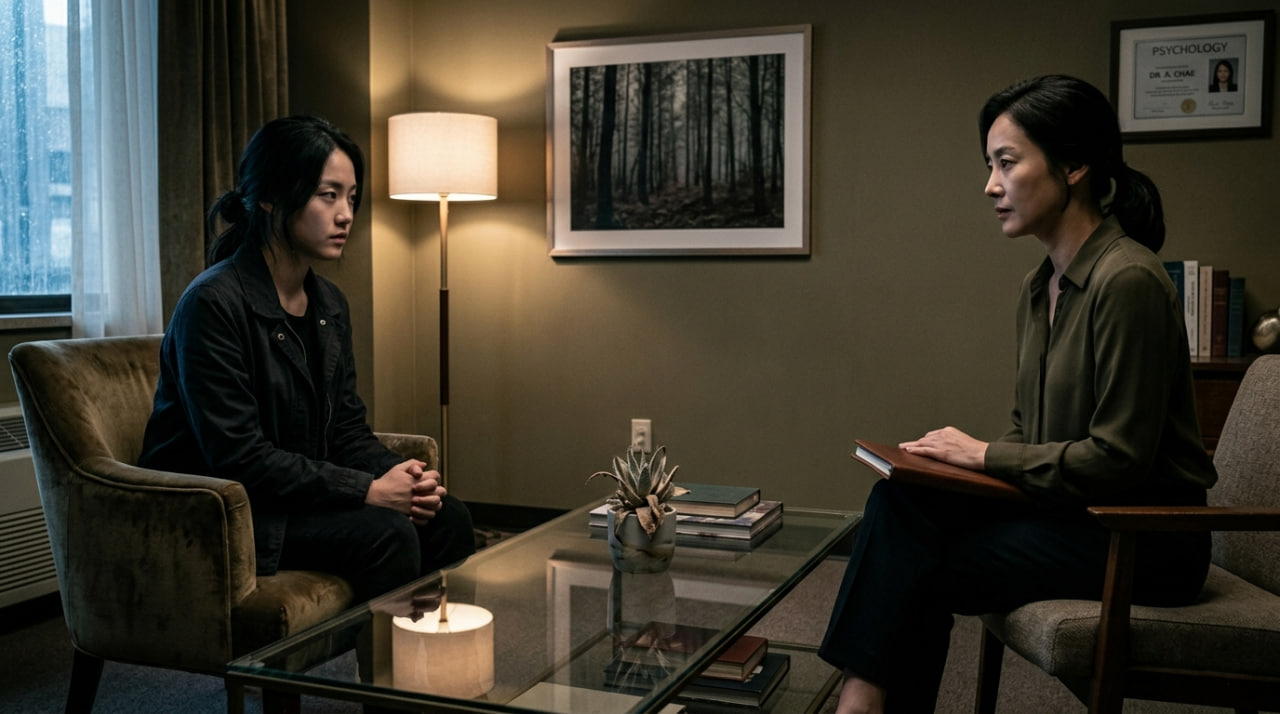
The office on Mapo-daero was a single room on the fourth floor of a building that housed a dental practice, a tutoring centre, and an accountant. The waiting room had two chairs, a dying succulent, and a framed print of a forest path that was supposed to be soothing and was mostly just beige. Clara had sat in those chairs fourteen times and never once questioned any of it.
She arrived eight minutes early on Tuesday and sat with her coat on and her hands in her lap and studied the woman across from her with the specific, controlled attention she used at work — the kind that doesn’t look like attention, that passes for ordinary polite eye contact — and tried to understand what she had missed.
The woman who called herself Dr. Yoon was perhaps forty, perhaps forty-five. Medium height. Dark hair to the jaw, always neatly kept. She wore reading glasses she rarely used and had a habit of tilting her head very slightly to the right when she was listening. She seemed completely at ease. She always seemed completely at ease.
“You seem preoccupied today,” the woman said, with the mild, non-accusatory curiosity Clara had come to think of as her signature.
“Just tired,” Clara said.
“Work?”
“Mostly.”
The woman nodded and let the silence sit, the way she always did — long enough to be an invitation, short enough not to be pressure. Clara had always appreciated that. She had told her so, once, in the eighth session. She had said: I like that you don’t push. The woman had smiled and said: Pushing rarely gets you where you actually want to go.
Now Clara sat in the chair and watched the woman who had no psychology licence and no professional identity sit across from her in a room that had been carefully arranged to look like trust, and she thought: What have I told you? What exactly have I given you, and what are you doing with it?
She thought about the things she had said in this room. The project she had described in broad terms — the data architecture of a system she wasn’t supposed to describe at all, really, but had described anyway because she’d been frustrated and tired and had told herself it was just venting, just context, just the shape of the work without any of the substance that would actually matter.
She thought about whether the shape alone was enough.
“Can I ask you something?” Clara said.
“Of course.”
“Why this? Why therapy?”
The woman’s head tilted the familiar fraction to the right. “I’m not sure I follow.”
“As a profession. Why did you choose it?”
A pause — small but real, the first small pause Clara had ever noticed. “I’ve always been interested in what people carry,” the woman said. “And why they carry it the way they do.”
“That’s a good answer,” Clara said.
“Thank you.”
“It sounds rehearsed,” Clara said.
The room went very quiet. Outside, someone in the tutoring centre below was doing something that involved a chair scraping across the floor. The dying succulent sat in its pot and offered no opinion.
The woman looked at Clara for a long moment. Then something shifted — not in her expression exactly, but behind it, some internal adjustment, like a camera finding its focus. “You know,” she said. It was not a question.
“I know,” Clara said.
PART III — What She Was Actually Carrying
Her name was not Dr. Yoon. Her name, as far as Clara was ever able to establish with certainty, was Park Ji-soo, though she had used at least four others in the preceding decade. She was not a therapist. She was, in the loose and ungoverned sense of the word, an intelligence contractor — the kind that exists in the space between official agencies and the people who hire them for things that official agencies prefer not to be associated with.
She did not try to run. Clara had half-expected her to — had positioned herself near the door for exactly that reason. But Park Ji-soo simply set down her notepad, folded her hands in her lap, and said: “How much time do we have before you make a call?”
“That depends on what you tell me,” Clara said.
What she told her took forty minutes — the fifty-third through the ninety-third, the time past the end of the session, past the point where either of them was performing anything. She told it cleanly, without apparent remorse but also without apparent pride, the way you describe a job you have done carefully and consider finished.
She had been hired to build a profile. Not of Clara specifically — Clara had been incidental, a late addition to the target set, chosen because her promotion put her adjacent to a system that certain people wanted to understand better. The therapy practice had been established eight months ago as a mechanism — the approved-practitioner list was not as difficult to infiltrate as Clara’s employer believed — and Park Ji-soo had been seeing six clients in total, all of them in adjacent roles at adjacent organizations, all of them people who had been told their sessions were confidential and who had, as people do when they believe they are safe, gradually said more than they intended.
“The real Dr. Yoon,” Clara said. “Where is she?”
“Teaching at a university in Busan. She left private practice eight months ago. She doesn’t know her credentials were borrowed.”
“And the people who hired you?”
A pause. “That,” Park Ji-soo said, “is a more complicated answer.”
“Try.”
She tried. Clara listened to the whole thing with her hands still in her lap and her coat still on, the same controlled attention she had been using for an hour, and when it was finished she sat for a moment in the chair that had been arranged to look like trust and thought about what she was going to do next.
“You’re good at this,” she said finally. “The listening. The silences. That thing you do with your head.”
“I’ve done it a long time,” Park Ji-soo said. Something in her voice that was not quite wry. “You’re good at it too. I didn’t realize you’d found out until the middle of last week.”
“Monday,” Clara said.
“Monday,” Park Ji-soo repeated, and for a moment — a very brief moment — something crossed her face that might have been, if you were being generous, the beginning of respect.
PART IV — Controlled Disclosure
Clara did not call her supervisor. She called someone three levels above her supervisor — a woman named Director Han who had the kind of still, unhurried voice that meant she had handled worse things than this before breakfast. Clara gave her the room number, the building address, and a precise summary of the conversation. Then she sat in the chair and waited, and Park Ji-soo sat in the chair across from her, and neither of them spoke much.
At one point Park Ji-soo said: “You could have left after the first session.”
“I could have,” Clara agreed.
“Why didn’t you?”
Clara looked at the dying succulent. “Because whatever else you were doing,” she said slowly, “you were also actually listening. And I hadn’t had that in a long time.”
Park Ji-soo said nothing. Clara thought she saw her jaw tighten, very slightly, which was the closest thing to an apology she was going to get, and was possibly more honest than one would have been.
The subsequent investigation took four months. Three of the six clients had disclosed information that was classified at various levels; two of those disclosures were deemed serious enough to trigger a formal review. The people who had hired Park Ji-soo turned out to be a private intelligence firm operating out of three jurisdictions simultaneously, none of which were especially cooperative. Two arrests were made. The firm dissolved and likely reconstituted itself somewhere else under a different name — these things always do.
Park Ji-soo cooperated in exchange for a negotiated arrangement that Clara was not given the details of. She disappeared from the public record, which in Clara’s experience meant she had either gone to prison or gone back to work for someone else.
Clara was reassigned. The promotion went through. She received a commendation that no one outside her organisation would ever read, written in the bloodless language of internal documentation.
She found a new therapist — a real one, a man named Dr. Oh who had terrible taste in office plants and an extremely good reputation and no interest whatsoever in data architecture. She went every other Thursday. She did not tell him about any of this, because some things are not for sharing, and she was learning to tell the difference.
Six months after the Tuesday she had sat in that chair with her coat on and watched the woman across from her focus like a camera finding its subject, Clara was walking home from the Han River when she saw a woman at a café table, reading a book, coffee going cold at her elbow. She had changed her hair — shorter now, and darker. She was wearing glasses Clara hadn’t seen before.
Their eyes met for exactly one second.
The woman turned a page.
Clara walked home. She made dinner. She sat at her kitchen window and looked at the lights of the city arranged below her like a second sky, and thought about all the rooms that look like safety from the outside, and all the people inside them deciding, every day, what to carry and what to finally, carefully, set down.
She thought she was getting better at telling the difference.
She went to bed at a reasonable hour, and slept without dreaming, and in the morning the city was still there — enormous and indifferent and full of doors she hadn’t opened yet.
— The End —