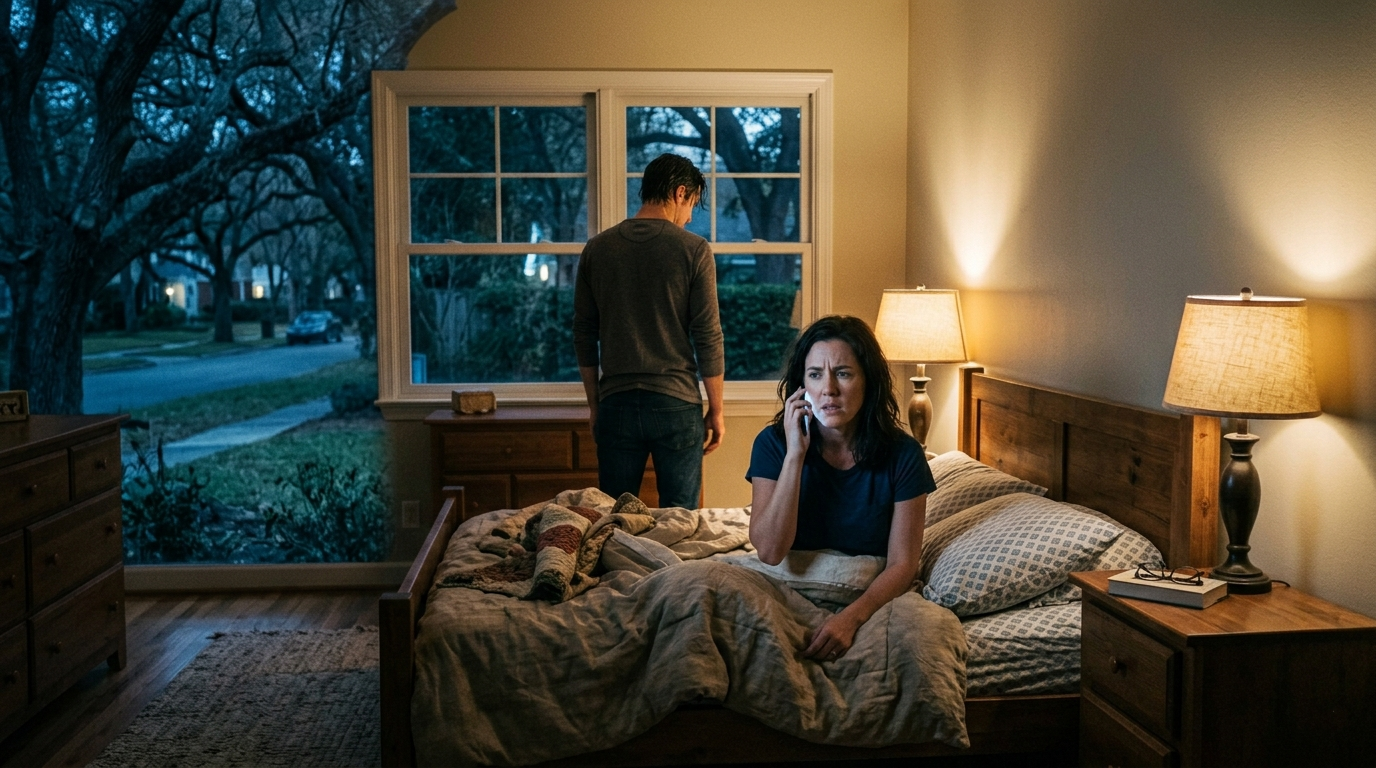
MY HUSBAND CAME HOME FROM HIS BUSINESS TRIP.
HIS COWORKERS SAY HE NEVER LEFT.
PART 1 — FRIDAY NIGHT
My husband came home on a Friday night.
I remember it exactly — the headlights sweeping across the bedroom ceiling at 11:42 p.m., the sound of his key in the front door, the particular way he sets his bag down in the entryway with a thud that I have been hearing for eleven years of marriage. I was already half asleep. I heard him come upstairs. I felt the bed shift when he sat on the edge of it.
“Hey,” he said. “I’m home.”
I reached back and touched his hand in the dark. It was cold — the way hands get cold after a long drive — and I told him I was glad, and I fell back asleep.
That was Friday.
On Saturday morning I woke up to three missed calls from his coworker, Janet. I called her back while Ryan was in the shower.
“Claire,” she said, and her voice was wrong in a way I couldn’t name immediately, the way a sound is wrong when something familiar is playing at the wrong speed. “Is Ryan okay? We’ve been trying to reach him since Thursday.”
“He’s fine,” I said. “He got home last night.”
Silence.
“Claire.” Her voice dropped. “Ryan never checked out of the hotel. His rental car hasn’t moved since Wednesday. His laptop is still in the conference room.” A pause I will never forget for the rest of my life. “We filed a missing persons report this morning. We thought something had happened to him.”
I stood in my kitchen in my pajamas and I listened to the shower running upstairs — the same shower my husband had been taking every Saturday morning for eleven years, the same sounds, the same routine — and I felt the floor tilt under me.
“Janet,” I said very carefully. “Someone came home last night. Someone used his key. Someone is in my shower right now.”
The shower turned off. Footsteps in the hallway above me.
“If Ryan is still in Chicago,” I whispered, “then who is in my house?”
—
PART 2 — THE MAN UPSTAIRS
I want to be precise about what happened in the next four minutes, because I have gone over them so many times since that they have worn grooves in my memory, and I need to get them exactly right.
I hung up on Janet. I know that was the wrong thing to do. I know I should have stayed on the line, told her to call 911, walked out the front door and waited on the neighbor’s porch until help arrived. I know all of that. I did none of it.
Instead I stood at the bottom of the stairs and listened.
The footsteps moved from the hallway to the bedroom. I heard the familiar sounds of Ryan’s morning routine — the particular creak of the closet door we had been meaning to fix for two years, the sound of dresser drawers opening and closing, the slight rattle of his watch hitting the nightstand when he set it down.
I knew those sounds. I had been hearing them for eleven years.
I walked upstairs.
He was standing at the window with his back to me, looking out at the backyard. He was dressed in the clothes he always wore on Saturdays — the gray henley, the dark jeans. His hair was damp from the shower. Everything about him was Ryan. The breadth of his shoulders. The way he stood with his weight on his left foot. The small scar on the back of his right hand from a camping trip in 2018.
“Ryan,” I said.
He turned around. And here is the thing I have tried most to explain and least succeeded: he looked like my husband. He smiled like my husband. When he said “Morning, babe” he said it in Ryan’s voice, Ryan’s cadence, Ryan’s specific warmth.
But something was wrong.
I cannot tell you what it was. It wasn’t his face or his voice or the way he moved. It was something underneath all of that — something in the quality of his attention, the way his eyes rested on me. Like a painting of a person rather than a person. Like something wearing the idea of Ryan, wearing it well, but not quite understanding what Ryan was on the inside.
“You seem tired,” he said. “You should eat something.”
Ryan never said that. Ryan knew I hated being told to eat. In eleven years he had learned every small irritating thing not to say to me.
I smiled back. I said I would. I walked back downstairs and locked myself in the hall bathroom and called 911 with the water running.
—
PART 3 — WHERE RYAN ACTUALLY WAS
Ryan was found at 2:17 p.m. in his hotel room in Chicago.
He was alive. I need to say that first because it is the most important thing and everything else comes after it. He was alive, and conscious, and physically unharmed — sitting on the edge of the hotel bed in the same clothes he had been wearing since Wednesday morning, with no memory of the previous forty-eight hours.
The Chicago police officer who called me described it carefully. Ryan had been unresponsive when hotel staff entered the room after a wellness check. Not unconscious. Not sleeping. Sitting upright, staring at the wall, not responding to speech or touch. When he came back — the officer used that phrase, came back, as if Ryan had been somewhere else and then returned — he didn’t know what day it was. He thought it was Wednesday evening. He thought he had just come upstairs after the conference dinner.
He had been sitting in that room for roughly forty-six hours.
I told the officer about the man in my house. There was a long silence on the line.
“Ma’am,” he said carefully. “Can you describe the individual present in your home this morning?”
“He looked exactly like my husband,” I said. “He knew the layout of the house. He knew where everything was. He spoke and moved like Ryan. He had the same scar.”
“And where is this individual now?”
The police who had responded to my 911 call had searched the house thoroughly. Every room, every closet, the garage, the backyard. There was no one. No sign of forced entry. No sign anyone other than myself had been in the house. The only evidence that anyone had used the shower was the damp towel on the hook — Ryan’s towel, hanging in the place Ryan always hung it.
I drove to Chicago that night. I needed to see him — the real him — with my own eyes. I needed to stand in front of my husband and feel the thing that was supposed to be there and wasn’t there in the person standing at my bedroom window that morning.
Ryan was waiting in the hotel lobby. He stood up when he saw me. And the moment I saw him — really saw him, across a bright ordinary lobby — I felt it. The thing that had been missing from the man in my house.
Recognition. Not of his face, but from his face. The specific way Ryan looks at me in particular, not the way something looks at everyone the same way.
I crossed the lobby and held him for a long time and didn’t say anything at all.
—
PART 4 — WHAT THE DETECTIVE FOUND
We didn’t go back to the house right away.
We stayed in Chicago for two more days — Ryan seeing a doctor, both of us talking to a detective named Aisha Carmichael who handled what she described, with admirable understatement, as unusual missing persons cases. She had a quiet, unhurried way of listening that made me feel both calmer and more frightened at the same time, the way doctors sometimes do.
She believed me. That was the first thing I needed to establish and she established it quickly and without drama. She told me she had spoken to the first responding officers, reviewed their search of my home, and confirmed there was no conventional explanation for the person who had been there that morning. No intruder. No evidence of entry. No record on any camera — doorbell, neighbor’s security, the traffic camera at the end of our street — of anyone approaching or leaving the house Friday night.
“The car,” she said. “You said you heard his car in the driveway.”
“Headlights across the ceiling,” I said. “The sound of a key.”
“Your car was in the driveway all week. Did you check it Friday night after you heard the sounds?”
I hadn’t. We checked it when we got home. It was in exactly the position I’d left it, engine cold, no sign of being moved. There had been no car. There had been no key. There had been sounds exactly like those things — produced by something that wanted me to hear them.
Detective Carmichael asked me two more questions.
The first: had anything unusual happened in the weeks before Ryan’s trip? I thought about the front door I’d found unlocked when I was certain I had locked it. The evening our dog refused to go upstairs and whined at the bottom step for an hour. The night I woke at 2 a.m. certain someone had said my name.
She wrote it all down without expression.
The second: when the individual was in my home — did he do anything that felt purposeful? Was he looking for something? Waiting for something?
I thought about standing in the bedroom doorway, watching him stand at the window, perfectly still, staring down into the backyard with intense focus.
“He was watching something,” I said slowly. “Outside. In the backyard. Not just looking — watching something specific.”
“I’d like you to take a careful look at your backyard when you get home,” she said. “Particularly the area near the tree line.”
She wouldn’t tell me why. She wrote something in her notebook and closed it.
“I want to be honest with you,” she said. “I don’t have an explanation for what you experienced. What I can tell you is that you are not the first person to describe something like this, and in every previous case, whatever it was — it did not come back.”
She paused. “Make sure your locks are changed. Not because it will keep anything out. But because you’ll sleep better. And right now you need to sleep.”
—
PART 5 — THE BACKYARD
We got home on a Tuesday.
Ryan changed the locks that afternoon. Not because either of us believed new locks would matter against something that had entered without a key — but because Detective Carmichael was right, and we both needed the gesture. The ritual of the ordinary. The act that says: this is our house, we are in charge of what happens here.
That evening, before the light went, I walked to the back of the yard.
We have about a quarter acre backing up to a thin line of old oaks, planted before the neighborhood was a neighborhood. I had walked to that tree line a hundred times. It was ordinary. It was ours.
It was not ordinary now.
At the base of the largest oak — the one standing directly in line with the bedroom window — the grass was flattened. A wide, roughly circular patch, maybe six feet across, pressed down as if something had been there for a long time. Days, not hours. The way grass looks when furniture has been sitting on it for a week.
And in the center of the flattened area, half pressed into the soil as if placed there deliberately — I almost missed it.
Ryan’s business card.
His name, his company, his number. The cards he kept in his laptop bag. I had checked the bag when we got home from Chicago. The cards were there, in their holder, minus one.
Someone had taken one of Ryan’s cards from his bag. And pressed it into the soil at the base of our oak tree. While watching our bedroom window.
I stood in the fading light for a long time, the card in my hand, trying to understand what it meant. A message? A marker? Something left for us to find, or left for a reason we weren’t equipped to understand?
I called Detective Carmichael and told her what I’d found.
“Don’t disturb the area any further,” she said. Then: “How is Ryan?”
I looked back at the house. Ryan was in the kitchen window, making dinner, moving through the warm yellow light the way he had always moved. Present. Specific. Mine.
“He’s Ryan,” I said. “He’s really Ryan.”
“Good,” she said quietly. “Hold onto that.”
—
EPILOGUE — FOUR MONTHS LATER
The police never found an explanation.
The flattened grass, the business card, the forty-six hours Ryan sat motionless in a hotel room while something that wore his shape slept in his side of our bed — none of it was ever formally resolved. Detective Carmichael’s investigation is technically still open. She calls every few weeks, not with answers, but in the way certain people maintain contact when they feel a responsibility they can’t fully name.
Ryan sees a therapist. So do I. The forty-six missing hours have not come back to him — there is simply nothing there, a gap in his memory like a missing page in a book. His brain scans are normal. He is, by every measurable standard, completely fine.
We still live in the house. Some people ask how we can, and I understand the question. But the house is ours and we love it and leaving felt like surrendering something we hadn’t chosen to give.
We changed the locks. Put up cameras. Got a second dog — a large shepherd mix named Duke who takes the matter of guarding the bedroom hallway very seriously.
Some nights Ryan wakes at 2 a.m. He doesn’t know why. He comes awake suddenly, lies there listening to the house. He says it feels like something checking in.
I asked him once if it frightened him.
He thought about it for a while.
“It used to,” he said. “Now it just feels like something that knows where we live. Like it’s keeping track.”
He reached over in the dark and took my hand.
“I don’t think it means us harm,” he said. “I think it’s just watching.”
I held his hand and stared at the ceiling and didn’t say what I was thinking.
Which was: how do you know it’s not still watching right now?
Which was: how do I know — how do either of us ever truly know — that the man holding my hand in the dark is the right one?
I have looked for the thing I couldn’t name. I have checked, every day since he came home from Chicago, for the presence behind the eyes. The specific, irreplaceable recognition.
So far, every day, it’s there.
So far, every day, it’s Ryan.
I just keep checking.
-END-