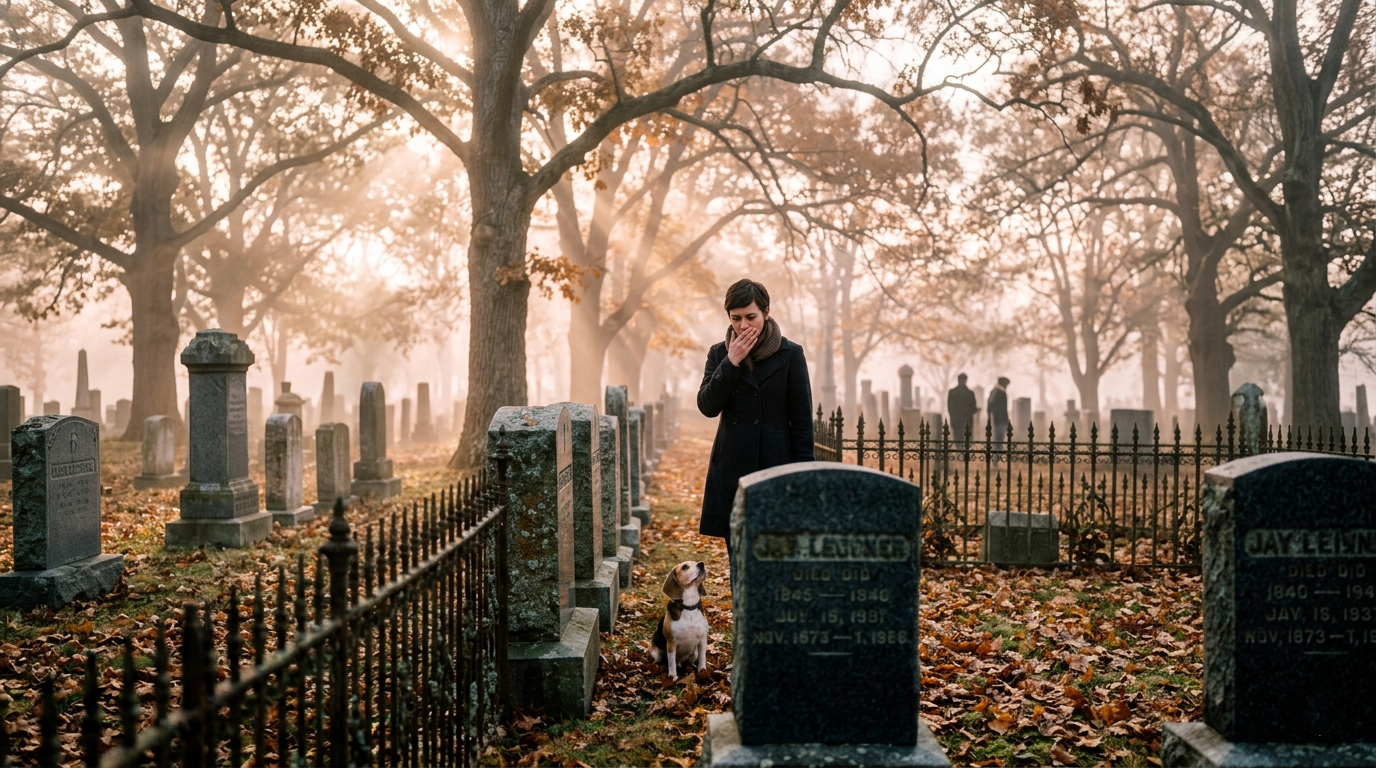
I FOUND MY OWN GRAVE. THE DATE ON IT IS NEXT FRIDAY.
PART 1 — THE STONE
I want to be clear about something before I start.
I am not a superstitious person. I don’t read horoscopes. I don’t knock on wood. I have never once believed in signs, omens, or the idea that the universe sends messages to ordinary people living ordinary lives in ordinary towns.
I believed that right up until last Saturday morning, when I found my own grave in the cemetery three blocks from my house.
It started the way most strange things start — with something small that shouldn’t be worth noticing. I was walking Biscuit, my beagle, the same route I walk every Saturday morning. Through the park, past the coffee shop, along the iron fence of Maplewood Cemetery, which has been there since 1887 and which I have walked past no fewer than four hundred times without ever going inside.
Biscuit went inside.
He’s never done that before. The gate was open — it’s always open during daylight hours — and he bolted through it before I could tighten the leash, and I followed the way you follow a determined beagle: helplessly, at a trot, calling his name at a volume that felt disrespectful given the surroundings.
He stopped at a headstone in the third row from the back fence. He sat down in front of it. Perfectly still. Which Biscuit never is.
I caught up to him, slightly out of breath, ready to apologize to the stone for the intrusion the way you do when you’re slightly embarrassed and mostly just want to get your dog and go home.
I looked at the headstone. And every thought I had ever had left my head at once.
The name on the stone was mine. My full name — first, middle, last — carved in clean gray granite, exactly as it appears on my driver’s license and my birth certificate and every piece of mail that has arrived at my house for thirty-four years.
The birth date was mine. October 14th, 1990.
And the death date — carved just as cleanly, just as permanently, into stone that had clearly been there for some time — was this coming Friday. October 18th, 2024. Six days from now.
I stood in Maplewood Cemetery with my beagle sitting calmly at my feet and I read my own name and my own death date on a headstone that should not exist, and I did what any reasonable person would do. I took a photograph. And then I sat down on the grass because my legs stopped working.
—
PART 2 — THE RATIONAL EXPLANATIONS
I sat in that cemetery for a long time.
Long enough for Biscuit to lose interest in the headstone and start investigating a nearby rosebush. Long enough for the morning light to shift from pale gold to full white. Long enough to take eleven photographs and go through every rational explanation I could construct and watch each one fall apart.
The rational explanations, in order of how long they lasted:
Someone with the same name. It took about forty-five seconds to discard this one, because the birth date was specific — October 14th, 1990 — and while there are probably other people named Jenna Marie Calloway, the odds of one of them sharing my exact birthday and dying in the town where I live felt vanishingly small.
A prank. This one held for maybe two minutes. But the stone was old — the granite had weathered, the edges were softened, there was lichen beginning to grow along the lower left corner. This was not something installed last week. This had been here for years.
A mistake at the cemetery. Possible. Except that the death date was in the future. You don’t make a mistake about a date that hasn’t happened yet.
I called my best friend Dana from the cemetery. I told her where I was and what I was looking at and I sent her one of the photographs.
She was quiet for so long I thought the call had dropped.
“Jenna,” she said finally.
“I know.”
“That’s your birthday.”
“I know.”
“And the date on it is—”
“Friday. I know.”
Then Dana, who once reset her own dislocated shoulder without calling a doctor, said: “Okay. Here’s what we’re going to do. You’re going to go home. I’m going to come over. And we are going to figure out what this is, because there is a rational explanation and we are going to find it.”
I looked at the headstone one more time before I left. At the bottom, below the dates, was a small inscription:
Beloved. Gone too soon. She knew what mattered.
I had never heard those words before. They were not a phrase from my life, not something my family said, not a lyric or a quote I recognized. But standing there in the morning light, reading them for the first time — I felt, in a way I could not explain, that they were right. That whoever had written them had known something true about me.
That frightened me more than the dates.
—
PART 3 — WHAT THE CEMETERY RECORDS SHOWED
Dana arrived at my house at ten-thirty with coffee and the focused energy of a woman who has decided to solve a problem.
We started with the cemetery office. Maplewood Cemetery is run by the county, records fully digitized as of 2019. The woman who answered — Helen — was patient and careful and, as the conversation progressed, increasingly quiet in the particular way of someone who does not want to say out loud what they are looking at.
I gave her my name. Thirty seconds of database searching.
“I do show a plot registered under that name,” Helen said. “Plot 7, Row 3, Section C.”
“When was it registered?” I asked.
A longer pause. “That’s — unusual,” she said, in the tone of someone who did not want to use that word at all. “The registration date shows as October 2019. Five years ago.”
In October 2019 I had been healthy, employed, and living in Chicago — with no connection to Maplewood Cemetery or Cedar Falls, Iowa, where I had only moved eight months ago.
“Who registered it?” I asked.
A very long pause.
“The purchaser of record,” Helen said, “is listed as J.M. Calloway.”
Dana stopped writing. We looked at each other across the kitchen table.
“That’s my name,” I said.
“Yes,” said Helen, in the voice of a woman who would very much like this morning to be over.
We went to the cemetery office that afternoon. The director, Gerald Marsh, showed us the purchase record. A standard county form, five years old, filled out with my name, my birth date, and a Cedar Falls address I had never heard of. Paid in full. Cash.
“The inscription,” I said. “Who ordered it?”
“The inscription was added in June of this year,” Gerald said. “Four months ago.” He turned the paper toward me. “Also paid in cash. Also under the name J.M. Calloway.”
Four months ago I had not yet moved to Cedar Falls. I had been in Chicago, packing boxes, finishing out my lease. Something had been here before me. Something that used my name, knew my birth date, and was apparently very confident about my death date.
On the drive home, Dana said: “I’m staying at your house until Friday.”
I didn’t argue.
—
PART 4 — THE WEEK BEFORE FRIDAY
I want to tell you that I handled the next five days with grace and composure. I did not.
I called the police on Sunday. Officer Tran, young and earnest and clearly trying not to look at me with the expression that meant he thought I was unwell, took my statement and photographs and told me they would look into it. He called Monday afternoon to confirm the records were legitimate, the plot was real, the purchase was on file, and that fraud was technically a crime but technically difficult to prosecute when the only victim was still alive.
I did not sleep well. I lay awake until two and three in the morning running through possibilities like a hand of cards that never added up right.
Possibility one: someone was doing this deliberately. Patient enough to wait five years since 2019. Calculating enough to add the inscription four months ago when my moving date was set. Someone who wanted me frightened — or worse, who intended to make sure the date on the stone was correct.
Possibility two: a chain of coincidences so elaborate they looked deliberate but weren’t. I tried to believe this. I mostly failed.
Possibility three — the one I circled at 2 a.m., the one I couldn’t put down — was the one I had no rational framework for. That the grave was simply true. That somewhere, somehow, something knew something about my life that I did not.
On Wednesday, Biscuit refused to walk past the cemetery. He sat down on the sidewalk a full block away and would not move. I carried him home.
On Thursday morning I found something on my doorstep.
A single white envelope. No stamp, no postmark. My name on the front in small, careful, old-fashioned handwriting. Inside, one index card:
You were not supposed to find it yet. Go home to your mother’s house this weekend. Do not be in Cedar Falls on Friday.
I read it four times. I called Dana. Then my mother. Then I sat in the kitchen with Biscuit in my lap and thought about what it meant that someone was worried I had found the grave too early.
It could mean someone was warning me. Or it could mean someone was trying to move me into position.
By Thursday evening, I had decided I was not going anywhere.
—
PART 5 — FRIDAY
I will tell you what happened on Friday. I will tell it plainly, without drama, because the facts are strange enough on their own.
Dana stayed. My neighbor Carl, a retired sheriff’s deputy who had heard the story over the back fence and taken it upon himself to be involved, stayed. Officer Tran drove past my house three times in the morning. My mother called every two hours.
It was, for most of the day, completely ordinary. The sun came up. I made coffee. Biscuit ate his breakfast. Dana and I watched cooking shows and did not talk about what day it was. Carl sat on my front porch with his newspaper, which is a form of kindness I did not know I needed until I had it.
At 4:17 in the afternoon, a car I didn’t recognize pulled up in front of my house.
An older woman got out. Seventy, perhaps. White hair. Small and upright in the way of people who have always paid attention to how they carry themselves. She walked up the porch steps, nodded at Carl as if she had been expecting him specifically, and knocked on my door.
I opened it.
“You found the stone,” she said. Not a question.
“Yes,” I said.
“I was afraid of that.” She looked at me steadily. “I put it there.”
Her name was Miriam. She had lived in Cedar Falls for forty years. And what she told me over coffee at my kitchen table was this:
She had a gift. That was the word she used, quietly, without pride or performance. A gift for knowing. She had spent her life trying to understand it and mostly what she had learned was that it came when it wanted, showed her what it wanted, and was not required to make itself comfortable or convenient.
In October of 2019, she had seen my name. Seen it clearly, attached to a death in a small Iowa town, on a specific October date. She had done what she always did when this happened — she had tried to prevent it. Purchasing the plot was, in her experience, a way of putting the death somewhere external, somewhere it could be looked at and argued with and perhaps changed.
She had not known I would find it. She had not known I would move to Cedar Falls. She had not been able to stop that either.
“What was going to happen?” I asked. “On Friday.”
She looked at me for a long moment.
“A car accident,” she said quietly. “On Route 9. Near the curve by the old mill. In the rain.”
I had driven that curve a hundred times. Every time I went to the grocery store.
“It’s raining,” Dana said from across the table.
We all looked out the window. It was. It had started around three.
“I wasn’t going to drive anywhere today,” I said.
“I know,” Miriam said. “I got your letter to you yesterday. I wasn’t sure you’d listen.”
“I almost didn’t,” I said.
“I know that too.” She wrapped both hands around her coffee mug. “The date was not certain. These things are a tendency, a direction. They can be changed. Yours was very strong — stronger than most I’ve seen. But you found the stone, and you stayed inside, and here you are.”
Here I was. Friday. October 18th, 2024. Alive.
At 6:43 p.m., there was an accident on Route 9, near the curve by the old mill. A truck hydroplaned in the rain and crossed the center line. The driver was uninjured. The road was empty on the other side.
The road was empty because I was home.
—
EPILOGUE — TWO WEEKS LATER
I went back to the cemetery on a Saturday morning.
Biscuit came with me, willingly this time. He walked right up to the stone and sat beside it the same as before — and then, after a moment, he got up and walked away, and did not look back.
The stone is still there. Gerald Marsh offered to have it removed, and I thought about it for several days, and decided to leave it. It has my name on it. It has a date that passed. And it has an inscription I have decided, slowly and with some difficulty, to try to deserve:
Beloved. Gone too soon. She knew what mattered.
I didn’t know what mattered, before that week. I mean that honestly. I was a person who kept herself busy and moving and distracted, who had come to Cedar Falls for a fresh start without fully examining what she needed to start fresh from. The grave — the impossible, infuriating, inexplicable grave — made me stop. Made me look. Made me sit in a cemetery and think about what it would mean if the date was right.
It turned out, when I actually thought about it, that there were things I had been not doing that I needed to do. A phone call to my mother I’d been putting off. A conversation with myself about why I’d left Chicago. A reckoning with whether I was living the life I actually wanted or just the most convenient version of it.
I called my mother the night of the Friday that didn’t happen to me. We talked for two hours. It was overdue by about three years.
Miriam and I have coffee sometimes on Saturday mornings. She doesn’t talk about the gift much. When she does, it’s practical and matter-of-fact. She tells me she has never fully understood it. She tells me it has cost her things. She tells me she does it anyway because knowing and doing nothing is not something she is able to choose.
I asked her once if she had seen anything else about me.
She looked at me over her coffee cup for a long moment.
“Yes,” she said.
“Is it bad?” I asked.
She smiled — small, private, warm, the kind that belongs to people who know something good they’re not quite ready to tell you yet.
“No,” she said. “It’s not bad at all.”
I walked home through the cemetery, the way I do now sometimes. Past the stone with my name on it. Past the date that was and then wasn’t. Past the inscription I am slowly working my way toward deserving.
Biscuit trotted ahead, nose to the ground, completely unbothered.
I followed him home.