I Paid for My Brother’s College for 11 Years. He Forgot to Mention Me at His Graduation.
I was twenty-three years old when I told my brother I would pay for his college.
Our father had just died. Our mother was working at a laundromat and sending half her paycheck to her sister in Baton Rouge who was sick and had no one else. Derek was seventeen and the smartest person I had ever known — the kind of smart that felt like a responsibility, like something that needed protecting. He had a partial scholarship to the University of Tennessee. He needed the rest.
I said yes before he finished asking.
I worked as an office manager at an insurance company for eleven years. I ate lunch at my desk. I drove a 2003 Honda Civic with a cracked dashboard until it died on the interstate in 2019 and I replaced it with a used 2011. I didn’t take a vacation until I was thirty-one, and even then it was four days in Gatlinburg because the cabin was cheap and I could drive there. I didn’t own a home. I didn’t finish my own degree. Every month, like a bill I had chosen and was glad to pay, I sent Derek money. Tuition. Books. The deposit on his first apartment near campus. The laptop when his old one broke the night before finals.
Eleven years. First his undergraduate. Then his master’s. Then — because he was Derek, because he was extraordinary — his PhD in biochemistry.
I never once told him what it cost me. That felt important at the time. I wanted it to be a gift, not a ledger. I wanted him to receive it freely, without the weight of obligation pressing down on everything he achieved. So I kept the full picture to myself — the months I overdrew my account, the dentist appointments I rescheduled twice and then forgot about, the work retirement plan I couldn’t contribute to for three straight years. I kept all of it quietly, the way you keep something precious, the way you cup a small flame against the wind.
* * *
His graduation was on a Saturday in May. I drove six hours the night before and slept in a Holiday Inn Express that smelled like carpet cleaner and optimism. I bought a card at a gas station — the nicest one they had, which was not very nice — and spent twenty minutes in the parking lot writing inside it, trying to find words that were honest without being sentimental and warm without being embarrassing.
I settled on: I always knew you’d get here. I am so proud I don’t have words for it. All my love — Renee.
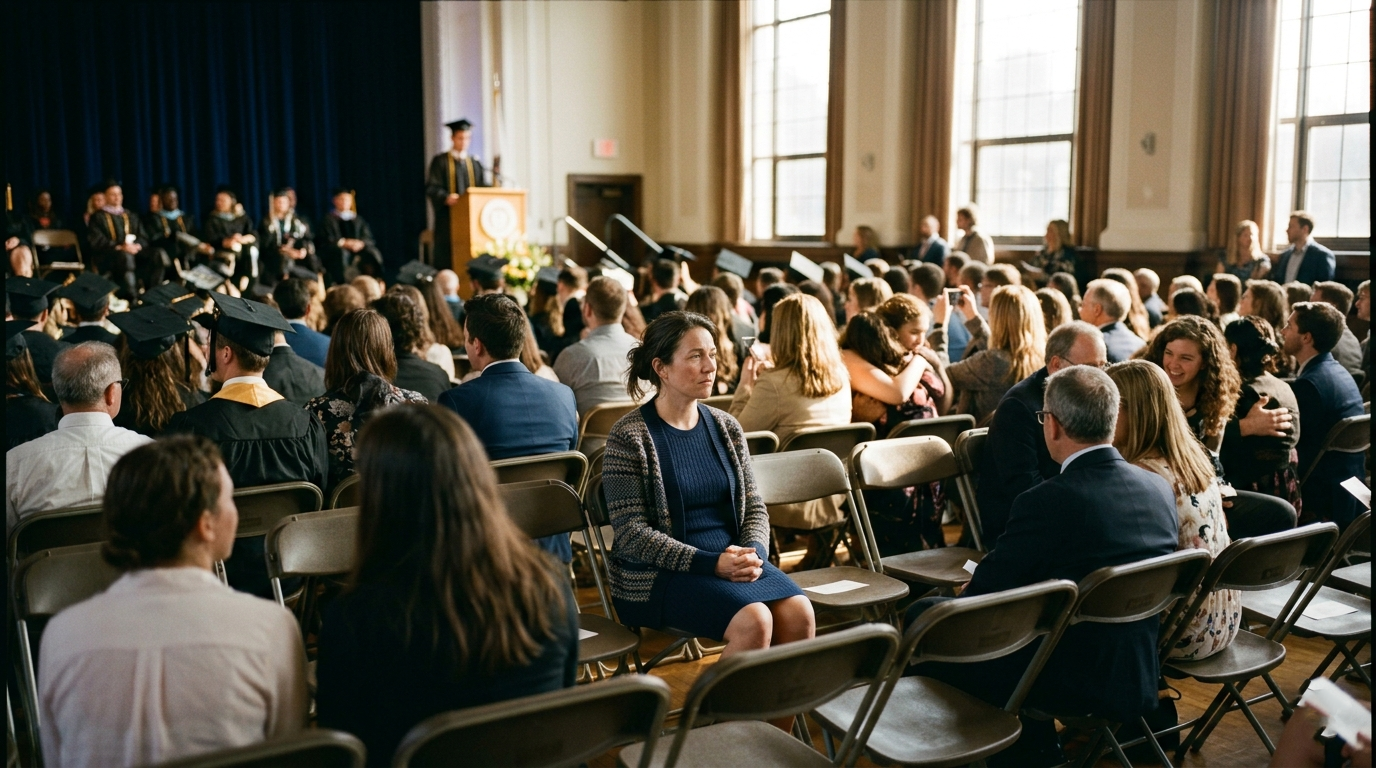
I sat in the third row in a yellow folding chair with a paper program in my hands and watched my brother walk across that stage in his cap and gown and accept his doctorate. I cried before they even called his name. I couldn’t help it. Eleven years of monthly transfers and packed lunches and a car with a cracked dashboard, and here he was — Dr. Derek Hollis — and it felt like something I had built with my own hands, which I know is not a fair or accurate thing to feel, but I felt it anyway.
Then came the speech.
The department selected three graduates to speak. Derek was one of them. He walked to the podium, adjusted the microphone, and smiled out at the auditorium the way he always had — easy, bright, completely at home in any room he entered. He thanked his advisor. He thanked his research team by name, all seven of them. He thanked his girlfriend, Maya, for her patience and her love. He thanked my mother for her prayers and her jerk chicken, which got a warm laugh. He quoted a poet I didn’t recognize. He talked about the responsibility of knowledge and the obligation of those given opportunity to reach back for the ones still climbing. He was eloquent and funny and generous.
Then he said, “Thank you,” and stepped away from the podium.
I sat very still in my yellow folding chair and stared at the program in my hands.
My name was not in that speech. Not once. Not a single word.
I kept thinking: maybe I misheard. Maybe there was a moment I’d missed — a blink, a shifted program, a second when the auditorium noise swallowed my name whole. But I hadn’t misheard. I had been listening the way you listen when you know something is meant for you.
At the reception afterward, Derek hugged me and said I looked great and introduced me to his advisor and accepted my gas-station card with a smile and set it on the table with the others. He was surrounded. He was beaming. He was everything I had spent eleven years helping him become. And I smiled and said the right things and ate a little triangle sandwich and congratulated him twice and drove back to the Holiday Inn at six-thirty because I couldn’t think of a single other thing to do with my face.
* * *
I sat on the edge of the hotel bed in my graduation-attendance dress and my low heels and I did not cry. I had expected to cry. I had spent the drive back rehearsing what I would do with the feeling — breathe through it, call a friend, give him the benefit of the doubt, remember that he was overwhelmed and nervous and it wasn’t personal.
But sitting there on that stiff hotel bedspread, I didn’t feel hurt, exactly. I felt something quieter and more clarifying than hurt. I felt, for the first time in a very long time, like I could see myself clearly — the shape of the life I had built and the shape of the life I had not built and the distance between them, measured in eleven years of someone else’s tuition payments.
I opened my laptop. Not to write to Derek. Not to process anything out loud. I opened it because I had been meaning to do something for three years and had always found a reason to wait.
I went to the admissions page for the University of Memphis online program. Business administration. I had started looking at it when I was twenty-nine, then put it aside because Derek’s rent had gone up that semester. I had looked again at thirty-two and closed the tab when his research stipend fell through and he needed a bridge.
I filled out the application. Every field. It took forty minutes. At the end it asked for a personal statement — just two hundred words about why I wanted to pursue this degree and what I hoped to do with it.
I wrote: I am thirty-four years old and I am choosing myself. That is the whole statement. That is all I have.
I submitted it. Then I closed my laptop, ordered room service for the first time in my adult life, and watched a movie I’d been meaning to watch for two years. I fell asleep before it ended and slept better than I had in months.
* * *
Derek called nine days later. I had not reached out. I don’t know exactly what prompted it — a mutual cousin, maybe, or my mother, or just the slow arrival of his own conscience. His voice on the phone was different from usual. Smaller.
“Renee,” he said. “I’ve been thinking about the speech.”
“Okay,” I said.
“I don’t have an excuse.” A pause. “I practiced it forty times and every time I meant to include you and every time I got up there and the lights were on me and I just — I choked. I went on autopilot and I said the thing I’d rehearsed and you weren’t in the rehearsed version because I kept thinking I’d add you at the end and I didn’t.” Another pause, longer. “That’s not an excuse. That’s an explanation. And I know they’re not the same thing.”
I was quiet for a moment.
“No,” I said. “They’re not.”
“I’m sorry, Renee.” His voice broke cleanly on the last word. “I don’t think I understood — I mean, I knew what you gave up in money. I didn’t let myself understand what else you gave up. Because if I understood it, I’d have to sit with what it means that I stood at that podium and didn’t say your name. And that’s—” He stopped. “That’s hard to sit with.”
“Yes,” I said. “It is.”
I didn’t tell him I forgave him. Not yet. Because I did — I do — but forgiveness felt like something that needed to arrive in its own time, not on demand, not to make the phone call easier for either of us. What I told him instead was what I had done in that Holiday Inn room. I told him about the application. I told him about the two-hundred-word personal statement.
He was quiet for a long time.
“Renee,” he finally said, and his voice was thick with something I hadn’t heard in it before — not guilt, exactly, but its more useful cousin. Reckoning. “I will do for you what you did for me. Whatever it costs, whatever it takes. I mean that.”
“I know you do,” I said. “But I’m going to do this one myself.”
* * *
I was accepted to the University of Memphis three weeks later. I start in the fall. I am thirty-four years old and I have never in my life been so terrified of anything or so completely certain that I am doing the right thing.
Derek and I talk every Sunday now. It is different from before — more honest, more careful, like two people who have agreed to stop pretending certain things are smaller than they are. He is going to be a brilliant scientist. He already is. He is also going to spend the rest of his life understanding, more and more clearly, what his sister’s name was worth — and the weight of what it cost her to give it so willingly for so long.
I don’t regret paying for his education. Not a single month of it. What I regret is telling myself that building someone else’s future was the same thing as building my own. It isn’t. It never was. Love is not a substitution for a life. Sacrifice is not the same as purpose.
I learned that in a Holiday Inn in Knoxville, Tennessee, sitting in a graduation dress on a stiff bedspread, finally — finally — putting my own name at the top of the list.
-END-