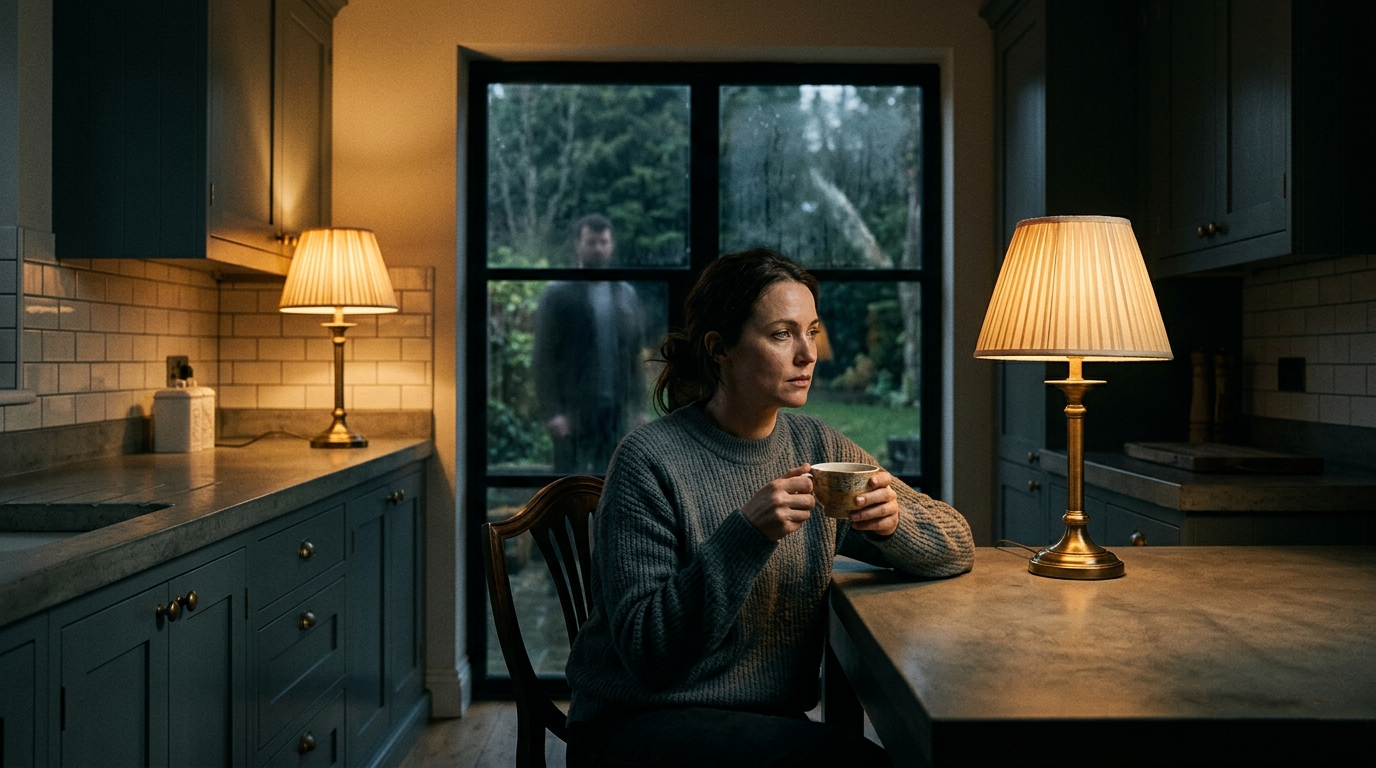
The Quiet Husband !
Chapter 1 — The Perfect Man
I met Daniel Mercer on a Tuesday in October, at a coffee shop in Austin, Texas. He held the door open for a woman with a stroller, picked up a stranger’s dropped keys without being asked, and smiled at me like I was the only person in the room.
I was thirty-one, freshly out of a relationship with a man who yelled so loudly the neighbors had called the police twice. So when Daniel sat down, stirred his coffee without a sound, and asked me genuine questions about my life — not to impress me, just to know me — I thought: This is what safe feels like.
We were married eighteen months later in a small ceremony in the Texas Hill Country. Wildflowers. String lights. His vows made three grown men cry.
The first years were good. Beautiful, even. We built a life in a craftsman house in South Austin. I taught third grade. He ran a small financial consulting firm from a home office down the hall. We had a rescue dog named Biscuit, a vegetable garden neither of us was very good at, and Friday nights with takeout and old movies.
We were happy. Or at least — I was.
Chapter 2 — The Cracks
It started small. The way it always does.
Year three: I mentioned I wanted to visit my college roommate in Chicago for a long weekend. Daniel didn’t say no. He never said no. He just got very quiet, set down his fork, and looked at me with those calm gray eyes until I heard myself say, “Actually, it’s probably not a great time anyway.”
I thought I had changed my own mind.
Year five: I was offered a department head position at a new school. More money, more responsibility, a real step forward. I brought it up at dinner, excited, nervous. Daniel listened to everything. Then he said, very softly, “I just worry about your stress levels, sweetheart. You know how you get.” He reached across the table and squeezed my hand.
I turned down the job the next morning.
Year seven: I realized I had not seen my mother alone — without Daniel present — in over two years.
But every time a flicker of unease rose in my chest, I would look at him — patient, gentle, steady Daniel — and think: What kind of wife suspects a man like this?
A smarter one, it turns out.
Chapter 3 — The Box
It was a Wednesday night in March. Daniel was at a client dinner. I went into his office to borrow the stapler — something I rarely did, because Daniel kept his office immaculate and I always felt vaguely like a guest in there.
Biscuit followed me in, sniffed around, and began scratching at the corner of the rug near the window. I pulled the rug back to stop him.
That’s when I saw it. A seam in the floorboard. Clean, deliberate. A small brass latch, nearly flush with the wood.
My hands were shaking before I even opened it.
Inside the box were three things:
A leather journal. A prepaid cell phone, old, cracked at the corner. And a manila envelope with my name on it — written in Daniel’s handwriting — sealed with a strip of tape.
I sat on the floor of his office for a long time before I opened anything.
The journal came first. Page after page, in his small, precise handwriting — notes. About me. About what I said, what I did, what I responded to. Triggers and outcomes, written like a scientist’s log. Reacted well to reassurance after the Chicago trip. Withdraw affection two days prior to large decisions — produces compliance.
I read that line four times.
Produces compliance.
The phone had texts. Another woman — no, two. Not romantic. Stranger than that. He was coaching them. Word for word. How to speak to their husbands. How to soften resistance. How to use silence as leverage. He called himself their “advisor.” They called him a lifeline.
Then I opened the envelope with my name on it.
It was a letter. Dated six months ago.
If you’re reading this, you found it before I was ready. I want you to know I love you more than you will ever understand. Everything I did was to keep you. Some people need tending to. You are one of them. I know you better than you know yourself, and that is not a curse — it is devotion.
I put the letter down on the floor.
I sat there in the quiet of his perfect office, in our perfect house, and I understood — fully, finally, completely — that the quietest prison has no bars.
Chapter 4 — The Way Out
I didn’t confront him that night. I put everything back exactly as I found it, replaced the rug, and was sitting at the kitchen table with a cup of tea when I heard his car in the driveway.
He kissed my cheek. Asked how my evening was. I said, “Quiet.” And I smiled.
Over the next three weeks, I did everything he had taught me — without him knowing I was doing it. I was calm. I was present. I gave nothing away.
I also called my sister for the first time in eight months. I called the department head who had offered me the job — she had filled the position, but she remembered me, and there would be others. I called a lawyer. I called a therapist who specialized in coercive control, a term I had Googled at the school library on a desktop computer, not my phone.
Daniel never suspected. Because he believed his own story about me — that I was someone who needed tending to. That I couldn’t see what he could see. That I was, in his careful estimation, manageable.
He underestimated the woman he had spent eleven years trying to shrink.
On a Saturday morning in April, while he was in the garden, I left. I took Biscuit, a single suitcase, and a folder of documents my lawyer had told me to gather quietly over the weeks prior.
I did not leave a note.
He had taught me well: sometimes, silence is the most powerful thing you can offer someone.
Epilogue — Two Years Later
I have the department head job now. Different school, better fit. My classroom is loud and joyful and occasionally completely chaotic, and I love every minute of it.
I talk to my mother every Sunday. I visited my college roommate in Chicago last spring — twice.
Biscuit sleeps at the foot of my bed in a small apartment that is entirely, wonderfully mine. No hidden compartments. No journals. No letters addressed to me that I didn’t ask for.
I still think about Daniel sometimes. Not with anger — that burned through cleanly, like a fever. With a kind of quiet understanding. He was a man so afraid of being left that he built a cage and called it love.
The saddest part isn’t what he did to me. It’s that he genuinely believed it was devotion.
People always ask me: what was the sign? What should I have looked for?
And I tell them the same thing every time:
It wasn’t what he did. It was what he never had to do. He never yelled. He never threatened. He never needed to.
Because he never raised his voice — he raised the stakes, slowly and silently, until I forgot what my own sounded like.
If any part of this story felt familiar — trust that feeling. It is not paranoia. It is not ingratitude.
It is your voice, trying to come back.
-END-