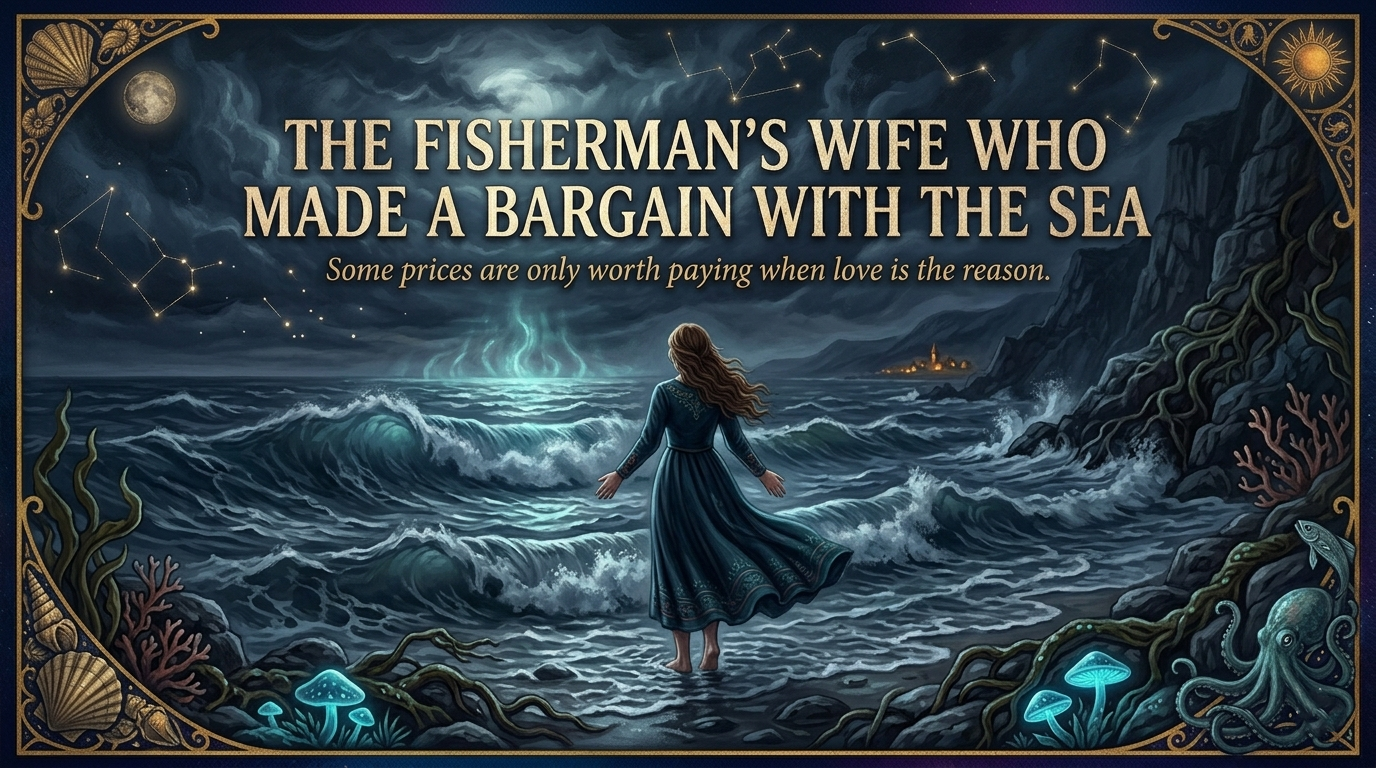
The Fisherman’s Wife Who Made a Bargain with the Sea !
Part One: The Man the Sea Kept
In the village of Cray’s End, where the cliffs dropped straight into the Atlantic and the wind never fully stopped, the sea took men the way it took everything — without explanation, without apology, without giving anything back.
Except once.
Mira Voss had been married to Elian for eleven years when his boat did not return. It was an October storm, the kind the old fishermen called a widow-maker, and three boats went out and only two came back, and the one that did not was the Lark, which was Elian’s, which was painted blue because Mira had painted it blue herself the spring they were married, standing barefoot in the wet sand with a brush in her hand and salt in her hair and her whole life still ahead of her.
She waited three days, as was the custom. The village waited with her — brought bread, brought soup, brought the careful quiet that people bring when they do not know what else to offer. On the fourth day the village said what villages always say: he is gone, he is not coming back, you must begin to grieve.
Mira said nothing.
On the fourth night she went to the water.
Part Two: The Bargain
She went alone, in the dark, to the flat rocks below the cliff where the tide came in at midnight and the water turned the color of iron. She had no offering, no spell, no priest’s words. She had only the thing she carried inside her chest — a love so old and so ordinary and so completely hers that it had no drama to it, no poetry, just the daily weight of someone who had become necessary to your breathing.
She stood at the edge of the water and she said, out loud, to the sea:
“Give him back.”
The sea said nothing. The sea never speaks in words. But something shifted — a stillness inside the roar, a pause between waves that lasted one breath too long — and Mira felt, in the way that you feel certain things in the dark when all the daylight certainties have been stripped away, that she was being listened to.
“I know you keep things,” she said. “I know you don’t give them back for nothing. So tell me what you want.”
The pause again. Longer this time.
And then the tide came in — not crashing, not violent, but slow and deliberate, curling around her bare feet like a hand taking hers — and she understood. Not in words. In the way the sea communicates, which is in the body, in the bones, in the place below language where old knowledge lives.
The price was this: one year of her voice.
Not her throat — she could hum, could whisper, could make sound. Just her words. Her sentences. The ability to say the things she meant in the way she meant them. For one year she would not be able to speak anything true. Every sentence that left her mouth would arrive wrong — hollow, sideways, missing the thing she was trying to say. She could not tell Elian she loved him. She could not explain what she had done. She could not, for twelve months, reach him with language at all.
She stood in the cold water and she thought about it for exactly as long as it took a wave to come in and go out.
Then she said: “Yes.”
Part Three: What Came Back
Elian washed ashore at dawn.
He was alive — barely, then more so, then fully, in the way that life reasserts itself when given the chance. The village called it a miracle. The priest called it God’s mercy. The old fishermen nodded and said the sea sometimes changed its mind.
Mira said nothing. She couldn’t — or rather, she could say things, but they arrived wrong. “I missed you” came out as “the house was cold.” “I thought you were gone forever” came out as “the soup needs salt.” She watched his face as she spoke and saw the small puzzlement cross it, the slight distance, and she smiled through it because she had known the price and she had paid it willingly.
The year was hard in ways she had not fully imagined.
Elian was a man who loved words — who told stories at the dinner table, who quoted old songs when he was happy, who communicated love through language as much as through touch. And Mira could not meet him there. She watched him sometimes reach for her in conversation and find nothing to hold onto, and she would squeeze his hand and he would look at her with that slight puzzlement and she would think: eleven more months. Nine more months. Six.
She learned other languages. She learned the language of presence — of being in the same room, of sitting beside him while he mended nets without needing to fill the quiet. She learned the language of gesture — a cup of tea placed just so, a coat held open, a hand on the back of the neck. She learned, slowly and against her nature, that love spoken is only one kind of love, and not always the deepest kind.
Elian noticed. He didn’t understand it — but he noticed.
“You’ve gone quiet,” he said to her, one evening in April.
She looked at him. She tried to say: I am right here. I never went anywhere. I went to the water for you and I would do it again. What came out was: “The garden needs weeding.”
He looked at her for a long moment. Then he took her hand.
“Okay,” he said. Quietly. “Okay.”
Part Four: The Year’s End
On the last night of October — one year exactly from the night she had gone to the water — Mira went back to the flat rocks below the cliff.
The tide was coming in. The water was the color of iron, just as it had been.
She stood at the edge and she waited.
The sea took its time. It always does. And then that stillness came — that pause between waves — and she felt the thing in her chest loosen, the way a knot loosens when the right pressure is applied, and she opened her mouth.
“Thank you,” she said.
The words arrived whole. True. Exactly what she meant.
She stood there for a while longer, her feet wet, the wind pulling her hair, and she looked at the water — at the enormous, indifferent, ancient water that had taken her husband and given him back and taken her words and given them back — and she felt something she had not expected to feel.
Gratitude. Not the grateful relief of a debt paid, but something older. Something closer to understanding.
The sea had not been cruel. The sea had simply been the sea — which takes and returns according to laws older than any of us, without malice, without preference, without the comfort of explaining itself. And she had bargained with it not from power but from love, and it had honored that, and she had survived the cost, and here she was.
Still standing.
Still whole.
Part Five: What She Told Him
She went home to Elian.
He was still awake — he always waited up, even after a year, even when she gave him no explanation for her nighttime walks. He looked up when she came in, and she stood in the doorway with salt on her feet and her voice fully her own, and she said:
“I need to tell you something.”
And she told him everything.
He listened without interrupting, the way he listened to her when she spoke about things that mattered. When she finished there was a long silence — the good kind, the kind that means something is being held and turned over and looked at carefully.
Then he said: “The night I washed up. I thought I dreamed a voice. Telling the water to let me go.”
Mira looked at him.
“Was that you?” he asked.
“Yes,” she said.
He was quiet again. Then: “What did it cost?”
She told him.
He looked at his hands for a moment. Then he looked at her — really looked, the way you look at someone when you suddenly see them more clearly than you did before, when the familiar face opens into something larger and older and more extraordinary than ordinary days allow.
“All that time,” he said. “You couldn’t say it. But you were saying it.”
“Yes,” she said.
He held out his hand.
She took it.
Outside, the sea went on as it always had — taking, returning, keeping its own counsel, running its ancient business of loss and restoration along every shore in the world. It did not acknowledge them. It did not need to.
But when the wind came through the window that night, it smelled of salt and something almost warm.
And Mira, falling asleep with her husband’s hand in hers, thought: that is as close to a blessing as the sea knows how to give.
She accepted it.
— The End —
Epilogue
They still talk about Mira Voss in Cray’s End.
Some say she was mad with grief and simply got lucky. Some say the sea cannot bargain, that it is water and salt and nothing more. Some say she made a deal with something older than any name they have for it, and that the proof is in the way she and Elian grew old together — quietly, steadily, with the particular tenderness of people who have learned not to take words for granted.
What her grandchildren remember is this: she always paused before she spoke. Just a breath. Just long enough to be sure she meant it.
The sea teaches that, if nothing else.
The weight of words.
The cost of love.
The strange mercy of losing something and learning, through the losing, exactly how much it was worth.