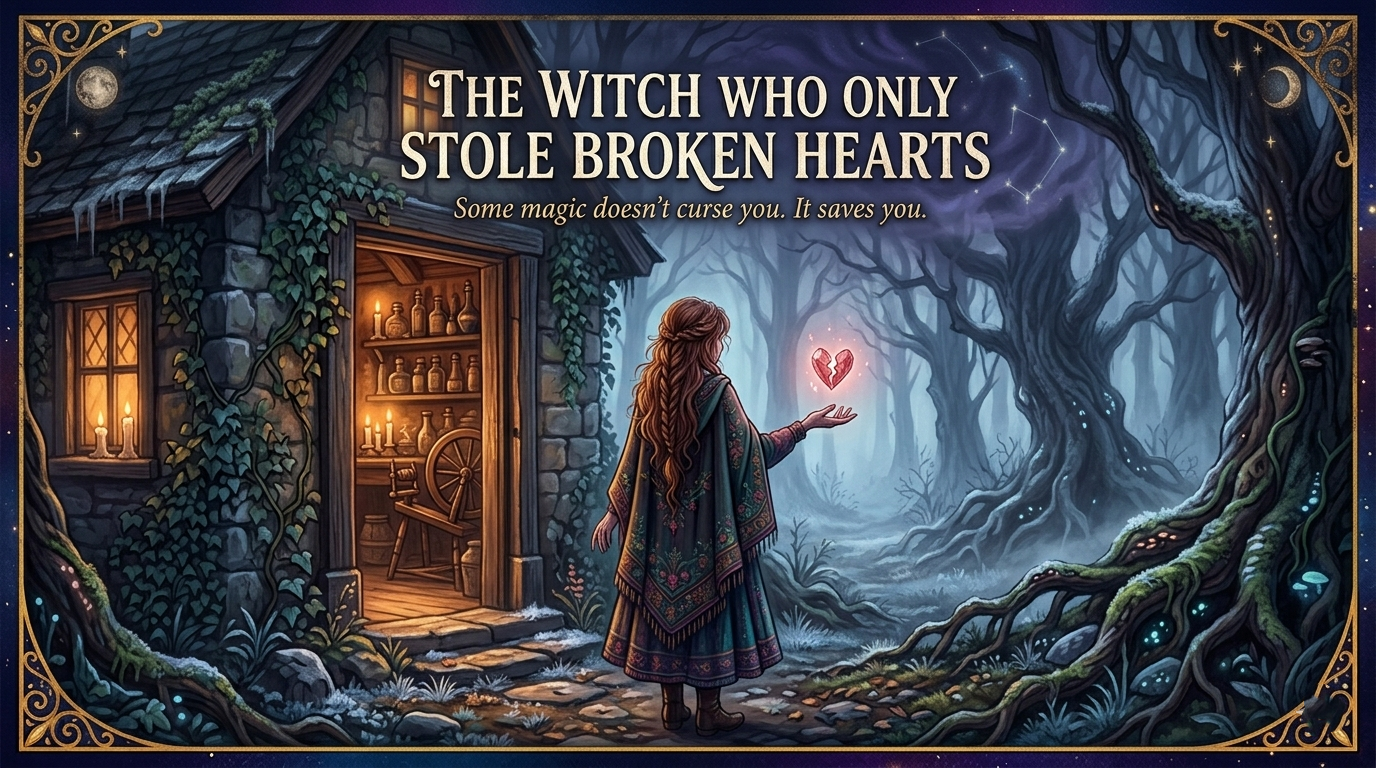
The Witch Who Only Stole Broken Hearts !
Part One: The Witch at the Edge of Town
Everyone in the village of Maren’s Hollow knew about the witch.
She lived at the edge of the Ashwood Forest in a house that was neither large nor small, neither old nor new — a house that seemed to exist in the space between things, the way grief does. Her name was Maren herself, though no one remembered who had named the village after her, or whether the village had come first or the witch had. These things get tangled over time.
She was not the kind of witch who cursed crops or soured milk. She did not ride the sky on moonless nights or turn princes into beasts for sport. She was quiet and dark-eyed and she made excellent tea, and the only thing she ever took from anyone was this: a broken heart.
Not the whole heart. Just the broken part.
She would hold it in her palm — it looked different for everyone, she once told a traveling merchant who asked. For some it was a splinter of black glass. For some a crumpled piece of paper with words on it too faded to read. For some just a gray stone, smooth and cold, that had no business being inside a living chest.
She would take it. She would put it in the iron box she kept on her mantle. And then she would send you home.
The village called her a blessing. The priests called her a danger. The children called her the Heart-Taker and dared each other to knock on her door, though no one ever did.
Until Petra.
Part Two: The Girl With Too Much Left to Carry
Petra was seventeen and had been carrying her broken heart for two years — since the morning she woke to find her mother gone. Not dead. Gone. A note on the table that said I am sorry I am not made for staying and nothing else.
Two years. She had tried everything the village healers suggested. Time, they said. Busyness. Prayer. New friendships. A change of air. She had tried all of it and the broken piece sat in her chest like a swallowed stone, heavy and immovable, and some mornings she had to hold the bedpost just to stand up under its weight.
So she went to the witch.
The witch answered the door before Petra knocked. She looked at her the way you look at someone you have been expecting, and stepped aside without a word.
The house smelled of woodsmoke and dried herbs and something else — something warm and faintly sweet, like fruit ripening. Every surface held candles. The iron box on the mantle was large and very old and sealed with three different locks, and it hummed faintly, the way a beehive hums, with a sound that was not quite sound.
“Sit,” said Maren.
Petra sat.
“Tell me what broke it,” said Maren.
Petra told her. All of it. The note. The empty chair at dinner. The way she still, after two years, turned to say something to her mother in the kitchen before she remembered. The way missing someone who is still alive is a stranger kind of grief than missing someone who is gone — because you cannot mourn cleanly, cannot close the door, because somewhere out there the person exists and has simply chosen a life that does not contain you.
The witch listened. She did not flinch. She did not offer comfort or correction or the careful re-framings that other adults offered when the story became too raw.
When Petra finished, the witch held out her open palm.
“Give it to me,” she said.
Petra pressed her hand to her chest. She felt it — the splinter of black glass, just as the merchant had described, sitting just below her sternum where it had lived for two years.
She hesitated.
“What happens to it?” she asked. “After you take it. What do you do with it?”
The witch glanced at the iron box. “I keep it safe,” she said. “Until it is ready.”
“Ready for what?”
The witch looked at her with those dark, patient eyes. “To go back.”
Part Three: The Box
Petra left the witch’s house lighter than she had felt in two years. Not happy — happiness was a different country, still far off — but lighter. The stone-weight was gone. She could breathe without calculation. She walked home through the Ashwood and noticed, perhaps for the first time, that the trees were beautiful.
She told no one where she had been.
But others had been before her. She started to see it, once she knew to look — the particular lightness that settled over people in the weeks after a visit to Maren’s house. Old Connell, who had lost his son in the river three winters back. Young Bess, who had loved a man who left without farewell. The blacksmith, who never spoke of his first family and now, suddenly, had stopped flinching when children laughed in the street.
The witch was busy. The village was, it turned out, full of broken hearts.
What Petra could not stop thinking about was the box.
She went back in autumn, on the pretense of returning a borrowed bowl — she had not borrowed a bowl, but the witch accepted the fiction graciously and made tea.
“The box,” Petra said, when they were seated. “You said the pieces go back. To the people they came from?”
“Eventually,” said Maren.
“How do you know when they’re ready?”
The witch considered her for a long moment. Then she rose and crossed to the mantle and put her hand on the iron box, and the humming grew slightly louder.
“A broken heart,” she said, “is just a heart that has not yet finished its work. The break is not the end of it. It is the middle.” She tapped the box lightly, once. “In here, the pieces rest. They do not have to do anything. They do not have to be brave or grateful or healed on anyone else’s schedule. They simply… wait. And while they wait, they change. The sharp edges round. The cold places warm.” She looked at Petra steadily. “And when the piece is ready — when it has become something the chest that carried it can bear again — I take it back.”
Petra thought about this.
“Does it hurt?” she asked. “Getting it back?”
“Yes,” said the witch, without hesitation.
“Then why would anyone want it?”
Maren sat back down and wrapped her hands around her cup and looked at Petra the way you look at someone standing at the edge of understanding something true.
“Because,” she said, “a heart without its broken parts is not a whole heart. It is a careful heart. A protected heart.” She paused. “It will never break again. But it will also never — quite — open.”
Part Four: The Return
Winter came. Petra turned eighteen.
On the first morning of the new year she woke to a knock at her door.
The witch stood on the threshold in the grey dawn with frost in her hair and her palm held out. In it, no longer glass — a small, smooth piece of something warm. Rose-colored. Pulsing faintly, like an ember, like a held breath.
Petra looked at it for a long time.
She thought about all the things she had been able to do this year without the stone weight in her chest. How she had laughed — genuinely, all the way through — for the first time in years. How she had made new friends without flinching. How she had walked into her mother’s empty room and sat on the bed and felt sad without being destroyed by it.
She thought about the witch’s words. A careful heart. A protected heart.
She thought: I have been careful long enough.
She took it back.
It did hurt. Like pressing a piece of a puzzle into a place that had forgotten its own shape. A sharp, bright, absolutely real pain — and then warmth, spreading through her chest like the first morning of spring, like something relearning how to be alive.
She breathed.
Her mother had not come back. That had not changed. That would perhaps never change.
But standing in her doorway in the new year’s dawn, with her whole heart present and accounted for — broken piece and all — Petra felt, for the first time, that she could carry it. That the weight was not a wound. That she had, without quite knowing when, become someone strong enough to hold her own grief without being held down by it.
She looked at Maren.
“Thank you,” she said.
The witch nodded once, the way people nod when something has gone as it should, and turned and walked back through the frost toward the edge of the Ashwood, and the village, and the box, and all the other pieces waiting to become something that could be carried home.
Epilogue
They still tell the story in Maren’s Hollow.
Some say the witch is still there. Some say the house is empty now, but the iron box remains on the mantle, still locked, still humming — waiting for someone who knows where to look.
What everyone agrees on is this: she never took anything that did not need rest. She never kept anything that was ready to return. And every person who came to her door carrying something too heavy to hold alone left a little lighter — not because the grief was gone, but because someone had agreed to hold it for a while.
That, perhaps, is the oldest magic of all.
Not the stealing.
The keeping safe.
The knowing when to give it back.
— The End —