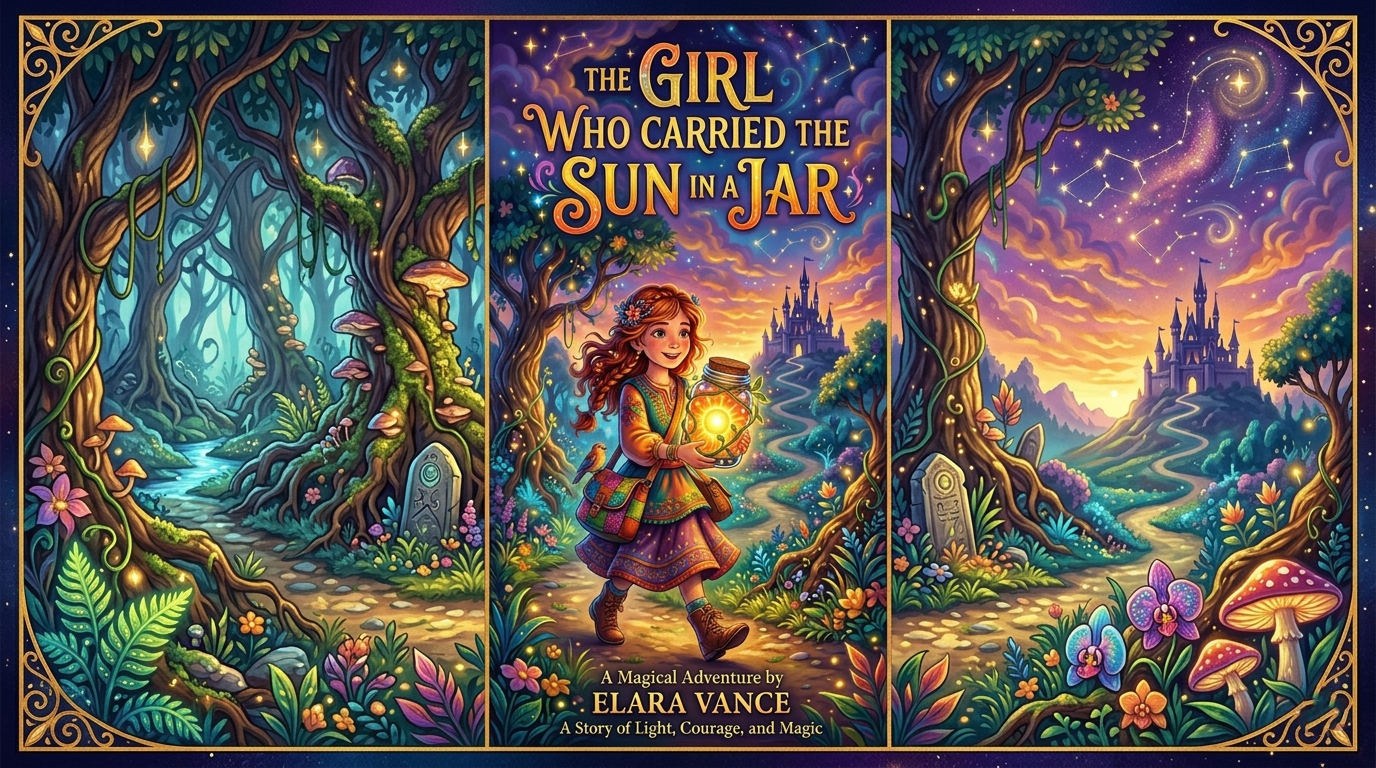
✨ The Girl Who Carried the Sun in a Jar !
Part One: The World Without Warmth
Once upon a time, in a kingdom called Valdenmoor, winter had lasted eleven years.
Nobody remembered how it began. Some said a sorcerer had cursed the sky the night the old king died. Some said the sun had simply grown tired of the world and turned its face away. The priests said it was punishment. The farmers said it was ruin. The children, who had been born into the cold and knew nothing else, said nothing at all — because to them, this was simply how the world was.
The snow had buried the wheat fields. The rivers had turned to glass. The orchards stood in rows of black skeleton trees, their branches reaching upward like the fingers of people begging for something they could not name. Every spring the kingdom waited for a thaw that never came. Every summer the sky stayed the color of old pewter. Every autumn there was nothing to harvest because nothing had grown.
The people survived on dried stores and pale root vegetables and a kind of thin grey bread that tasted of nothing. They wore all their clothes at once. They slept beside their animals for warmth. They told stories at night by candlelight to remind themselves that color had once existed — that things had once been red and gold and green, that there had once been a season when you could walk outside without your breath turning to fog.
The king sent his finest knights to find the cause of the endless winter. None returned.
He sent his wizards to the four corners of the kingdom to cast searching spells. They found nothing.
He sent his astronomers to study the sky. They reported that the sun was still there — still burning, still present — but that something stood between it and the earth. Something enormous. Something that had no name in any book they owned.
The darkness, it seemed, was not a curse.
The sun, it seemed, was simply dying.
Part Two: The Miller’s Daughter
At the edge of Valdenmoor, where the frozen forest met the frozen plain, there lived a miller named Oskar and his daughter, whose name was Sable.
Sable was sixteen and slight, with dark eyes and dark hair and the kind of quietness that people mistake for shyness until they get to know her well enough to understand that it was something else entirely — a habit of watching, of storing things up, of waiting until she was certain before she spoke. She had her mother’s hands: small, capable, always in motion.
Her mother had died three years into the eternal winter, of a cold that settled into her chest and would not leave. Before she died she had pressed a single object into Sable’s hands — a small clay jar, round and smooth, sealed at the top with a cork and a ring of copper wire. It was the color of river clay, ordinary in every way, with a faint warmth to it that had no explanation.
“Your grandmother made this jar,” her mother had whispered, “and her grandmother before her, and hers before that. It has been waiting in our family for a very long time for the right hands and the right moment. Keep it close. You will know when.”
“Know what?” Sable had asked.
But her mother had closed her eyes and did not answer.
Sable had worn the jar on a cord around her neck for three years. She didn’t know what it was for. She didn’t know what she was waiting for. She only knew that it stayed warm against her chest even on the coldest nights, and that somehow, holding it made her feel less afraid.
Part Three: The Glass Mountain
The Glass Mountain appeared one morning in the middle of November, on the eleventh anniversary of the winter’s beginning.
It had not been there the night before. Everyone in Valdenmoor agreed on this. One moment the northern horizon had been flat and white as always — and then, between one breath and the next, there it was. Enormous. Crystalline. Rising from the frozen plain like a shard of the sky itself, its facets catching what little grey light existed and throwing it back in cold blue and silver sparks.
And at its peak, visible on clear days through the thinnest of the clouds, something burned.
It was small from a distance. The size of a candle flame, perhaps, or a firefly. But in that world of grey and white and endless cold, it was the only warm-colored thing anyone had seen in eleven years. It pulsed with a slow, ancient rhythm, like a heartbeat, like breathing.
The king sent his remaining knights to climb it. The mountain’s glass surface was perfectly smooth — no purchase for a boot, no crack for a finger. Three knights broke their legs in the attempt. Two more made it halfway up before sliding back down, bleeding from the hands, unable to explain why they had kept trying for so long or why, afterward, they could not stop weeping.
The wizards declared it unclimbable.
The priests declared it sacred and forbade anyone from approaching.
The people of Valdenmoor went back to their grey bread and their cold and their stories of warmth, and tried not to look at the thing burning on the mountain’s peak, because looking at it made the cold feel worse somehow — more deliberate, more cruel.
Sable looked at it every day.
On the morning of the twelfth day after the mountain appeared, she woke before sunrise, put on every piece of clothing she owned, tucked the clay jar inside her coat against her chest, left a note for her father weighted down with a stone on the kitchen table, and walked north across the frozen plain toward the Glass Mountain.
The note said: I think I know when.
Part Four: The Climb
The mountain’s surface was, as the knights had reported, perfectly smooth. Glass in the truest sense — cold and clear and hard as winter itself, with the ground visible through it far below and the sky visible through it far above, so that climbing it felt like climbing through something that did not want to be climbed.
Sable’s boots slid on the first step. She caught herself on her hands, and her hands slid too, and she sat at the base of the mountain for a long time in the grey morning, thinking.
She thought about the jar.
She uncorked it.
She had never opened it before — had been afraid to, had felt that opening it before the right moment would ruin something she didn’t yet understand. But now, sitting at the foot of a glass mountain in the eleventh year of a dying sun, she uncorked it and held it open in her palm and waited.
Nothing came out. No light. No smoke. No magic. The jar appeared empty, or nearly so — only the faintest warmth rising from it, the way heat rises from stone that has been in the sun. A whisper of warmth. A memory of warmth.
She held the open jar against the mountain’s surface.
Where the warmth touched the glass, a small circle of surface softened — not melted, exactly, but changed. Dimpled, like a thumbprint in cold wax. Just enough for a fingerhold.
Sable pressed her finger into it. It held.
She made another, an arm’s reach higher.
And another.
She climbed the Glass Mountain the way her great-great-great-grandmother’s jar had perhaps always intended — one small handhold at a time, the clay warming in her grip, leaving behind her a trail of imperfections ascending the perfect surface of that impossible slope. Each dimple just large enough for fingers. Each one fading slowly after she had moved past it, the glass healing itself in her wake.
She could not go back.
She could only go up.
It took three days. She slept pressed against the glass with her arms hooked through the handholds she had made. She ate the bread she had brought in her pockets. She drank water melted from the glass surface with the jar’s warmth, catching it in her palm. She did not look down. She did not look at anything except the next handhold, and the next, and the one after that.
On the third day she pulled herself over the edge of the peak and lay flat on her back on the glass and looked up at the sky and breathed.
Above her, at the very tip of the mountain, sat a thing that was the size of a fist and the color of the sun.
Part Five: The Last Ember
It was a coal. That was the only word for it, though it was like no coal she had ever seen. It rested in a small hollow of glass as though the mountain had grown up around it specifically to hold it, and it burned with a slow, patient fire — not consuming itself the way ordinary fire does, but simply glowing, the way embers glow when the night is longest and the fire has burned down to its last living heart.
It was the last ember of the sun.
She understood this without being told. The way you understand things in dreams, in the deepest and truest kind — not with your mind but with something older and quieter. The sun was dying. This was what remained. This small, ancient, burning thing at the top of a glass mountain in the middle of a frozen kingdom in the middle of an endless winter.
She held the open jar above it.
She hesitated.
She was sixteen years old and cold to her bones and she had climbed for three days and her hands were bleeding and she was sitting at the top of a mountain that no one else had been able to climb, holding a jar her mother had given her and her mother before her, and she understood — the way you understand things at the top of mountains that you cannot understand at the bottom — that what she was about to do was not going to leave her the same.
She didn’t know what it would cost her.
She lowered the jar over the ember.
The light came into it slowly, the way dawn comes — not all at once but gradually, warmth spreading through the clay, the jar beginning to glow in her hands like a second heart, like a lantern, like a small and furious dawn. The ember rose from its glass cradle and settled into the jar and the jar sealed itself, the cork pressing back into place without her touching it, the copper wire winding closed.
The mountain shuddered.
Below her, spread in every direction as far as she could see, the frozen world of Valdenmoor lay still and grey and cold and waiting.
Sable stood up. She held the jar above her head with both hands.
And the jar opened.
Part Six: The Thaw
Not the cork — the jar itself. The clay split along lines she had never seen, blooming outward like a flower, and the light that came from it was not candle-light or fire-light or any kind of light that had a name.
It was morning-light. First-morning-light. The kind of light that existed before the world had words for anything.
It went out in all directions at once.
Below her, on the Glass Mountain’s surface, the ice began to weep. Small rivulets at first, then streams, then a sound like a thousand bells as the mountain changed from glass to water to mist, and Sable with it — she fell not downward but outward, carried on the light, borne on the warmth the way a seed is borne on the wind, and she was not afraid.
She landed in a field.
Not a frozen field. A field.
The snow was pulling back like a tide going out, and under it — improbably, impossibly, as though it had been waiting there this whole time with its hands folded — the earth was already green. Already flowering. As though spring had been coiled just below the surface for eleven years, patient as a held breath, waiting for exactly this.
The sky above Valdenmoor cracked open with gold.
The sun — the real sun, whole and enormous and blazing — poured through.
In the city, children who had never felt warmth on their faces turned them upward without knowing why, only knowing that something had arrived that they had been missing without a name for the missing.
In the orchards, the skeleton trees trembled.
By evening, the first blossoms had appeared.
Part Seven: What It Cost
Sable sat in the flowering field for a long time.
The jar was gone — dissolved with the mountain, with the light, with the eleven years of cold. She had known it would be. She had understood, at the top of the mountain, that some things cannot be given back once given, that some vessels exist only to carry something once and then let it go.
She held her hands in the new warmth and looked at her palms where the glass had cut them on the way up.
They had healed. More than healed — they were the same hands as before, but they remembered the mountain. They would always remember.
She was not the same girl who had left her father’s house three days ago. She knew this the way you know it when something enormous has passed through you and rearranged the furniture. Not broken. Not diminished. But changed, the way iron is changed by the forge — the same material, made into something that could bear more weight.
Her father found her before sunset, running across the greening plain with tears streaming down his face, and she stood up and let him hold her and smelled the warmth in his coat and felt the sun on the back of her neck and said nothing.
There was nothing to say that the sun wasn’t already saying.
Epilogue: What They Remember
They tell many versions of the story in Valdenmoor now.
Some say Sable was magic — the chosen one, born with a destiny already written. Some say the jar was enchanted by ancient forces beyond mortal understanding. Some say none of it happened exactly this way, that the details have grown in the retelling the way all things grow in good soil.
But the millers along the northern road will tell you this much, because they have told it to their children and their children’s children and it has never changed: a girl climbed a glass mountain alone in the eleventh year of the endless winter, carrying nothing but a clay jar and the patience to place one handhold at a time. She did not wait for a knight or a king or a prophecy. She did not wait to be chosen. She looked at the burning thing at the top of the impossible mountain and she thought, I think I know when, and she went.
The jar is gone, yes.
But on warm mornings in Valdenmoor, when the sun comes through the orchard in a particular slant of gold, the people stop what they are doing for a moment without knowing why.
They turn their faces toward it.
They close their eyes.
And for just a breath, they feel something that has no name — something that feels like being carried, like being held by warmth, like being someone’s most important thing.
That is Sable.
That is what she left behind when she let the light go.
And so the sun rose over Valdenmoor, and has risen every morning since,
and if the winter ever tries to return,
the people remember the girl with the jar
and they are not afraid.
— The End —