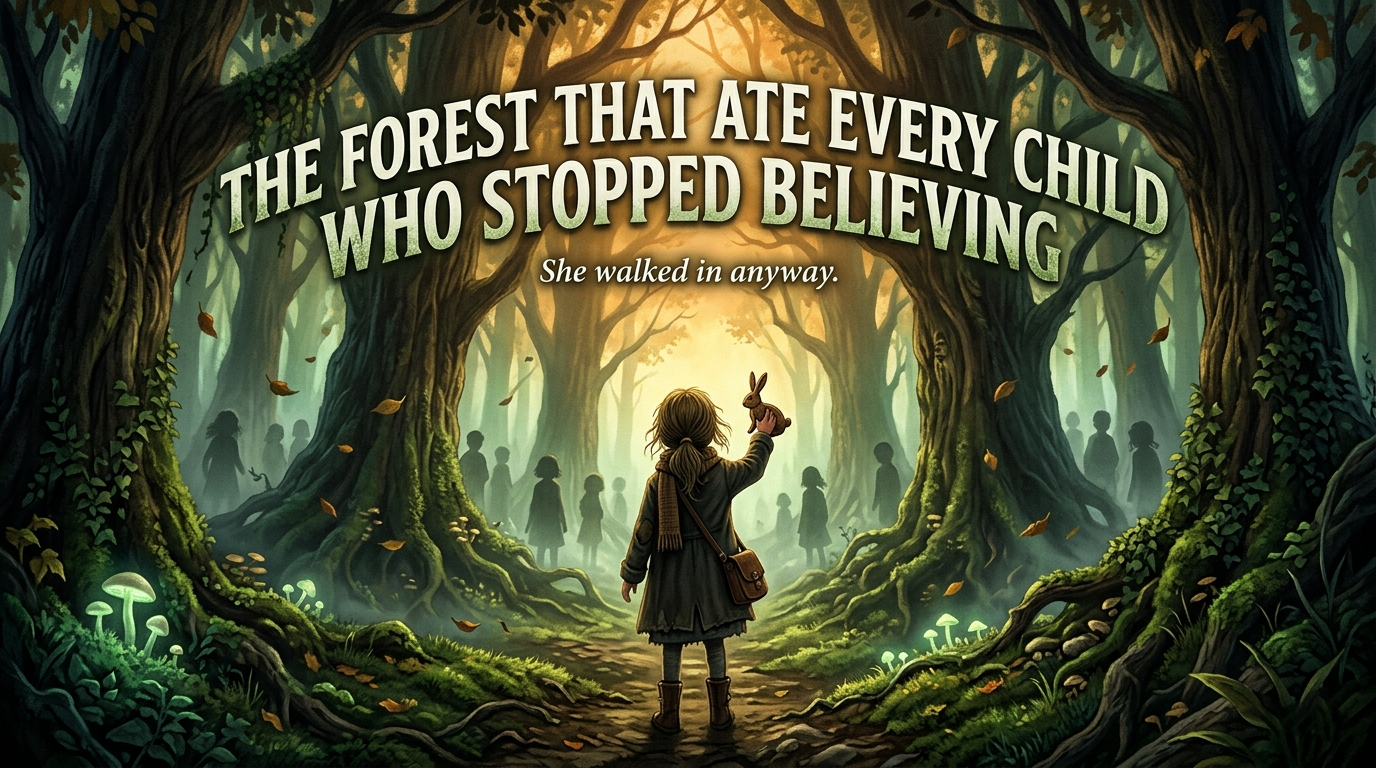
The Forest That Ate Every Child Who Stopped Believing !
Part One: The Rule Nobody Wrote Down
There were no signs at the edge of the Greywood. No fences, no warnings carved into stone, no official decree from the mayor’s office in the town of Hollow Creek. The rule that kept children safe was older than signs and fences. It was passed from parent to child the way all the most important things are passed — quietly, at bedtime, with the lights low and the voice careful.
Believe, the parents said. Keep believing. In small things and impossible things and the things that have no name. The moment you stop — the forest notices.
Nobody said what happened next, because nobody needed to. There had always been children who went missing near the Greywood. And there had always been, among those children, a particular kind — older ones, mostly, on the cusp of something, the ones who had begun to cross the invisible border between childhood and the long serious country of adulthood. The ones who had recently, quietly, decided that magic was for babies.
Those children were gone by morning.
The forest did not chase them. It did not reach out with roots or branches. It simply — opened. A path appeared where no path had been. And the child, drawn by something they could not name and would not have admitted to feeling, walked in.
And the path closed behind them.
And that was that.
Part Two: Theo
Nora was ten when her brother disappeared.
Theo was twelve, and he had been changing all year in the way that twelve-year-olds change — pulling away from stories, rolling his eyes at wonder, declaring things childish with the ferocious certainty of someone who is terrified of being caught still loving them. He had stopped drawing dragons in his notebooks. He had told Nora that her collection of carved wooden animals was babyish. He had sat at dinner last Tuesday and said, in the flat voice of someone trying on a new self like an ill-fitting coat: “None of those old stories are true. Magic isn’t real. The forest is just trees.”
Their mother had gone very still.
Their father had looked at his plate.
That night, Theo’s bed was empty.
The adults searched for three days. They called his name into the Greywood and heard nothing back but wind. The mayor organized search parties. The priest said prayers. The old women of Hollow Creek, who had seen this before, said nothing and made tea and waited for the grief to settle.
Nora did not grieve.
Nora planned.
Part Three: What She Brought
She spent a week preparing. She did not tell her parents, because they would have stopped her, and she understood — in the deep practical way that younger siblings understand things about the world — that they would have been wrong to do so.
She packed a bag. In it she put: a candle, three apples, a ball of red string, the carved wooden rabbit Theo had called babyish, and a letter she had written herself in her best handwriting that said, at the top: Things I still believe in, followed by a list so long it spilled onto the back of the page and then onto a second page and then a third.
She stood at the edge of the Greywood on a Tuesday morning when the autumn light was thin and gold and the trees stood dark and close and enormous.
She said, out loud, to the forest: “I know you have my brother. I’m coming in. And I’m not afraid of you, because I know what you eat and I know what I am, and I am not that.”
The forest said nothing.
She walked in anyway.
Part Four: Inside
The Greywood was not what she had expected, which was dark and frightening and monster-full. It was something much stranger than that.
It was beautiful.
Not pretty-beautiful, not postcard-beautiful — but the deep, strange, overwhelming beauty of a place that has never been made safe for human beings and does not particularly intend to start. The trees were older than the town. Their roots had buckled the earth into shapes that looked almost deliberate. The light that came through the canopy was green and gold and moved like water. Mushrooms the size of plates glowed faintly in the shadows. Birds she had no names for sat in branches and watched her with eyes like dark mirrors.
And between the trees — almost invisible unless you were looking, and Nora was looking — she could see them.
Children.
Dozens of them, standing very still among the roots and shadows, their eyes open, their faces peaceful in a way that was not quite sleep and not quite waking. Each one was wrapped loosely in something that looked like vines but moved like breath — gentle, rhythmic, unhurried. Not trapped. Not suffering.
Simply… held.
Waiting, she understood, for something.
She found Theo near the center of the wood, standing beside a tree so old it had a hollow in its trunk the size of a doorway. His eyes were open. He did not see her.
She stood in front of him and she held up the wooden rabbit — his old wooden rabbit, the one she had kept after he’d said it was babyish, because she had known even then that he hadn’t meant it.
“Theo,” she said. “Look.”
He did not look.
She opened her letter. She read it out loud, every word, standing in the green half-light of the ancient forest with the watched-by-birds silence all around her. Every impossible thing she believed in. Dragons and doorways and the way music sometimes feels like it’s from somewhere you haven’t been yet. The way certain books feel like they were written specifically for you. The way you can love someone so much it changes the shape of the air between you. The way the world, if you look at it right, is full of things that have no business being as beautiful as they are.
She read every word.
And on the last word, something shifted.
Part Five: The Forest’s Answer
It was not dramatic. The Greywood was not a dramatic place. It was ancient and patient and it did not deal in thunder and lightning.
What happened was this: the light changed. The green-gold canopy light deepened, warmed, became the color of late afternoon in October — the particular amber that makes everything it touches look like it is being seen for the first time. And in that light, one by one, the held children blinked.
Theo blinked.
He looked at Nora. He looked at the rabbit in her hands. Something moved across his face — not shame, not quite, but something adjacent to it, and something much larger than it, something that had no clean name but felt like the moment you stop pretending and remember who you actually are.
“Nora,” he said. His voice was rough, like a door that hadn’t been opened in a while.
“I know,” she said.
She held out the rabbit.
He took it. He held it the way you hold something you thought you’d given up the right to hold. Carefully. With both hands.
Around them, the other children were stirring — blinking, looking at their hands, looking at the trees, confused and unhurt and, one by one, beginning to find their way toward the light at the forest’s edge where the parents who had not stopped waiting were waiting still.
Nora took Theo’s hand.
She led him out.
Part Six: After
He did not go back to the way he had been before. That would not have been true, and the story does not deal in untrue things.
He was still twelve. He was still changing. He still had days when the long serious country of adulthood seemed more real to him than dragons and doorways. Growing up has its own gravity and it does not release anyone completely.
But he kept the rabbit on his desk.
And sometimes, on autumn evenings when the light went amber and the Greywood was a dark line on the far horizon, he and Nora would sit on the back porch together and he would say: tell me one, and she would tell him something she believed in — something small, something impossible, something with no proof but its own stubborn existence — and he would listen the way you listen when you know that listening is the thing that keeps the door open.
He never said the forest was just trees again.
Nora never asked him to say anything different.
That, perhaps, was its own kind of magic — the ordinary, daily, unglamorous kind that requires no ancient forests and no written rules. Just two people choosing, again and again, to leave the door between them open.
— The End —
Epilogue: What the Forest Kept
The Greywood still stands at the edge of Hollow Creek.
Parents still tell their children the rule at bedtime, with the lights low and the voice careful. And the children, being children, believe them — not from fear but from the particular wisdom of people who are still close enough to wonder to know that it is worth protecting.
They say, sometimes, that if you walk to the edge of the forest on a clear October morning and listen very carefully, you can hear something in the trees that sounds almost like breathing. Slow, deep, patient breathing — the breathing of something very old that is simply waiting.
Not to take.
Just to remind you.
That the world is larger than you think.
That the things you can’t explain are not the things to be afraid of.
That believing — in anything, in anyone, in the stubborn impossible beauty of being alive — is not weakness.
It is the only armor that has ever worked.