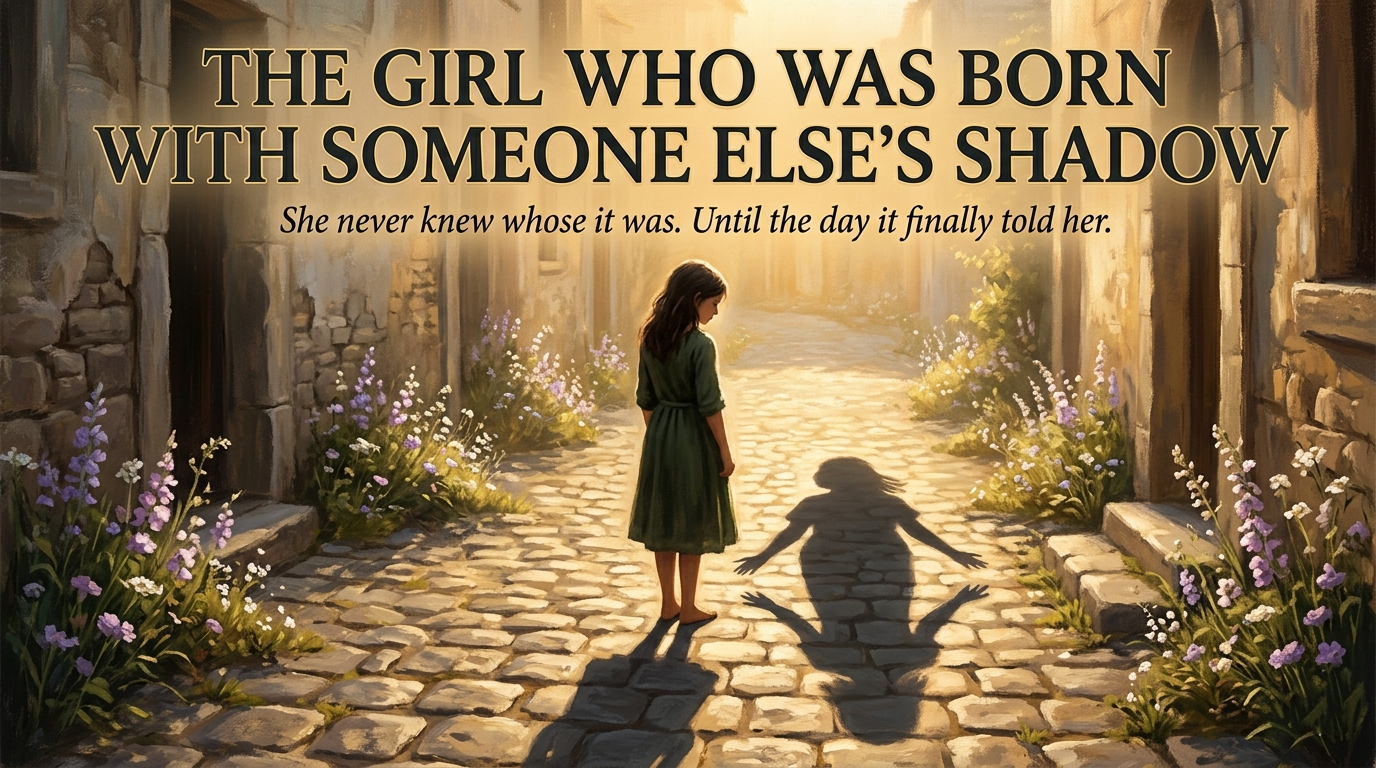
The Girl Who Was Born With Someone Else’s Shadow !
Part One: The Shadow That Didn’t Fit
On the night Lena was born, the midwife noticed it first.
She didn’t say anything — not then, not ever, to anyone except her sister, in a low voice, weeks later, over tea. She said: the baby was perfect in every way, except that when I held her up to the candle, the shadow on the wall was not hers.
It was close. A child’s shadow, roughly the right size, roughly the right shape. But the hands were longer. The head tilted at an angle Lena’s head was not tilting. And when the midwife moved the candle — slowly, carefully — Lena’s shadow moved with it, as a shadow should. But the other shadow stayed.
Then it turned its head. Just slightly. As if it was looking at the baby.
The midwife put the candle down and said nothing.
Lena’s parents noticed within the first week. They didn’t speak of it either, at first — did what parents do when a child is different in a way they don’t have words for, which is to love her twice as carefully and hope the thing takes care of itself.
It did not take care of itself.
Lena grew. Her shadow grew with her — her true shadow, the one that matched her shape, that stretched behind her in the morning sun and puddled at her feet at noon. But beside it, always, was the other one. The one that was not quite hers. The one that moved with a slight delay, or didn’t move at all, or moved in a direction Lena wasn’t going, as if it were looking at something she couldn’t see.
The village had opinions. Opinions, as they always do, varied.
Some said she was cursed. Some said she was blessed. Some said it was a trick of the light, and those people had clearly never stood in the same room as Lena at noon when the light was direct and flat and there was no explaining it away.
Lena herself did not find it frightening. This surprised people. She had grown up with it, which meant it was as normal to her as her own hands. She called the other shadow her quiet friend when she was small, and later, when she was old enough to understand that not everyone had one, she simply called it the shadow, in the same tone you use for a fact you have made peace with.
She did not know whose it was.
She did not know yet that it mattered.
Part Two: What the Shadow Knew
By the time Lena was eight, she had learned to read it.
Not in any mystical way — not visions, not voices. But the shadow had a language, small and subtle, the way weather has a language if you pay attention long enough. When it leaned left — not dramatically, just fractionally, the way a compass needle drifts — something was wrong in that direction. When it went very still, stiller than shadows go even in windless rooms, something required her full attention. When it stretched itself long and thin toward a door or a window or a path, something through that door or window or down that path was calling.
She learned to listen.
She found her neighbor’s lost cat twice. She pulled her little cousin back from a well the boy hadn’t seen. She sat beside an elderly man at the village market and talked with him for an hour — she didn’t know why until his daughter arrived crying and said he had wandered from home and no one could find him, and Lena realized the shadow had led her there.
She did not think of this as magic. She thought of it as paying attention in a language most people hadn’t learned.
Her mother watched all of this with the careful, unreadable expression of a woman holding two feelings at once — love and something that was not quite fear but lived in fear’s neighborhood.
“The shadow,” she said once, when Lena was nine. “Do you ever wonder whose it is?”
Lena thought about it seriously, the way she thought about most things.
“Yes,” she said. “But I think it will tell me when it’s ready.”
Her mother looked at her for a long moment.
“You sound very certain of that,” she said.
“I am,” said Lena. “It has never once led me somewhere that didn’t need me.”
Part Three: The Girl in the Mirror
When Lena was fourteen, she saw her.
She was walking home from the market through the narrow lane behind the tanner’s yard, the one with the high stone walls and the puddles that never quite dried, and she passed a section of wall that was wet and dark from the morning’s rain, smooth enough to reflect. She glanced at it as she passed — and stopped.
The shadow on the wall was not hers.
It was a girl. Roughly her height, roughly her age — or the age she had been at some point, because there was something about the figure that felt arrested, held, the way a photograph holds a moment that has since moved on. The shadow-girl was standing very still with her arms slightly away from her sides and her face — her shadow face, the shape of it, the suggestion of it — tilted up, as if looking at something above and ahead.
Lena stood very still.
“Who are you?” she said, out loud, to the wall.
The shadow did not answer in words. It never had. But it did something it had never done before — it reached out. A slow, deliberate movement, the shadow-hand extending toward where Lena’s hand was, closing the distance, and when the shadow-fingers touched the place on the wall where her own shadow-hand was, she felt it.
Not pain. Not cold. Something older than either.
Recognition.
The feeling you get when you find the word for something you have felt your whole life without being able to name it. The feeling of a key finding a lock that has been waiting without knowing what it was waiting for.
She pressed her hand flat against the wet wall.
She said: “I’ll find out. I promise.”
The shadow was still for a long moment.
Then it did something Lena had never seen it do in fourteen years.
It nodded.
Part Four: What Her Mother Finally Told Her
She went home and asked.
Not gently — she was fourteen and it was time. She stood in the kitchen doorway and looked at her mother and said: “Tell me about the shadow. The whole truth. You know something. You have always known something.”
Her mother sat down. She was quiet for a long time — the kind of quiet that is not hesitation but is the gathering of something that has been kept carefully folded for years.
Then she told her.
Before Lena was born, there had been another child. A girl — her parents’ first daughter, the one who had come before her. She had lived for three days. Small and early and so, so wanted. She had no name yet, because they had been waiting — the way some families wait, superstitiously, afraid to name a thing before it has proven it intends to stay. She died before they named her.
And then, a year later, Lena was born.
“We thought —” her mother stopped. Started again. “We thought the shadow was a haunting. Something sad. Something we had brought on you by grieving too hard, or not hard enough, or in the wrong direction.” She looked at her hands. “But the way you talked about it. The quiet friend. The things it led you to.” She looked up. “I started to think maybe she wasn’t haunting you.”
“She was helping me,” Lena said.
Her mother’s eyes filled.
“She never got to be anyone,” she said. “She never got a name or a story or a life. And I thought — I thought perhaps — ”
“She got mine,” Lena said. Not sadly. Quietly. With the steadiness of someone who has just understood something enormous and found, to their own surprise, that they are large enough to hold it.
Her mother wept.
Lena held her.
Outside, on the kitchen wall, in the afternoon light, two shadows sat side by side — one moving with Lena’s movements, one very still. Not separate. Not the same. Together, the way sisters are together: distinct, and inseparable, and shaped by the same beginning.
Part Five: The Naming
That evening Lena went to the garden, where the light came long and golden from the west and the shadows stretched the farthest.
She sat down in the grass and she looked at the shadow beside her own and she said: “You need a name. You should have had one a long time ago. I’m sorry it took this long.”
The shadow went very still.
“I’ve been thinking about it,” Lena said. “All afternoon. And I think — ” she paused, considered, with the particular seriousness of someone doing something irreversible and wanting to do it right. “I think your name is Wren. Because wrens are small and they show up when you’re not expecting them and they are louder and braver than anyone gives them credit for, and they always seem to know where to go.”
The shadow did not nod this time.
It did something different.
It lay down beside her — slowly, the way someone lies down in warm grass when they are finally, finally allowed to rest — and it was still in the peaceful way, the way that is not absence but completion, and the last of the long golden light moved across the garden and the two shadows merged at their edges the way shadows do at dusk and Lena felt, in the quiet place below words, that something that had been waiting for a very long time had just, gently, arrived.
She stayed in the garden until dark.
She was not alone.
— The End —