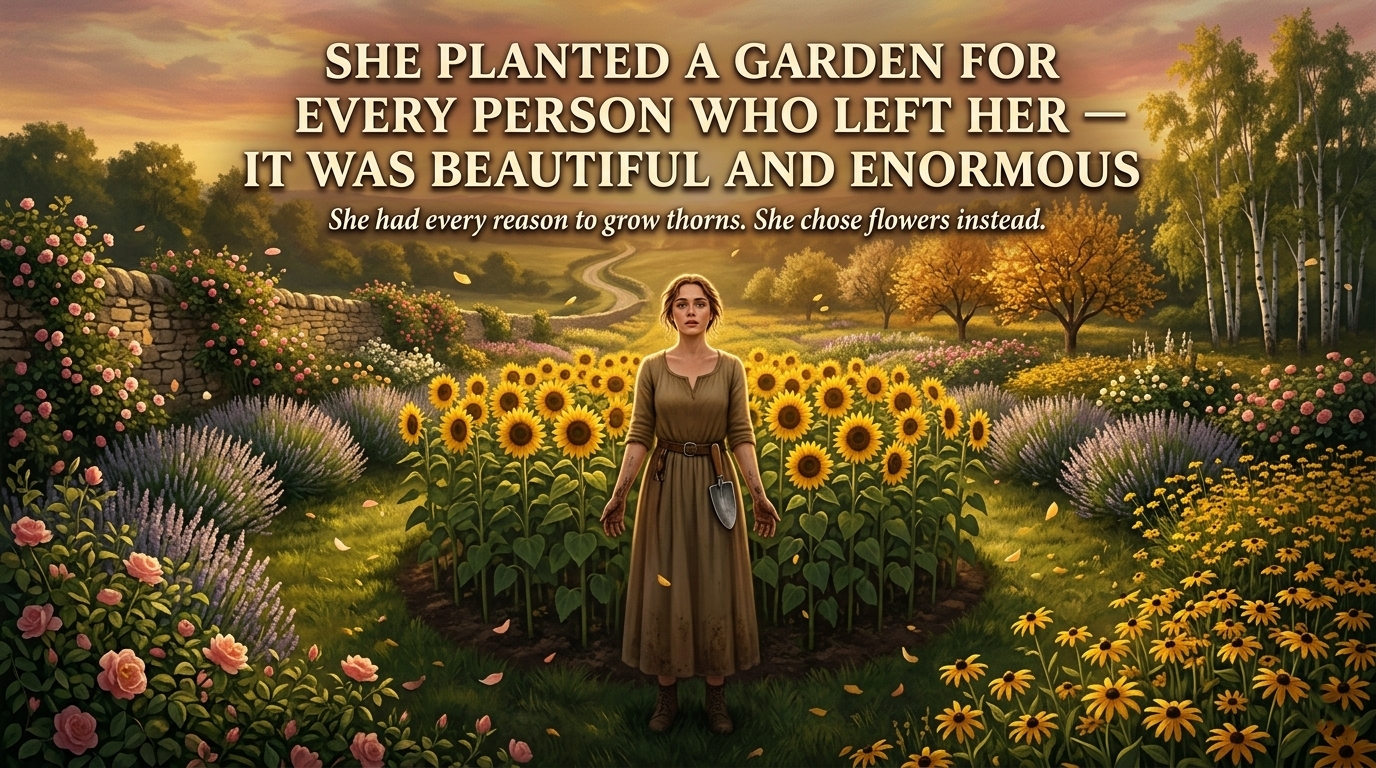
She Planted a Garden for Every Person Who Left Her — It Was Beautiful and Enormous !
he first thing Wren ever planted was a white rose, and she was five years old, and she did not entirely understand what she was doing except that her mother had gone and left a space in the world the shape of a mother, and the space needed something living in it or Wren felt certain she would fall in.
She dug the hole with her hands in the soft earth behind the cottage her grandmother kept. She placed the cutting — broken from the wild hedge at the road’s edge — into the ground with the careful reverence of someone performing a ceremony they have invented themselves, which is the most sincere kind. She packed the earth back around it. She watered it from the rain barrel. She said nothing aloud because she did not have the words yet, only the feeling, which was large and rootless and needed somewhere to go.
The rose grew. Extravagantly, almost immediately, as though it had been waiting for permission.
Wren noted this and filed it away in the part of herself that was always quietly observing.
✦ ✦ ✦
The garden grew with her, one loss at a time, each departure translated into something rooted and alive and refusing to leave.
For her mother — white rose
Wild and climbing. Grew over the entire east wall by the time Wren was eight, as though reaching for something just out of frame.
For her grandmother — rosemary
Planted at eleven, the week after the funeral. Dense and silver-green and fiercely fragrant. Wren rubbed a sprig between her fingers every morning for years because the smell was the closest thing she had left to being remembered by someone who had known her first.
For her best friend — lavender
Who left at thirteen for a city with better prospects and wrote twice and then stopped. The lavender came back every year without being asked, which Wren found either comforting or infuriating depending on the season.
For her father, who she met once — black-eyed susans
Bright and warm-faced and slightly wild at the edges. She planted an entire meadow of them and then felt embarrassed by how much she had hoped, and then decided the embarrassment was not something she owed anyone.
For the man who said forever — an orchard
Apple and pear and quince. Planted the morning he left because she needed something that would take years to bear fruit, something that demanded a future, something that made leaving feel like an unfinished argument she intended to win. The orchard was now the most spectacular thing for three valleys.
There were others. Many others. A wisteria for the mentor who took credit for her work and moved on. Jasmine for the friend who chose the husband’s opinion over twenty years of Wren’s companionship. A line of silver birches for the three miscarriages she had not spoken about to anyone, each tree slender and quiet and unbearably graceful.
By the time Wren was thirty-four, the garden stretched from the old cottage to the edge of the forest — acres of it, layered and intricate and luminous in every season, a place so beautiful that people walked from neighboring villages simply to stand inside it and feel something they could not name.
They called it a gift. They called it a wonder. They called Wren extraordinary.
None of them asked what it had cost.
✦ ✦ ✦
The stranger arrived on a Wednesday in early May when the orchard was in full blossom and the air was so thick with scent it was almost a solid thing. He had no particular reason to be in the village — he was a cartographer, mapping the old roads of the region, and had taken a wrong turn somewhere past the mill and ended up at the garden gate simply because the gate was beautiful and he was the kind of person who followed beautiful things to see where they led.
Wren found him standing in the middle of the orchard with his head tilted back and his eyes closed, breathing slowly, like someone drinking something they had been thirsty for without knowing it.
“The gate was open,” he said, without opening his eyes. “I should have knocked. I apologize.”
“People forget to knock when they find something beautiful,” Wren said. “I’ve stopped minding.”
He opened his eyes then and looked at her — a direct, unhurried look, taking in not just her face but the dirt on her hands and the set of her shoulders and the particular quality of her stillness, which was not the stillness of peace but the stillness of someone who has learned to hold a great deal without visibly trembling.
“Did you build all of this?” he asked.
“I planted all of it,” she said, which felt more accurate.
He turned slowly, taking in the orchard, the rose wall, the lavender rows, the silver birches at the far edge standing pale and close together like a quiet conversation. “What made you start?”
She had answered this question a hundred times. A love of growing things. A grandmother who taught me. Something to do with my hands. The answers were all true and none of them were the truth.
She looked at him for a moment — at his open, patient, genuinely curious face — and said, for the first time to anyone: “Someone left. I needed something that would stay.”
✦ ✦ ✦
He stayed for the afternoon. He was easy to talk to in the way that people who have spent long stretches alone are easy to talk to — comfortable with silence, unhurried by it, genuinely interested in what other people say rather than simply waiting for his turn.
She walked him through the garden. She did not tell him what each section meant, only that each one had a reason, and the reasons were private. He accepted this without pressing, which she found unexpectedly moving.
At the silver birches he stopped and stood quietly for a moment. “These feel different from the others,” he said.
“They are,” she said.
He nodded and asked nothing further. She had the startling sensation of being handled with care by someone who did not yet know how breakable she was — and doing it right anyway, by instinct, the way some people are simply careful with things they sense matter.
At the gate, as the light went amber and long across the garden, he turned to her and asked the question no one had ever thought to ask in all the years visitors had walked through her extraordinary, enormous, beautiful garden of goodbyes.
“Is there any part of it,” he said, “that you planted just for yourself?”
✦ ✦ ✦
She stood very still.
She looked back across the acres — the rose wall, the lavender, the black-eyed susans, the orchard, the birches — all of it grown from loss, all of it tended with the faithful, almost ferocious care she had never quite managed to turn on herself.
The answer was no. The answer had always been no. She had made beauty out of every person who had abandoned her and had not once thought to make something simply because she was here, and alive, and worthy of a garden too.
Her throat tightened.
“No,” she said. Very quietly.
He nodded slowly, as though this confirmed something he had suspected but hoped was wrong. He did not offer comfort or rush to fix it. He simply said: “That seems like the next thing, then.”
✦ ✦ ✦
He came back on Thursday. And Friday. And he did not leave on Saturday as he had planned, and by the following week the maps could wait, and by the month after that he was no longer a stranger at all.
In June, he helped her break new ground at the very center of the garden — a circular plot, bare and ready, directly in the heart of everything. He asked what she would plant there. She had thought about it for weeks.
“Sunflowers,” she said. “Because they face toward light. And because they are enormous and unashamed about it.”
He smiled. “Like someone I know.”
She planted them with her own hands, in the center of everything she had grown from grief, and when they came up — tall and golden and almost aggressively alive — they changed the whole character of the garden. Visitors who had always called it beautiful now said something else. They said it felt inhabited. Complete. Like a place where someone actually lived, not just tended.
Wren thought that was exactly right.
She had spent thirty-four years making room for everyone who had left.
It turned out there was still, right in the middle of it all, a perfect circle of space waiting — patient and dark and full of possibility — where she could finally plant something just for herself.
And the garden grew, and grew, and grew.
Not only because people kept leaving.
But because she had finally, tenderly, learned
to stay.
For herself.
First.