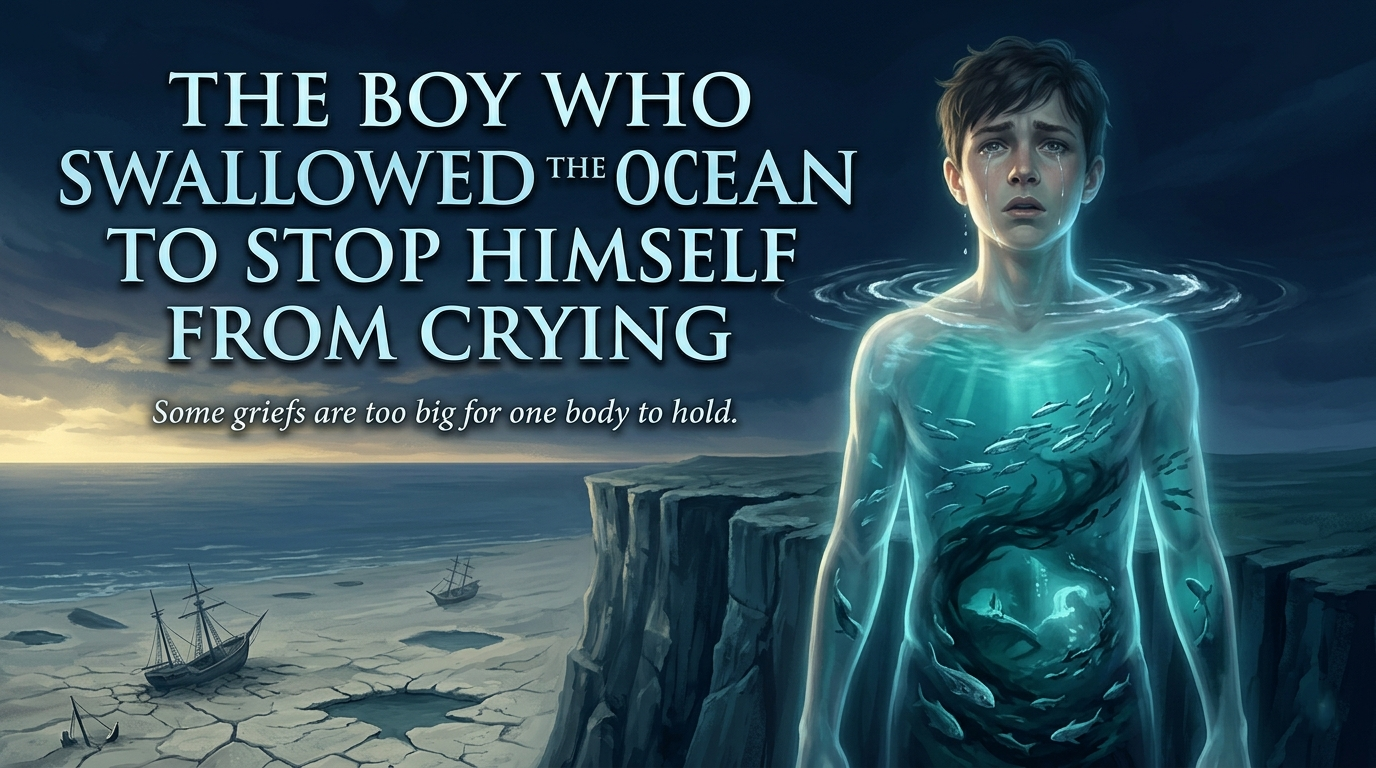
The Boy Who Swallowed the Ocean to Stop Himself From Crying ! A Fairy Tale
The Boy Who Swallowed the Ocean
to Stop Himself From Crying
Some griefs are too big for one body to hold — and too heavy for one heart to keep.
Facebook Hook Caption
His father told him on the day of his mother’s funeral: “Men do not cry. Not in this family. Not ever.”
So the boy walked to the edge of the sea — and swallowed it whole.
Every wave. Every current. Every dark and fathomless mile of it.
And for years, no one noticed what it was doing to him from the inside.
Until the day he met a girl who said the four words that undid everything he had ever been taught. 🌊
This fairy tale is for everyone who was ever told that their grief was too much. Read it and feel it. 👇
Full Fairy Tale
On the morning they buried his mother, the boy’s father gripped his shoulder so hard it left a bruise the shape of a handprint, and said into his ear — low and certain as a law of nature — “We do not cry. Not in this house. Not in this family. Do you understand me?”
The boy was nine years old. His name was Idris. His mother had smelled of rosemary and warm bread and had called him her little tide because, she said, he was always moving and always coming back.
He understood. He nodded. He put the grief where his father pointed — down, deep, somewhere below the ribs — and he held it there.
But grief is not a stone. It does not simply sit. It moves, and swells, and presses, and by the time Idris was ten the pressure had become something physical — a heaviness in his chest that made drawing a full breath feel like a small act of courage.
By eleven, the first strange thing happened.
He was standing at the shore — he went there often, because the sea did not ask him to be anything — when the tide came in further than it should have, curling around his bare feet and then his ankles, and then, without entirely meaning to, he breathed in through his nose and something enormous and cold and alive rushed into him like an answer to a question he had not known he was asking.
He swallowed the wave. The whole of it. Then the next. Then the next.
By the time the fishermen arrived at dawn, the cove was empty — dry pale sand where the ocean had been, small silver fish left bewildered in the sudden absence of their world. And Idris walked home with the sea inside him, cold and vast and perfectly, terribly contained.
He did not cry that day. He had found something better than crying.
Something he could control.
✦ ✦ ✦
The years passed. The grief kept coming — his father’s silence at the dinner table, the empty chair, the rosemary plant in the kitchen window that no one watered and no one threw away. His father’s second marriage to a woman with a flat, careful smile. The way Idris’s own name began to feel like something he wore rather than something he was.
Each time the sorrow rose, he went to the shore. Each time, he swallowed what he found there.
The sea gave willingly. It did not seem to mind. Or perhaps it understood, the way deep things understand — that it was simply going from one kind of vast and dark and unexamined place to another.
By the time Idris was seventeen, the ocean was almost entirely inside him.
The kingdom’s fishermen were baffled and frightened. The harbor sat nearly dry. Ships could not sail. The tide charts made no sense. Scholars came from distant cities with instruments and theories and left with neither answers nor dignity. Priests prayed. Politicians argued. Children drew pictures of the empty seabed in school and wrote stories about where the ocean had gone.
No one looked at the quiet boy on the hill above the harbor who never cried and always kept his jaw very slightly clenched, as though holding something enormous in place by pure force of will.
✦ ✦ ✦
He met her at the empty harbor on a Tuesday in October.
She was sitting on the old dock with her bare feet dangling over nothing — over dry sand and scattered shells and the ghost of where the water used to be — and she was drawing in a notebook with great focus and not the faintest trace of self-consciousness.
He almost walked past. He was good at walking past people.
But she looked up, and looked directly at him — not the polite glance of strangers, but a full and unhurried look, the kind usually reserved for things worth studying — and said: “You look like you’re holding your breath. Are you all right?”
No one had asked Idris that in eight years.
He opened his mouth to say yes, of course, fine, always fine — the answer so practiced it lived in his throat like a stone in a river. But what came out instead was a sound he did not recognize. Not words. Just — sound. A low, overwhelmed, unguarded sound, like a door opening in a room that had been sealed for a very long time.
He sat down on the dock beside her, suddenly and heavily, as though his legs had simply decided they were finished holding him up.
“Sorry,” he said. “I don’t know why I—”
“Don’t apologize,” she said. Not unkindly. Just clearly, the way you say a thing when you mean it absolutely. “You don’t have to explain yourself to me.”
✦ ✦ ✦
Her name was Sable. She had come to the harbor to draw the strange dry seabed — she was collecting images of things that had disappeared from the world, she explained, because she believed that looking directly at absence was the only honest way to understand it.
He found himself talking to her. Not about the ocean — not yet. But about his mother. The rosemary plant. The handprint bruise. The way a person could be told so many times that their feelings were too large for the room that they eventually believed it and started carrying those feelings somewhere else instead — somewhere interior and airless and absolutely alone.
She listened the way very few people listen — without assembling her response while he spoke, without flinching, without offering the blunt comfort of easy words. She simply received what he said, and held it with both hands, and when he finished she was quiet for a moment before she spoke.
“What would happen,” she asked carefully, “if you let it out?”
“It would flood everything,” he said immediately. “Everything would drown.”
She considered this seriously. “Or,” she said, “everything would finally drink.”
✦ ✦ ✦
He sat with those words for three days.
He turned them over the way you turn a stone — looking for what lives underneath. He thought about the dry harbor. The stranded ships. The fishermen with nothing to cast their nets into. The children who had grown up drawing pictures of a sea they were too young to remember. He thought about all the living things that needed what he was holding — that had always needed it — and how he had taken it, convinced that containing it was the same as controlling it, never understanding that grief held in the body does not disappear. It simply waits. And grows heavier. And takes up more room. Until the holder is all container and no person.
On the fourth morning, he walked to the highest cliff above the dry harbor.
He stood at the edge.
And he let himself cry.
Not a little. Not politely. Not the controlled, apologetic kind of crying that asks forgiveness for existing. The other kind — the enormous, ancient, tidal kind that comes from the deepest part of a person and does not stop until it is finished, however long that takes.
The ocean came back all at once.
It poured from him in a wave that hit the harbor with a sound like the world exhaling — vast and silver and cold and alive, rushing back into its bed with the urgency of something that had been away too long. The fishermen ran to the shore. The children screamed with joy. The ships rocked in their moorings. The tide charts corrected themselves overnight, as though they had simply been waiting, patiently, for the numbers to come home.
Idris stood on the cliff, empty in a way he had never been, and found — to his extraordinary surprise — that empty did not mean hollow. It meant open. Rinsed clean. Ready.
✦ ✦ ✦
Sable found him there an hour later, sitting on the cliff edge with his feet dangling over the restored sea and his face wet and his eyes — for the first time in eight years — fully, quietly open.
“Everything flooded,” he said.
“Yes,” she said, sitting beside him.
He looked at the sea — his sea, returned, shining and enormous and entirely indifferent to the smallness of the humans watching it. “Everything also drank,” he said.
She smiled. “It usually works that way.”
He breathed in — fully, completely, without effort, the way he had not breathed since he was nine years old — and the salt air filled him and the sound of the waves rose to meet them both and somewhere below a boat put out from the harbor for the first time in years, its white sail catching the wind like an open hand.
And they say the boy who swallowed the ocean learned, in the end, the thing the ocean had always known —
that the ones who hold the most
are not the strongest.
They are simply the ones
who have not yet been loved
enough to let go.