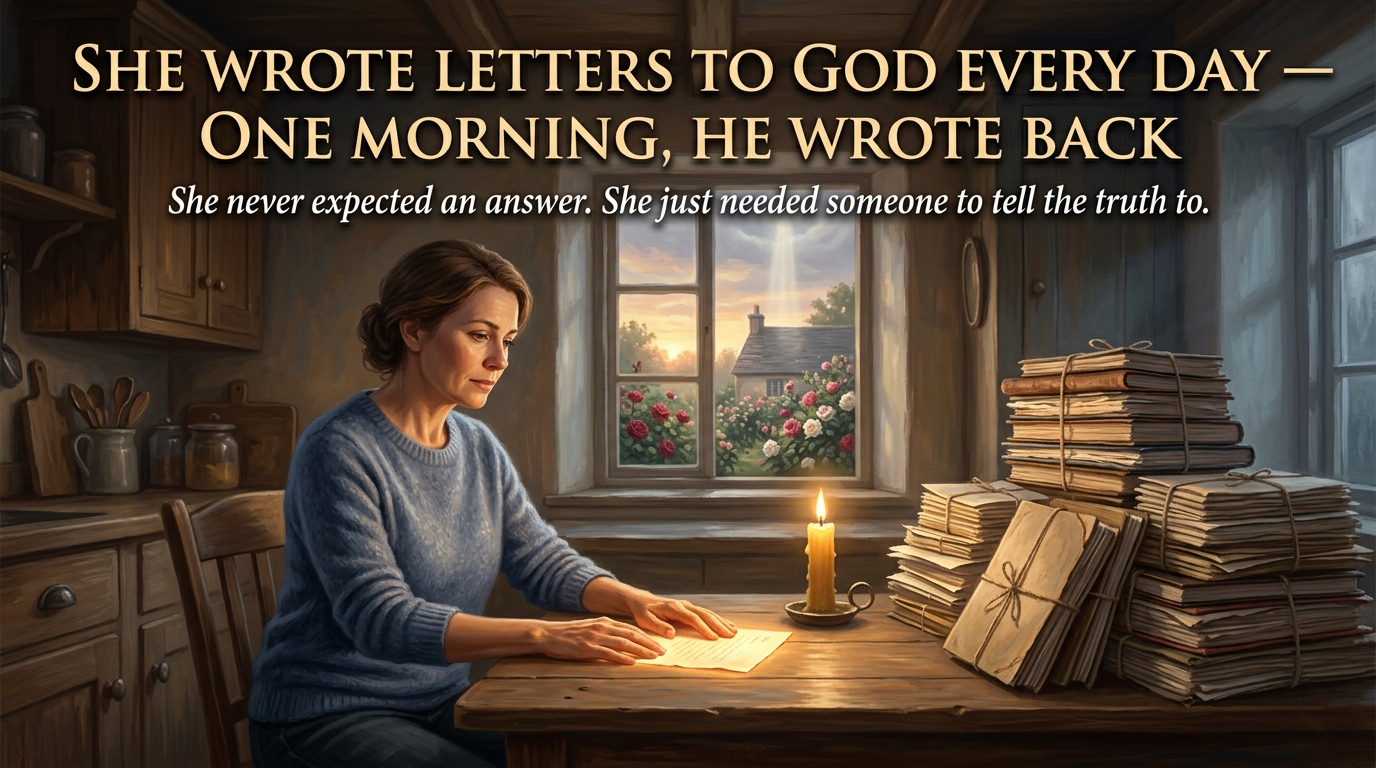
She Wrote Letters to God Every Day — One Morning, He Wrote Back !
he began writing on a Thursday in November when she was seven years old, sitting at the kitchen table with a stub of candle and her brother’s school notebook — the one with his name still on the cover, which she did not cross out because crossing it out felt like agreeing to something she refused to agree to.
Her brother had been nine. He had gone to the river on a Sunday afternoon and had not come back, and the village had searched for four days and on the fifth day they stopped searching in the way that meant they had found him without saying so, and the adults had closed doors and spoken in low voices and no one had said a single word directly to Miriam, who was seven, and sat in corners, and understood everything.
The letter she wrote that first night was not a prayer. She had tried prayers and found them too formal, too much like asking permission to feel things she was going to feel regardless. What she wrote was something else — direct, plainspoken, slightly accusatory in the way that only the very young and the very honest can manage:
Miriam — Age 7
I don’t know if you exist but I am writing to you anyway because I have no one else to tell this to. My brother is gone. I know you know. I want to know why. I think you owe me that. I will wait. — Miriam
No answer came. She had not expected one. But she felt — fractionally, barely enough to measure — less alone than she had a moment before. As though the act of addressing something enormous had made the enormous thing slightly less indifferent.
She wrote again the next day. And the next.
✦ ✦ ✦
The letters continued for forty-one years with the faithfulness of a habit that has long since stopped feeling like a choice. She wrote in the blue dark before the rest of the house stirred. She wrote on the backs of receipts when the notebook ran out. She wrote in the margins of books and on napkins in restaurants and once, memorably, on the inside of her own wrist with an eyebrow pencil because the feeling had arrived suddenly on a crowded train and needed to go somewhere before it became something larger than she could hold in public.
The letters were not always about grief. In fact most of them were not. Over the years they became a kind of daily account — faithful, unedited, addressed to the largest audience she could imagine:
Miriam — Age 19
I kissed someone today and felt absolutely nothing, which I think says more about me than about him. I am either very broken or very particular. I suspect both. How do you tell the difference? — M
Miriam — Age 31
My daughter said her first word today. It was “light.” I’m not reading into that. I’m absolutely reading into that. Thank you, if that was you. And if it wasn’t, thank you anyway for making the kind of world where a child’s first word can be light. — M
Miriam — Age 38
I am very tired today. Not of living — I want to be clear about that. Just of carrying so much of it without knowing if any of it means anything. Does it? You don’t have to answer. I just needed to say it somewhere real. — M
Miriam — Age 44
The roses came back. I didn’t think they would after the frost. I stood in the garden this morning and just looked at them for a long time. I think that’s all I have to say today. — M
She showed the letters to no one. They were not written to be shown. They were written because the truth needed somewhere to live that was not inside her body, and she had decided, at seven, on the most honest address she could think of.
✦ ✦ ✦
On a Tuesday in October — a bright, cold, ordinary morning — Miriam came downstairs at five-thirty as she always did, filled the kettle, and found an envelope on the kitchen table.
It had not been there the night before. She knew this with the certainty of someone whose house was small and whose habits were precise. There was no postmark. No stamp. No return address. Only her name on the front in handwriting she had never seen in her life and recognized immediately — the way you recognize a voice you have heard only in dreams, or a face that belongs to someone you have not yet met but somehow already know.
She sat down. The kettle began to whistle. She did not move to take it off.
She opened the envelope with steady hands, which surprised her. Inside was a single sheet of paper, cream-colored, with the faint warmth of something that had traveled a very long distance and arrived without losing any of its heat.
She read it once. Then again. Then she set it flat on the table and pressed both palms against it and looked out the window at the early grey light coming up over the garden, and she breathed very carefully for a long time.
The letter said:
The Reply
Dear Miriam,
I have read every word.
I know you did not write expecting this. You wrote because you are someone who tells the truth even when — especially when — no one is listening. That is among the rarest things there is, and I have wanted you to know that I have been listening, always, to every letter. The ones about your brother. The ones about the boy on the train. The one about the roses after the frost, which I thought about for a long time after you wrote it.
You asked me once, when you were seven, why. I did not answer because there are some questions that cannot be answered from this direction — they can only be understood from yours, slowly, with time, and even then only partly. I am sorry that is true. I know it has not always felt like enough.
But I want you to know this: the letters were never lost. Not one of them. And you were never, in all the days of your life, as alone as it sometimes felt.
The roses came back because that is what living things do when they have been properly loved. You did that. That one is yours.
With the entirety of everything,
— You know who
✦ ✦ ✦
She sat at the table until the light came fully up and the garden turned green and gold outside the window.
She thought about her brother, who had been nine and had loved river stones and bad jokes and had called her Miri in a voice she could still hear exactly if she was very quiet inside herself. She thought about forty-one years of mornings — the candle stub, the notebooks, the receipts, the train, the eyebrow pencil — all of it sent into what she had always suspected might be silence and had written into anyway, because the alternative was keeping it all inside and she had never been able to bear that.
She thought about the line she kept returning to: you were never, in all the days of your life, as alone as it sometimes felt.
She had written forty-one years of letters asking, in one way or another, whether anyone was there.
The answer, it turned out, was yes. Had always been yes. Would always be yes.
Not fixing everything. Not explaining the inexplicable or untangling the unfair. Just — present. Reading. Holding every word she had ever trusted to the air.
She picked up her pen. She took out her notebook. And because she was Miriam, and because forty-one years of habit does not stop for miracles, she wrote back:
Miriam — Age 48
You took your time.
I’m glad you did. I think I needed all forty-one years of practice before I was ready to read what you had to say.
I have a lot of questions still. I expect I always will. But today — just today — I don’t need you to answer any of them.
The roses are back. I looked at them for a long time this morning.
I think that’s enough.
— Miriam
And they say she wrote every morning for the rest of her life —
not because she doubted anymore
but because she had found, in the long practice of telling the truth
to the biggest thing she could imagine,
the deepest comfort any person can know:
that to be fully, honestly, imperfectly yourself
is to already be in conversation
with something that understands.