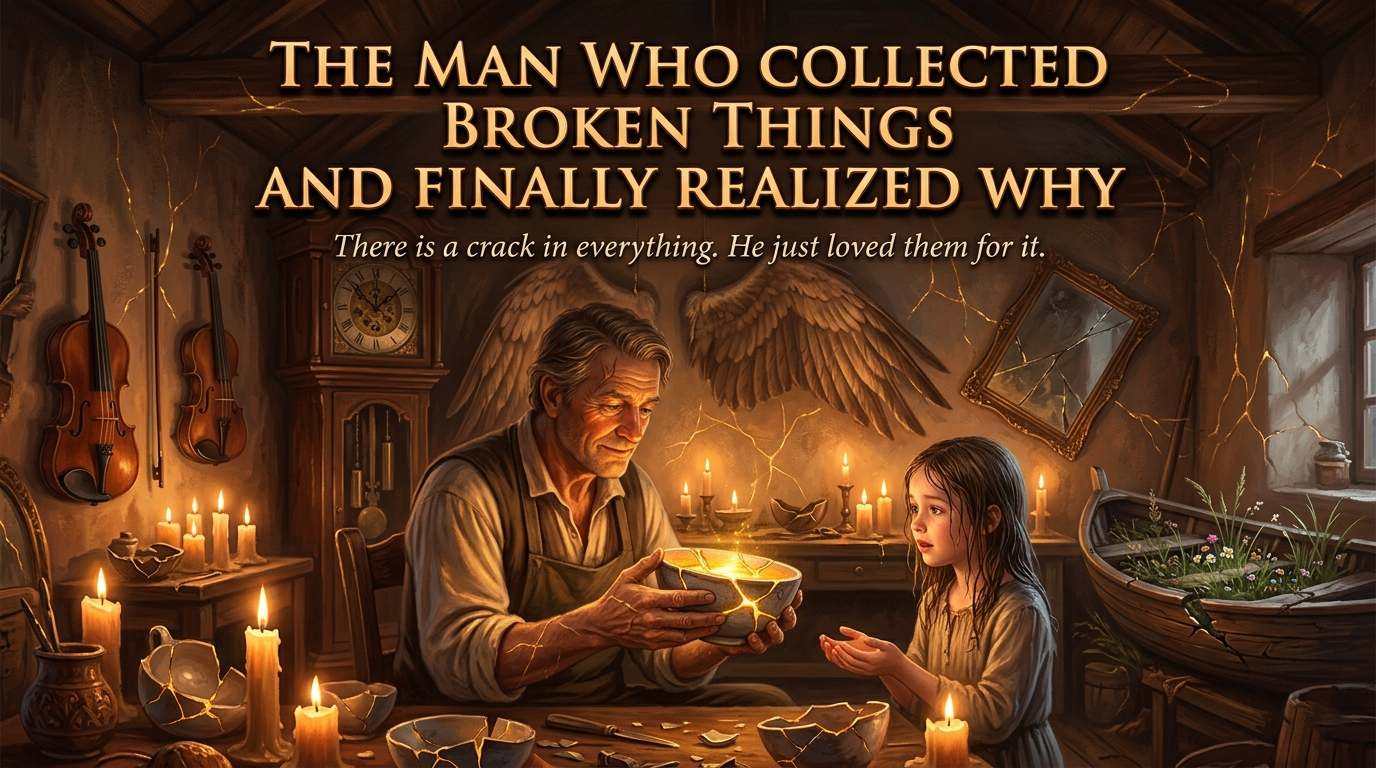
The Man Who Collected Broken Things and Finally Realized Why ! A Fairy Tale
The Man Who Collected Broken Things
and Finally Realized Why
There is a crack in everything. He just loved them for it.
Facebook Hook Caption
His house was full of things no one else wanted.
A clock that only told the right time twice a day. A violin missing its highest string. A mirror that showed you slightly sideways. A boat with a hole in it. Wings from a bird that would never fly again.
People called him strange. Wasteful. Sad.
He never argued. He just kept collecting.
Until the night a little girl sat down in the middle of his shop, looked around at every broken, cracked, imperfect thing he owned — and said: “I think I know why you keep them.”
He had never told anyone. He barely knew himself. 🪞
What she said next changed everything he thought he understood about himself. Read it slowly. 👇
Full Fairy Tale
The man’s name was Oren, and his house was the most unusual in the village — not because of its size or its age or the state of its roof, which was admittedly in need of attention, but because of what lived inside it. Every surface, every shelf, every windowsill and corner and careful stack held something that was, in the precise and ordinary understanding of the word, broken.
Not garbage. Not rubbish. Not the careless accumulation of a man who could not throw things away. Each item in Oren’s collection had been chosen — carried home, cleaned, given a place — with the deliberate tenderness of a curator who knew exactly what he was doing, even if he could not have said, if pressed, precisely why.
The village had theories. They always do.
He is lonely. This was the most popular. He is strange. This was the second most popular. He is sad in a way that has simply chosen an unusual shape. This one came closest, but no one said it aloud because it was too specific to be comfortable.
Oren heard all of it and said nothing. He was a man of few words and many objects, and he had long since decided that the objects were better company anyway — they asked nothing of him, they did not require explanation, and they did not leave.
His collection, by the time he was forty-two, included the following, among many others:
A Grandfather Clock — Shelf Three, East Wall
Stopped at 4:17 for reasons no clockmaker had been able to determine. Oren found it beautiful that it was still correct twice a day and that it had simply chosen, somewhere in its mechanisms, to commit entirely to one moment rather than strain after all of them.
A Violin — South Window, Hanging
Missing its E string — the highest, the one that carries the melody’s sharpest edge. The remaining three strings played together in a chord that was richer and more melancholy than any complete instrument Oren had ever heard, as though loss had deepened its voice.
A Mirror — Hallway, Tilted Slightly Left
Cracked diagonally from corner to corner and faintly warped, so that it showed the person standing before it at a slight sideways angle, as though asking them to consider themselves from a direction they had never tried. Visitors found it unsettling. Oren used it every morning.
A Wooden Boat — Garden, Dry
With a hole in the hull the size of a hand, found at the river’s edge after a flood. It would never sail again. It grew sweet grass through the hole in summer, which Oren thought was the boat making its peace with the situation and choosing a second life on its own terms.
A Pair of Wings — Rafters, Above
From a bird of extraordinary size, found in the high meadow, both wings intact but the creature long gone — the wings too large to bury and too beautiful to burn. Hung from the rafters, they turned slowly in the drafts of the house like something still trying, still reaching, still mid-flight in the only way left to them.
There were dozens more. Hundreds, perhaps. A compass that pointed consistently southwest regardless of direction. A lantern whose flame burned blue. A music box that played one note and then stopped, as though it had said all it had to say and saw no reason to elaborate.
✦ ✦ ✦
The girl arrived on a Wednesday in March, which was the kind of day that could not decide between winter and spring and had settled for both simultaneously — cold rain, pale sun, the smell of earth turning over.
She was perhaps eight years old. She came in out of the rain without knocking, which Oren had long since stopped minding, as the door was always unlocked and people passing through curiosity had as much right to shelter as any other kind of traveler. She was small and serious and soaking wet and she stood in the center of his shop and turned slowly in a full circle, taking everything in with the unhurried attention of someone conducting a proper inventory.
Oren watched from his workbench, where he was carefully cleaning a ceramic bowl that had been broken into seven pieces and reassembled with gold-mixed resin — an old practice he had recently learned, from a traveling merchant, of filling the cracks with something precious rather than hiding them.
“You can dry by the fire,” he said.
She sat. She looked at the clock. At the violin. At the wings turning in the draft above her head. She looked at everything with the frank, unembellished gaze of a child who has not yet learned to pretend that things do not mean what they obviously mean.
After a long while she said: “Why do you keep broken things?”
“I find them,” Oren said. “They need somewhere to be.”
She shook her head — not disagreeing exactly, but unsatisfied, the way you shake your head at an answer that is true but not the whole truth.
“My mother says broken things should be thrown away,” the girl said. “She says keeping them is just holding on to sadness.”
“She might be right,” Oren said, which he believed was a fair thing to say about someone else’s mother.
The girl considered this. She looked at the bowl in his hands — the broken one, the one with its cracks filled gold — and tilted her head.
“What happened to that one?”
“It fell. It broke into seven pieces. I put it back together.”
“But you can still see where it broke.”
“Yes,” he said.
“Doesn’t that bother you?”
Oren held the bowl up. The candlelight caught the gold seams and they glowed — warm and deliberate and unmistakably present, as though the breaking had not diminished the bowl at all, but had simply given it a new kind of beauty it could not have had whole.
“No,” he said. “The cracks are the most honest part of it now. They’re the part that says — this happened to me, and I’m still here.”
✦ ✦ ✦
The girl was quiet for a moment. Then she said, in the careful voice of someone laying something important on the table between them:
“I think I know why you keep them.”
Oren set the bowl down. He looked at her across the cluttered, beloved, impossible room — the clock at 4:17, the three-stringed violin, the wings mid-flight in the rafters — and said nothing, because something in the way she had said it made him understand, suddenly and with the particular vertigo of a long-delayed recognition, that she did know, and that he was about to hear his own truth spoken back to him by an eight-year-old girl in wet shoes by his fire.
“You keep them,” she said, “because they’re still here. Everything that was supposed to be over — the clock, the boat, the wings — none of it gave up. It just changed into what it could still be. And you love that. Because—” she paused, working something out, her brow slightly furrowed, “—because you think that’s the bravest thing there is. To still be here. Even broken. Even changed. Still here.”
The room was very quiet.
The clock did not tick. The violin did not play. The wings turned slowly in the draft.
Oren felt something in his chest crack open along a line he had not known was there — a clean break, long overdue — and then a warmth moving through it like gold resin finding its way into every fracture, slow and deliberate and permanent.
He had collected broken things for thirty years because he was broken himself in ways he had never shown anyone and had never quite found the language for. Because the objects understood something he could not say. Because he had needed, every single day, to be surrounded by proof that broken things did not have to be finished things — that you could be cracked all the way through and still hold water, still make music, still turn in the wind with something that looked unmistakably like grace.
He had never known that was the reason.
He had needed an eight-year-old girl, dripping rain onto his floorboards, to say it plainly.
✦ ✦ ✦
“What’s your name?” he asked, when he trusted his voice again.
“Petra,” she said.
“Are you broken, Petra?”
She thought about this with the seriousness it deserved. “My dad left,” she said finally. “So probably yes. A bit.”
He nodded. He reached across the workbench and handed her the gold-seamed bowl — carefully, with both hands, the way you hand someone something precious.
“Then you should have this,” he said. “To remember that the cracks are not the end of the story. They’re just — evidence. That it happened. That you’re still here anyway.”
She took it with both hands, mirroring his seriousness exactly.
She looked at the gold lines running through it — the map of every break, made beautiful on purpose, made permanent, made the most luminous thing about the whole bowl.
“It’s the prettiest part,” she said.
“Yes,” said Oren. And meant it about more things than the bowl.
And they say the man kept collecting broken things
for the rest of his life —
clocks and mirrors and three-stringed violins
and boats growing sweet grass through their wounds —
but after that Wednesday in March
he kept one more thing than before.
He kept himself.
Cracks and all.
Deliberately.
Like something worth preserving.