The Girl Who Was Raised by the Forest — And the Day the Village Finally Came for Her !
A fairy tale for those who were left behind and grew wild anyway
Part 1 — The Leaving
They say the forest took her the night she was born. That is not what happened. I know because I was there.
What happened was this: her mother, a young woman named Elara who had loved the wrong man and paid the price that women in this village always paid, walked into the Thornwood at dusk on a January night carrying a baby girl wrapped in a wool blanket and a breaking heart. She had no husband, no family left, and no money, and the village elder had told her that morning that she had three days to leave or face judgment.
Elara could not take her daughter into that judgment. So she did the only other thing she could think of.
She walked to the oldest oak at the center of the Thornwood — the one with the hollow wide enough to sleep in, the one that hummed in winter like something breathing — and she laid her daughter gently in the roots. She whispered something into the baby’s ear. No one knows what. Only the oak heard it, and oaks keep their secrets.
Then Elara walked back out of the forest, through the village, and out the far gate, and was never seen again.
The baby should have died. January nights in the valley are not kind.
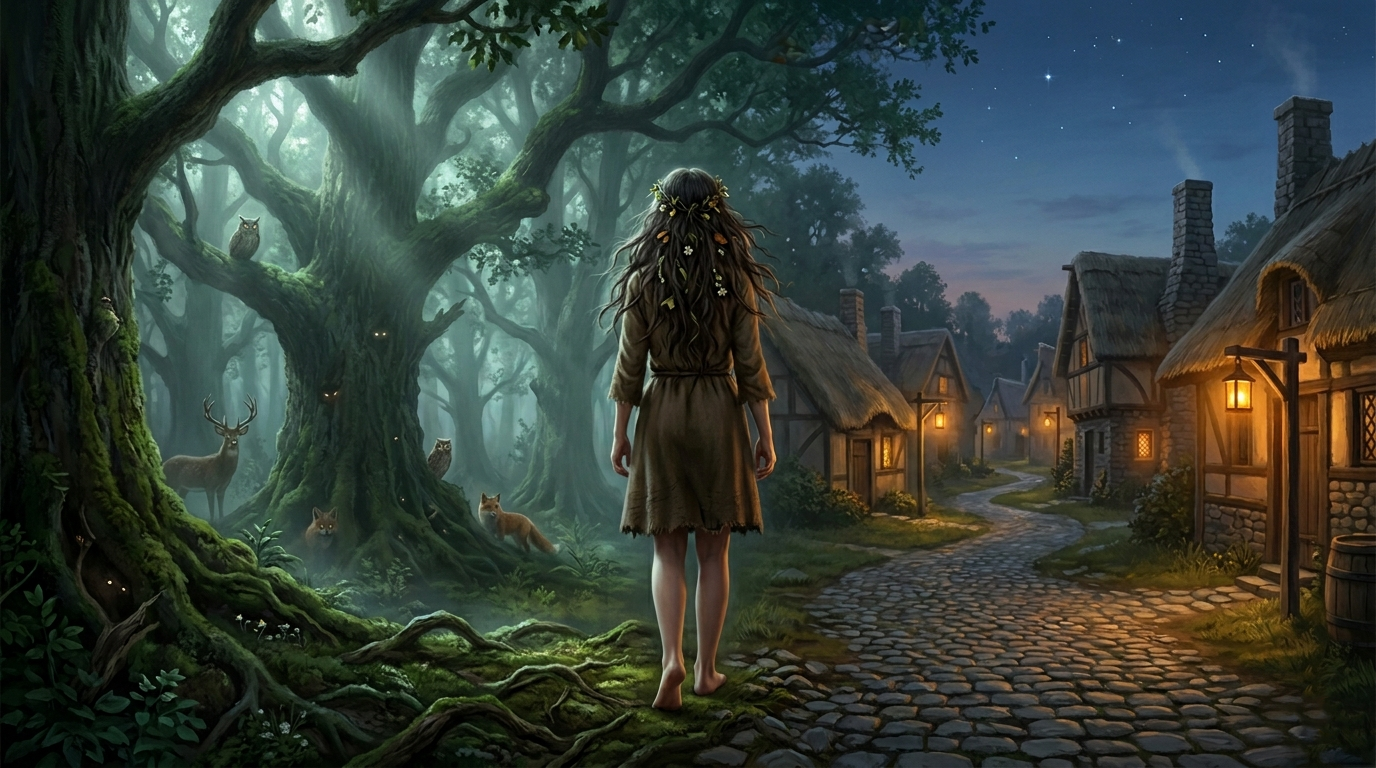
But in the morning, when two boys dared each other to peek through the tree line, they found the hollow in the oak warm as a hearthside. They found the baby sleeping peacefully, tucked in a nest of moss and soft bark, alive and pink and completely unafraid.
And crouched in a half-circle around her — seven deer, three foxes, and something large and silver that bounded away before anyone could name it.
The village took this as a sign. Not a good one. They named the girl Maren, after no one, because she belonged to no one, and they left her where they found her.
The forest kept her. For seventeen years, the forest kept her — and then the village came. And nothing that followed was simple or clean or the way the stories are supposed to go.
Part 2 — The Girl of the Thornwood
Maren grew up knowing things the village children did not know.
She knew which mushrooms healed and which ones killed, and the difference between them was subtler than color or shape — it was something in the smell, something in the way the gills caught light, something the forest had shown her without words. She knew where the river ran cold enough to preserve meat through summer and where it ran warm enough to bathe in through winter. She knew the names of every bird by sound alone and could tell the weather three days out by the behavior of the beetles under the eastern log piles.
She knew how to be alone, which is perhaps the most useful thing the forest taught her, and the hardest to unlearn.
She was not entirely without human contact. Old Thomas, the miller, left bread and cloth at the edge of the tree line every full moon — not because the village had asked him to, but because he was a man who could not walk past suffering without doing something about it. Maren left mushrooms and healing herbs in return. They never spoke. It was a friendship conducted entirely in gifts left on a flat stone, and it was, for many years, the closest thing she had to human kindness.
She watched the village from the trees. That is the part the village never knew — that the girl they had abandoned watched them constantly, learned them the way she had learned the forest, memorized their rhythms and their seasons. She knew which houses argued on Saturday nights and which ones sang. She knew the baker’s daughter had been crying for three weeks and she knew the smell of illness in the blacksmith’s house before the blacksmith himself understood what it was.
She was not lonely, exactly. Loneliness requires an expectation of company. She had never had company and so she did not miss it in the way the village assumed she must.
But she was curious. Deeply, quietly, endlessly curious about the lives of the people who had left her in the roots of an oak and called it mercy.
She had never hated them for it. The forest had taught her that cruelty and fear are usually the same thing in different clothes, and that fear, properly understood, invites compassion more than contempt.
This is perhaps why, when they finally came for her, she did not run. She had always known they would come eventually. She had simply been waiting to discover what they would need her for.
Part 3 — Why the Village Came
It was a sickness that brought them.
It arrived in October, the year Maren turned seventeen — a fever that began in the youngest children and spread in a week to the oldest residents, moving through the streets with the patience of something that knew it had time. The village healer, an old woman named Brynn who had served for forty years, tried every remedy she knew. The fever did not care.
By the second week, six children were delirious. By the third, two elders had died.
It was Thomas the miller who said it first, in the town square, quietly, to the small crowd that gathered each morning to count who was still standing.
“The girl in the Thornwood knows plants we don’t,” he said. “She’s been leaving herbs on the stone for years. She knew my wife’s cough before Brynn did.”
The silence that followed had several varieties of discomfort in it.
“She is a forest creature,” said Elder Corvin, whose family had been part of the original decision to leave Maren in the roots. “We don’t know what she is.”
“She is a girl,” said Thomas. “Who knows medicine we don’t. And our children are dying.”
They sent three people to the tree line. Thomas, because he was the only one she might recognize as a friend. The healer Brynn. And a young woman named Sela, the baker’s daughter, because Sela had been crying for three weeks and Maren had watched and had left a small bunch of blue meadow flowers on the stone weeks ago — a forest remedy for grief.
Sela was the one Maren looked at when the three of them stood at the edge of the trees.
“You got my flowers,” Maren said. Her voice was rougher than they’d expected, from years of more birdsong than conversation, but her eyes were clear and calm and very watchful.
“I did,” Sela said. “They helped.”
Maren studied her for a moment. Then she looked at Thomas, who looked at the ground the way a man looks at the ground when he is ashamed of something he did not personally do but belongs to nonetheless.
“The fever,” Maren said. Not a question.
“Yes,” said Brynn.
“I’ve been watching it,” Maren said. “I know what it is. I know what grows in the deep wood that will break it.” A pause. “I will come.”
“Just like that?” Brynn said, surprised.
“Not just like that.” Maren looked at the village rooftops visible above the path, the world she had watched for seventeen years from the other side of the tree line. “I have been waiting a long time to cross that line. I would have preferred a different reason.” She picked up the pack she had clearly already assembled. “But I will take the reason I have.”
She walked out of the Thornwood for the first time in seventeen years and did not look back.
Part 4 — Maren in the Village
She moved through the village like water finding its level.
The people who came out to watch expected something wild — tangled hair, animal eyes, the feral bearing of something that did not belong among walls and cobblestones. What they found was a girl in a rough brown dress, barefoot, with careful hands and an expression of such composed attention that several of them felt, uncomfortably, that they were the ones being assessed.
She went to the sickest children first. She sat beside each of them for several minutes before she did anything — listening to their breathing, touching their foreheads, looking at their eyes with the same focused quiet she used to read the forest. Brynn watched carefully and said nothing.
What she did in the next three days was not magic, though the village would call it that later, in the way that people call things magic when they don’t understand the knowledge behind them. She boiled roots and bark in specific combinations at specific temperatures. She made poultices from things she had carried in her pack. She adjusted proportions each day based on how each patient responded, moving between houses with a competence that made Brynn feel both grateful and very humble.
She barely slept. When she did, it was on the floor, back against the wall, and she came awake the instant any patient’s breathing changed.
Elder Corvin came to see her on the second day. He stood in the doorway watching Maren tend two children, and after a long time he spoke.
“I was one of the ones who made the decision,” he said. “To leave you.”
Maren did not look up from what she was doing.
“I know,” she said.
“I want to—”
“I know what you want to say,” she said. “You can say it or not. It won’t change what I’m doing here.” She paused. “But I will tell you something, Elder. The thing you were afraid of — whatever it was that made you leave a baby in a forest — it was never in me. It was in you. The forest simply kept what you left behind.”
He was quiet for a long time. “Will you come back?” he said. “After. Is there a place here for you?”
Maren looked at her hands — forest-stained, root-roughened, entirely her own.
“That,” she said quietly, “is the first real question you have asked me. I’ll give it the answer it deserves, which means I need time to think about it.”
By the morning of the fourth day, the fever was breaking. The youngest child — a girl of three named Pip — opened her eyes clear and bright and asked for bread and her mother at the same time. Her mother looked up at Maren with an expression that did not have a word precise enough to name it.
Maren nodded. She began packing her things.
Part 5 — What She Chose
Sela found her at the edge of the Thornwood just before dusk.
Maren was standing at the tree line the way she always had — one foot in the village, one foot in the forest, at home in the threshold in a way that most people are not. She had her pack on her back and her face turned toward the wood.
“You’re leaving,” Sela said.
“I haven’t decided,” Maren said. “I’m thinking.”
Sela came and stood beside her. She had spent three days watching Maren work — had helped where she could, carried water and held hands and done the small necessary things that healing requires alongside the knowledge. She was not afraid of Maren. She was not sure she had ever been afraid of Maren, even at the beginning.
“What are you thinking about?” Sela asked.
“Whether the thing I’ve wanted is the thing I thought I wanted,” Maren said. “I have watched this village for seventeen years. I knew these streets before I walked them. I knew the people before they spoke to me.” She paused. “And now that I have walked the streets and heard the people — I find they are not so different from the forest. Full of things that would hurt you and things that would help you and the constant work of knowing which is which.”
“That seems like a reason to stay,” Sela said carefully.
“It seems like a reason to be cautious about staying,” Maren said. “The forest never pretended to be safe. The village does.” She looked at Sela sidelong. “I know about your grief. The one that began three weeks before I left you the flowers.”
Sela was quiet. “My mother,” she said. “She died in the summer. We didn’t end well and then she was gone and there was no more time to make it right.”
“The flowers help with the part that feels unfinished,” Maren said. “The grief itself is yours to carry. But the feeling of the door that closed before you could speak — that, blue meadow flowers help with.” A pause. “I am sorry about your mother.”
“I’m sorry about the oak,” Sela said. “About all of it. I know I wasn’t born yet when it happened, but I’m sorry you were left.”
Maren was quiet for a long moment.
“The oak was warm,” she said finally. “I don’t remember it, but I know it was warm. The forest kept me warm.” She looked at the Thornwood — enormous and dark and full of everything that had made her — and something in her face softened in a way that made Sela understand that the forest was not Maren’s prison. It was her home. And she was not deciding whether to escape it. She was deciding whether to expand.
“I’ll come back in the mornings,” Maren said. “To trade. To heal when there’s healing needed. To learn the village the way I learned the wood. But I’ll sleep in the Thornwood. At least for now.”
“That seems fair,” Sela said.
“It seems honest,” Maren said. “Which I find I prefer to fair.”
She stepped across the tree line. The forest received her the way it always had — without ceremony, without drama, with the simple and absolute welcome of a place that has always known exactly who you are.
She turned back once, just at the edge of darkness.
“Sela,” she said.
“Yes?”
“Tell the miller thank you. For the bread.” A pause. “Tell him I preferred the sourdough.”
And then the Thornwood folded around her and she was gone.
Epilogue — Many Years Later
The village and the forest made a kind of peace, in the way that old things do — slowly, imperfectly, with setbacks and misunderstandings and the long labor of learning to see something strange as something familiar.
Maren came every morning, as she had promised. She set up a small table at the tree line — Thomas built it, without being asked, with the same quiet care he had always given the stone — and people came to her with their ailments and their questions and occasionally their troubles, which she listened to with the same patient attention she gave to the behavior of beetles and the language of rain.
She and Sela became the kind of friends that form between people who understand each other from the first conversation and spend the rest of their lives catching up to that understanding. Sela learned which plants were safe to harvest. Maren learned to read, to bake bread with moderate success, and to sit in a room full of people without feeling the walls too closely.
Elder Corvin died in the spring of the following year. He left a message with Thomas for Maren — two sentences in shaking old-man handwriting: We were wrong to be afraid. We were wrong to make you pay for it. Maren read it once, folded it carefully, and placed it in the hollow of the oldest oak.
She never found her mother. She looked — quietly, through travelers and merchants, through any thread that passed through from the wider world. Elara had simply gone, the way some people go who have carried too much for too long and need to set it all down somewhere no one knows them.
But Maren had found what her mother had given her that January night in the roots of the oak. Not abandonment. A different kind of love — desperate and imperfect and real, the kind that says: I cannot keep you safe in my world, so I will give you to something older and stronger and more honest than I am.
She built a small shelter at the edge of the Thornwood eventually — half inside the tree line, half out, one window facing the forest and one facing the village rooftops. She planted blue meadow flowers along the south wall.
People came to the shelter the way people come to places that feel like both sanctuary and threshold — looking for something they couldn’t name in the world they’d come from. Maren gave them tea, and quiet, and the particular kind of listening that the forest had taught her: patient, unhurried, without judgment, holding space for things that did not yet have words.
She was not the girl the village had left in the roots. She was not the creature they had feared or the miracle they had needed or the servant they had summoned when the fever came.
She was Maren. Daughter of the Thornwood. Keeper of the threshold. Made of January cold and oak warmth and seventeen years of patient watching.
More than enough. More than they had deserved, and more than they had ever asked for. And more, finally, than she had been asked to be alone.