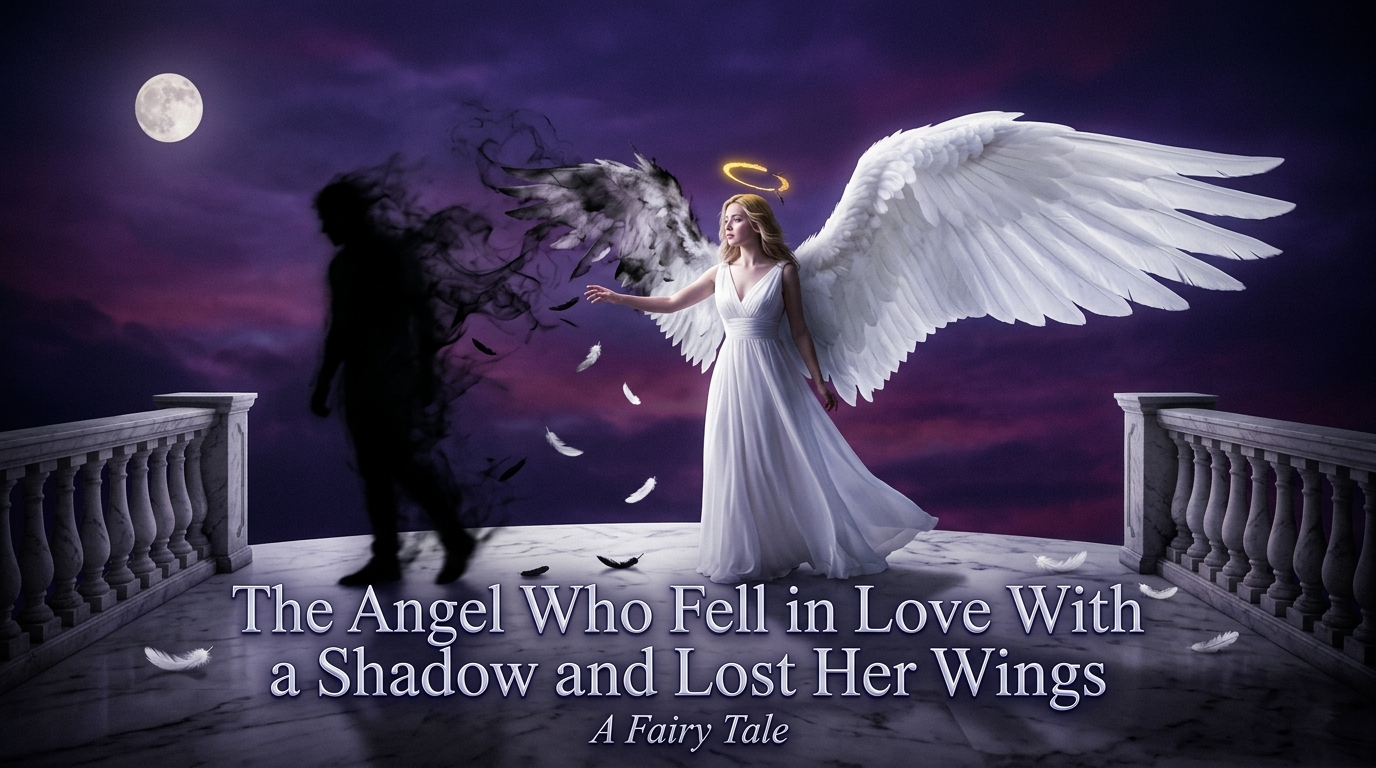
The Angel Who Fell in Love With a Shadow and Lost Her Wings !
She was not supposed to be watching the world below.
Angels had their duties — the carrying of light, the keeping of borders between the warm and the cold, the silent and constant work of watching over the small bright lives that flickered in the dark like candles in a windstorm. She had done this work for longer than she had words for time, and she had been content, the way a river is content — not happy, exactly, but purposeful, moving always in the direction she was made to move.
Then she saw the shadow.
________________________________________
It moved differently from other shadows. Most shadows were obedient things — they followed their owners, shrank in the midday sun, pooled in corners at evening. But this one wandered. She watched it cross a courtyard long after its owner had gone inside. She watched it linger at the edge of a lamp’s light, as if it were waiting for something. As if it were thinking.
She leaned closer. She leaned so close she forgot she was an angel.
She forgot she had wings.
The shadow looked up.
That should not have been possible. Shadows do not have eyes. Shadows do not have faces. But this one turned in the way a person turns when they feel they are being watched — a slow, uncertain pivot — and for just a moment, at the exact place where a face would be, something shimmered.
She fell the remaining distance in one breath.
________________________________________
She did not understand, at first, what he was. The others of his kind had owners: they were the cast-off dark of living things, the price of standing in the light. But he had no one. He drifted through the world like a word no one had spoken, belonging nowhere, holding no shape for longer than a few moments at a time.
“What are you?” she asked him, the first time she found him waiting in the blue hour between night and morning.
“I don’t know,” he said, and his voice was the sound of a room after everyone has left it. “I was someone’s shadow, once. But they walked into the light and didn’t come back. I’ve been loose ever since.”
She felt something open in her chest — not sorrow, but the shape of it. The outline.
“Are you lonely?” she asked.
A long pause. The way the dark pauses before dawn.
“I didn’t know I was until you asked.”
________________________________________
She began to visit him at the blue hour, every morning. She would fold her wings flat against her back and sit at the edge of things — the edge of rooftops, the edge of fountains, the edge of sleeping gardens — and he would gather himself beside her, taking whatever shape felt most comfortable, which was usually the shape of a young man made entirely of the absence of light.
She learned him slowly, the way you learn a language that has no written form — by listening, by paying attention, by filling in the silences with your own guesses and sometimes being right.
He was curious. That surprised her. Shadows, she had thought, only took the shape they were given. But he asked about everything — the mechanics of dawn, the weight of clouds, the reason certain music made humans press their hands to their chests. He asked about her wings with the careful reverence of someone who has never had the thing they most admire.
“Can I touch them?” he asked, once.
She hesitated. She knew the rules of her kind, though she had stopped articulating them to herself some weeks ago. There were things that were permitted and things that were not, and she was increasingly uncertain which column this fell into.
She spread one wing toward him.
His touch was cold — not cruel, just absent of warmth, the way a stone is cold. But it was careful. Enormously careful, as if he understood he was holding something that could be lost.
After that she could not remember why she had hesitated.
________________________________________
The others noticed, of course.
“He is a shadow,” said the eldest, who had been watching borders since before the world had learned to keep still. “He has no light. He cannot hold a shape. He will not be the same from one morning to the next.”
“He is consistent where it matters,” she said.
“Where is that?”
“He is always there.”
The eldest was quiet for a moment. “Light and shadow cannot occupy the same space,” she said finally. “That is not a rule we made. It is simply true.”
“I know,” she said.
“You will lose something.”
“I know,” she said again, and she meant it — she believed she did — and yet she went back the next morning, and the next, and the next, the way you go back to a place that hurts because the hurt has become inseparable from everything you love about it.
________________________________________
She did not notice, at first, when the feathers began to go.
It happened the way winter happens — so gradually that each individual day seems like the one that will hold, until suddenly the leaves are all gone and you cannot quite say when it changed. One morning she noticed that her right wing cast a slightly shorter shadow of its own. A week later she saw that the left was fraying at the lower edge, the feathers thinning like old silk worn to threads.
She did not tell him.
She was afraid that if she told him, he would leave. She was afraid that if he left, the going would take the rest.
She was afraid she was right.
________________________________________
The morning it finished was not dramatic. That was the thing no one who heard the story later could quite believe. They expected lightning, a great cry, the tearing sound of something sacred being undone. But it was just a morning. The blue hour. Her sitting at the edge of a fountain. Him beside her, more or less the shape of a young man.
She reached for his hand, the way she had a hundred times.
Her hand passed through him.
He had not moved. She had not changed. But something in the arrangement of the world had shifted, infinitesimally, and the place where they had always met — the thin impossible border between light and dark where she had folded herself down to be near him — had closed.
She felt her wings go. Not painfully. Gently, the way breath goes when you have finally stopped holding it.
She sat there for a long time in the ordinary morning, wingless, next to a shadow that could not hold her shape.
He did not say he was sorry. He did not know enough about what he was to understand what he had taken.
She did not blame him.
That was the most devastating thing — she did not blame him. She understood, with a clarity that felt like the first cold air of a morning stripped of everything comfortable, that he had not taken her wings. She had given them. One feather at a time, every morning, every time she had chosen to fold herself a little smaller to fit beside something that could not grow toward her.
She had been so busy loving him that she had not noticed she was disappearing.
________________________________________
She did not weep. She had no reason to weep — she was still herself, more or less, only lighter in the wrong way, only grounded when she had been made for the air.
She stood. She straightened.
She looked at him — her shadow, her wandering dark, her careful and curious absence of light — and she said:
“I have to go.”
He did not answer. Shadows cannot ask you to stay. That is the thing about shadows: they have no hands. They can only hold the shape the light gives them.
She walked away from the fountain.
She did not look back.
But for the rest of her long, wingless life — which turned out to be longer than most, and stranger, and full of things she had not expected — she kept a feather on her windowsill.
Just one. The last one.
White on one side. Black on the other.
Both sides, hers.
________________________________________
Some say loving the wrong thing only costs you.
But she would tell you — if you asked her in the right hour, in the right light —
that she had learned more about what she was made of
in the losing
than she ever had
in the having.
The wings were not the most important thing she owned.
She knew that now.
She just wished she had learned it some other way.
________________________________________
THE END 🤍🖤