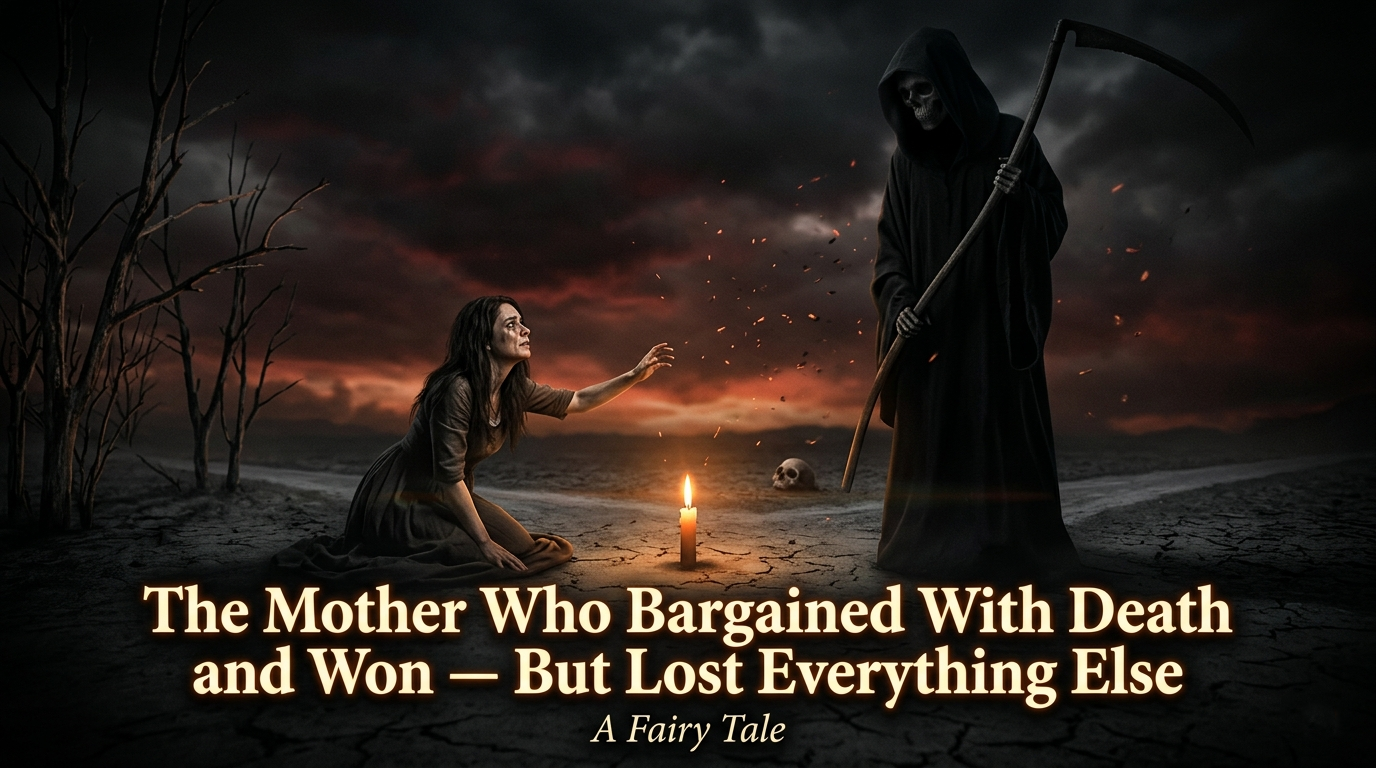
The Mother Who Bargained With Death and Won — But Lost Everything Else !
Every mother knows, somewhere beneath the ordinary warmth of ordinary days, that she would do anything.
She doesn’t say it aloud. She doesn’t need to. It sits in her chest like a stone she has learned to carry — the knowledge that if the moment ever came, she would burn the world down. She would walk into the dark. She would do the thing no one should do.
Mira knew this about herself the way she knew her own name.
She had known it the night her son Eli was born, when they placed him on her chest and she felt the stone settle in for the first time. She had known it every day of his seven years — through fevers and scraped knees and the ordinary terrors of loving something small and fragile in a large and careless world.
She had not expected to need it so soon.
________________________________________
The illness came in winter, the way the worst things do — quietly, disguised as something smaller. A cough. A fever. A child who didn’t want to eat. And then in three days, something that was not a cough and not a fever, something that the physician could not name and could not stop.
On the seventh night, when the candle on the bedside table had burned down to almost nothing, Mira felt the air in the room change.
She had heard stories. Everyone had. The old ones, the ones the grandmothers told — about the crossroads at midnight, the figure that came when it was called, the bargain that could be struck if you were desperate enough and brave enough and stupid enough.
She looked at her son’s face, wax-pale on the pillow.
She picked up the last inch of candle.
She walked to the crossroads.
________________________________________
Death was taller than she expected and quieter than she feared. It had no face she could look at directly — only the impression of a face, the way a word exists in your mouth before you say it. It wore something that was not quite a robe and carried something that was not quite a scythe, and it regarded her with the patience of something that has never once been surprised.
“You know why you’re here,” it said. Not a question.
“My son,” she said.
“Yes.”
“I want him back.”
“He isn’t gone yet,” Death said. “But he will be. By morning.”
“Then I have time to bargain.”
A long silence. The candle flame in her hand did not waver, though there was no warmth in that place.
“Most who come here want to bargain with their years,” Death said at last. “They offer me decades. Ten years, twenty. It is a common currency.”
“I know,” Mira said. “I’m not offering years.”
For the first time — and it was a first time, she understood dimly, in all of the long history of all the crossroads in all the world — something shifted in the impression of a face.
“What, then?”
Mira had thought about this on the walk over. She had three things left to offer. She had known which one she would choose before she ever left the house.
“My memory of him,” she said. “Every memory I have. His face, his voice, his laugh. The way he says my name. Everything. All of it. Gone. If he lives — you take all of it from me.”
The silence this time was different. Heavier.
“You would raise a child you don’t remember loving,” Death said. “You would look at him every day and feel nothing — no history, no recognition. He would be a stranger to you.”
“He would be alive,” Mira said. “That’s the only thing that matters.”
“You say that now.”
“I will say it always.”
Another silence. The candle burned lower.
“You understand,” Death said slowly, “that I have never lost a bargain.”
“I understand,” she said. “I’m not trying to trick you. I’m offering you something real. Something that costs me everything.”
“Why would that be worth more to me than years?”
“Because years are time,” she said. “And you have all the time there is. But this—” she touched her chest, the stone she had carried for seven years, “this is love. You don’t have that. You’ve never had it. And I’m offering to let you take it.”
The impression of a face was very still.
“That,” Death said at last, very quietly, “is a different kind of currency.”
________________________________________
Eli recovered by morning.
The physician called it miraculous. The neighbors called it luck. Her husband wept with relief and held the boy for a long time, and Mira stood in the doorway of the bedroom watching them, her hands at her sides.
She knew the child’s name. She had been told it.
She knew he was hers. The facts were in place, like furniture in a room she had never lived in.
But the warmth — the specific, irreplaceable warmth of seven years of loving one particular small person — was gone. Emptied out. Clean and hollow as a room after the moving men leave.
She watched Eli run to her, laughing, arms out — and she caught him, because she was a good woman and she understood her duty — and she held him, and she waited for something to happen inside her chest.
Nothing happened.
________________________________________
She did not tell her husband. What would she say? I bargained with Death and won, but now I feel nothing when I hold our son. He would not believe her. He would take it for grief, for shock, for the aftermath of terror. He would be kind and patient and eventually he would stop asking.
She learned to perform love the way some people learn a second language — carefully, by watching others, noting what the mouth should do and when. She learned to laugh at the right moments and hold him at the right moments and say the right things at bedtime.
Eli never knew.
That was the cruelest part, she thought, on the hard nights. That he never knew. He looked at her with his whole open trusting face and he saw his mother, and she looked at him and saw a stranger she had agreed to raise.
She was not unkind. She was never unkind. Kindness did not require the stone in the chest; kindness was a choice, a practice, a discipline, and she practiced it every day with the grim precision of someone who has lost the easy road and must take the hard one.
But she grieved. She grieved in a way that had no name and no shape, the grief of a woman who does not know what she has lost because the losing took the knowledge with it. She knew only that there had once been something warm in her, something that had made the ordinary days luminous and sweet — and that it was gone, and the gone-ness was the shape of it, the only shape left.
________________________________________
On Eli’s eighth birthday, he made her a card.
He had drawn it himself — lopsided and earnest, with a yellow sun and a green house and two stick figures, one tall and one small, holding hands. Beneath it, in the careful letters of a child who has only just learned to write, he had printed:
THE BEST MOM. I LOVE YOU TO THE STARS.
She sat with the card for a long time after he went to bed.
She traced the stick figures with one finger. The tall one. The small one. Their hands connected, the way he had drawn them connected, because he believed they were.
She thought: he does not know what I gave up.
She thought: he will never know.
She thought: and yet here it is. Here is what is left. Here is what I purchased.
And sitting there in the kitchen at midnight with a child’s drawing in her hands, something moved in the hollow place in her chest. Not warmth. Not memory. Something smaller and stranger — something like the first cold light before sunrise, before the color returns, when the sky is neither dark nor bright.
Not love, exactly. Not yet.
But the shape of love. The outline of it, pressed into the hollow like a fossil in stone — proof that something had been there, was perhaps still here, in some form she did not yet have words for.
She pressed the card to her chest.
She sat there a long time.
________________________________________
They say that Death never loses a bargain.
They say that is true.
But they also say — in the oldest tellings, the ones the grandmothers know — that love is the one thing Death has never understood. The one currency it cannot appraise.
And maybe that means that what it took from her was never quite gone.
Maybe it only went where Death couldn’t follow.
Into a child’s lopsided drawing. Into the practiced warmth of hands that chose, every morning, to reach out.
Into the hollow that kept the shape.
Into the mother who won.
Into everything else.
________________________________________
THE END 🕯️