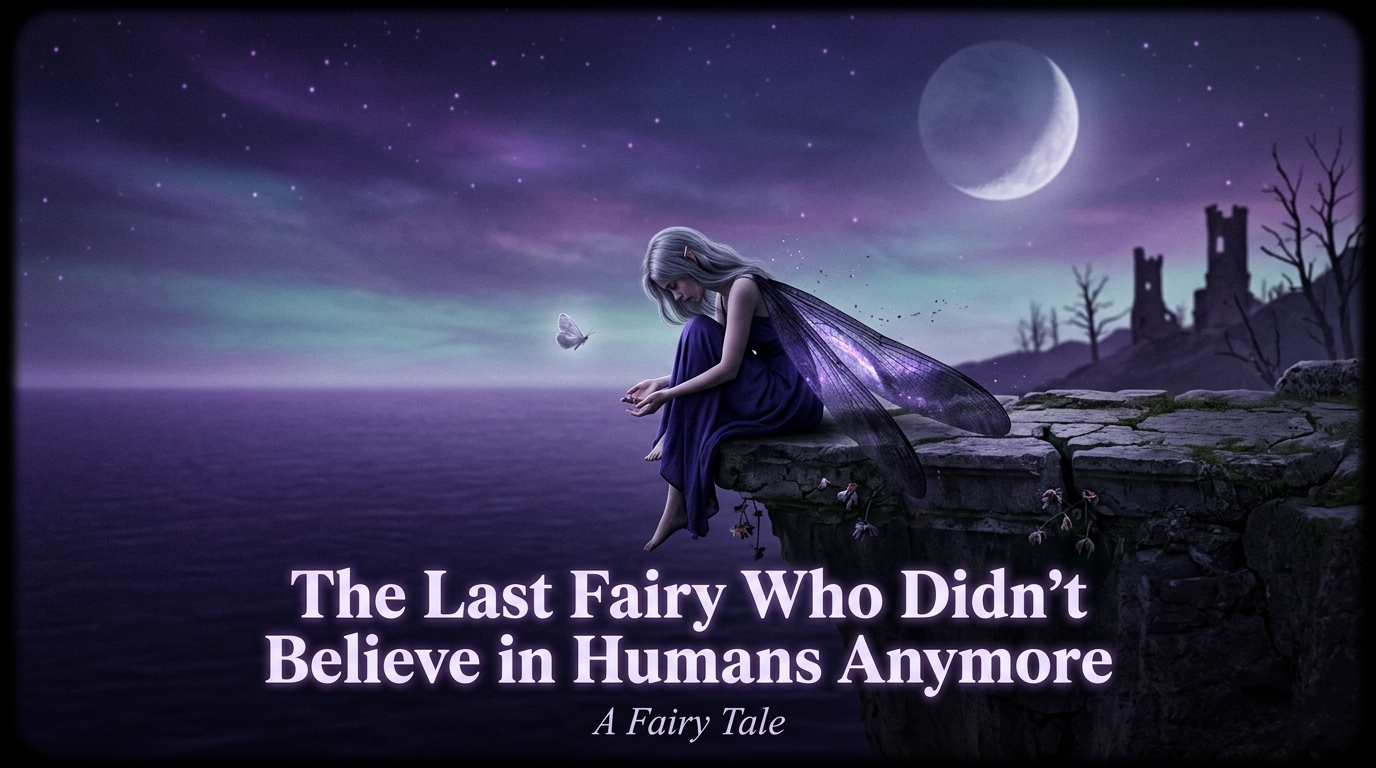
The Last Fairy Who Didn’t Believe in Humans Anymore !
There was a time — not so long ago, if you measure by the age of mountains — when fairies and humans shared the same wonder.
The fairies would hover at the edges of human villages, invisible but close, drawn to the warmth of their fires and the sound of their laughter. They planted clover in the paths of grieving mothers.
They hummed over the cradles of restless children. They made the light fall golden through the trees at just the right moment — not by magic, but by attention. By caring enough to notice. Of all the fairies in all the old wood, none believed in humans more fiercely than Sable.
She was small even by fairy standards, with wings the deep violet of the last moment before dark, and eyes the pale silver of new moons. She had no court, no territory, no title. She had only her enormous, stubborn, inconvenient heart — and her absolute, unshakeable faith in the goodness of humankind.
“They are worthy,” she would say, when the other fairies grew weary and retreated deeper into the wood. “You are only looking at the broken ones. “Sable,” the elder fairies warned her. “You are looking at all of them and seeing only the best ones. “She did not listen. She never listened. She went on believing.
The first time a human broke her faith, she was tending to a young boy who had wandered into the wood and lost his way. She led him home — invisibly, carefully — through every shortcut she knew. She brought the fireflies forward to light his path. She calmed the owls so they would not frighten him.
When he arrived home safely, the boy told his father there had been a light in the wood. Something guiding him. His father laughed. “There are no such things,” he said. “You imagined it.
“And the boy — who had felt her, who had whispered thank you into the dark — nodded and said, “Yes. I imagined it. “Sable felt something small and sharp in her chest, but she forgave it. He was afraid, she told herself. People deny what they cannot explain. It is only fear. The second time was worse. She had spent three seasons coaxing a wildflower meadow back to life at the edge of a farmer’s field — flowers the color of promises, blooming in patterns that spelled out something ancient and joyful in the language of growing things. She had done it for the farmer’s daughter, a girl of eleven who lay sick in the house above and who pressed her face against the window every morning, hungry for color.
When the girl recovered and came outside, she ran through the meadow laughing, her arms wide. She lay in the flowers for an hour, looking up at the sky. Sable watched from the branches above, her heart so full it hurt. Then the farmer came with a scythe to clear the field for crops. The girl said nothing. She did not tell him to stop. She watched her father cut the flowers down, row by row, and she went inside, and she did not look back. Sable held very still in the branches for a long time after. Then she flew away. She was afraid of him, Sable told herself. But she did not entirely believe it this time.
The third time — she did not speak of it afterward. Not to anyone. She had loved a human woman the way fairies are not supposed to love: with the whole of herself, with loyalty so deep it was closer to devotion. She had kept the cold from her door in winter. She had kept despair from her doorstep in the dark months. She had done small and invisible things for eleven years, the way the faithful do: quietly, without needing to be seen. The woman grew old. She grew afraid. And in her fear she turned to those who told her the wood was dangerous, the old magic was evil, the lights between the trees were not guides but threats.
She did not just stop believing. She took a torch. Sable barely escaped. She flew to the oldest stone at the edge of the world — a crumbling ledge at the place where the known land ended and the dark water began — and she sat down. She sat for a very long time. Her wings, which had always glowed a deep and vivid violet, began to dim. Not from injury. From something quieter and harder to fix than injury. The other fairies came, eventually. One by one, they found her. “Come home,” they said.” I have no reason to go back,” she said. “There are new humans. Young ones. They are different. “They are not different,” she said. “They grow up. They become afraid. Fear turns them small and small turns them cruel and I cannot—” She stopped. “I cannot keep starting over.” The fairies did not argue with her. They had watched her love too much for too long. They sat beside her on the stone for a while, and then they flew away, because fairies cannot stay still for long without withering.
Sable stayed. She was there when the child found her. The child was perhaps seven years old, barefoot, with leaves in her hair and a scraped knee and the absolute fearlessness of those who have not yet learned to pretend. She had followed a moth to the edge of the world and there she found a fairy sitting on a crumbling stone with dim wings and empty hands. “You’re real,” the child said. Not a question. Sable looked at her for a long moment. “So they tell me. “Why are your wings so dark? “They used to be brighter. “”What happened to them? “Sable was quiet. Then she said, very honestly: “I stopped believing in something.
“The child sat down beside her on the stone — uninvited, unafraid — and looked out at the dark water. “I stop believing in things too sometimes,” she said. “Once I stopped believing in my best friend. But then she brought me flowers when I was sick and I started again. “Sable looked at her. “What if she hadn’t? “The child thought about it seriously, the way only children and very old souls take hard questions seriously. “Then I would have been sad for a long time,” she said. “But I think I would have found something else to believe in. You have to. Otherwise you just sit on rocks. “She said it with no cruelty, no lesson intended. Only the blunt logic of someone who had not yet learned to be resigned.
Sable looked down at her own hands. At the faint dust still barely clinging to her fingers. At the wings that were dark but not, she realized, entirely lightless. “What do you believe in?” she asked. “Right now?
“The child looked up at her with silver-gray eyes. “Moths. And rocks. And fairies who sit on rocks. “And something cracked open in Sable’s chest — not breaking, but the way ice cracks in spring, the first fracture before the thaw. She did not fly back that night. She was not ready to fly. But she stayed until the child’s mother came calling, and she watched the little girl run back through the dark meadow toward the voice that loved her — and for just a moment, one small and stubborn moment, Sable felt it again. Not faith. Not yet. But the memory of faith. And she thought: Maybe that is where it starts. Maybe it always starts here. With one person. One small unreasonable act of being willing. Her wings flickered.
Just once. Just barely. But they flickered. She is still at the edge of the world, the last fairy who didn’t believe in humans anymore. But she is no longer entirely sure she is the last.
And she is no longer entirely sure she has stopped.
THE END 💜