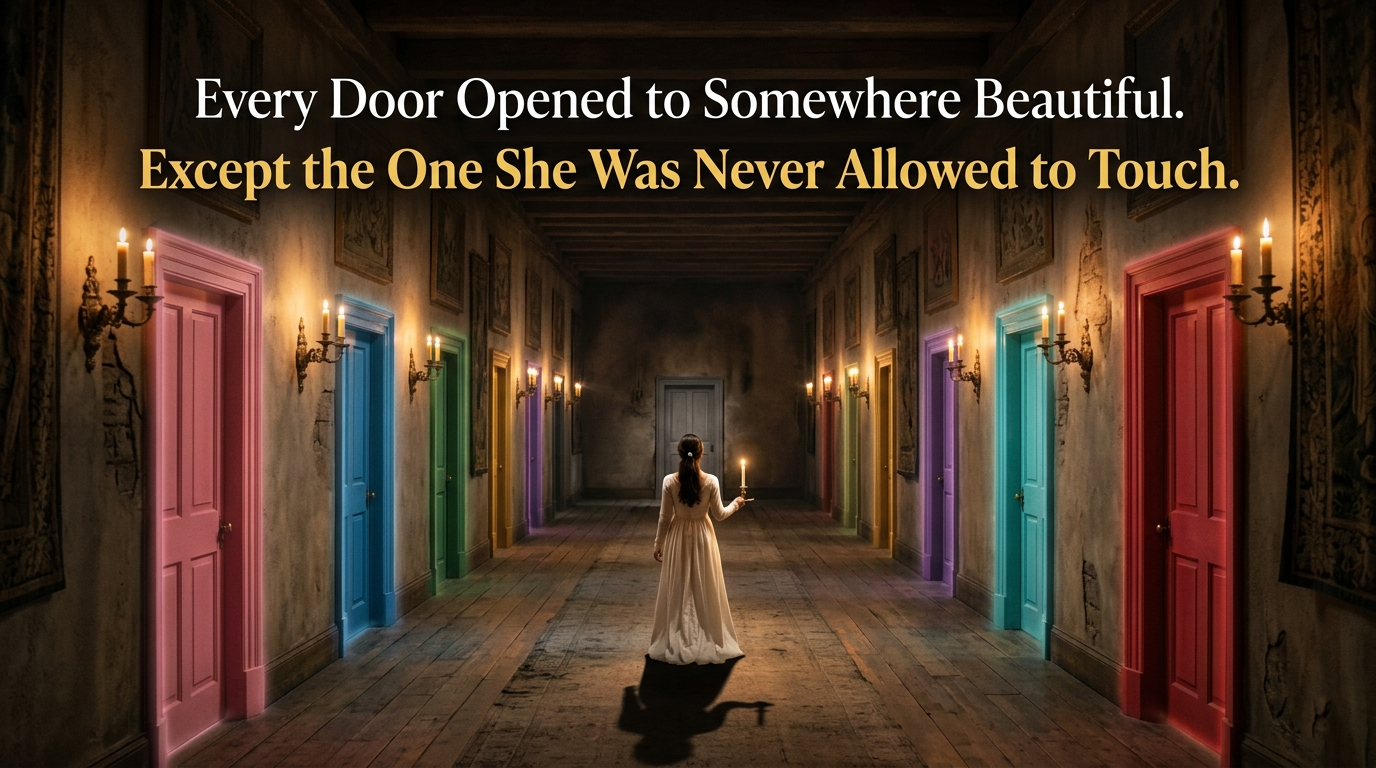
Every Door in the Old House Opened to Somewhere Beautiful. Except the One Her Mother Told Her Never to Touch.
Part 1: The House With a Hundred Doors
When Elara was seven years old, her mother gave her the most extraordinary gift a child had ever received — a house with a hundred doors, each one painted a different color, each one opening to somewhere more beautiful than the last.
The pink door at the end of the east hallway opened to a meadow where it was always the first week of May — wildflowers to the horizon, warm wind, the smell of honeysuckle so thick you could almost taste it. Elara spent whole afternoons there, lying in the grass, watching clouds drift like sleeping animals.
The blue door in the kitchen opened to a sea cliff at golden hour, where the waves sang in a language just below understanding and the salt air made everything feel clean and new. She went there when she was sad. She always came back lighter.
The gold door at the top of the stairs opened to a sky in permanent twilight, stars falling slow as snow, close enough to catch in your hands. They dissolved like sugar on your tongue and tasted faintly of something you’d loved and forgotten.
Ninety-nine doors. Ninety-nine wonders.
And one door — grey, plain, set low in the north wall of the cellar — that her mother had pressed both hands against on the day they moved in and said, in a voice Elara had never heard her use before or since:
“This one is not for you. This one is not for anyone. Promise me you will never touch it.”
Elara had promised. She had kept that promise for seventeen years.
Then her mother died. And left her the house. And left her — alone — with ninety-nine beautiful doors and one grey one she had never opened.
The morning after the funeral, Elara walked down to the cellar. She stood in front of the grey door for a long time. And for the first time in seventeen years, she noticed something she had never seen before — a thin line of golden light coming from underneath it.
Part 2: The Door That Breathed
She did not open it that morning.
She stood before it for a long time — close enough to feel the faint warmth seeping through the grey wood, close enough to hear, if she held her breath, a sound like wind moving through tall grass on the other side — and then she went back upstairs and made herself a cup of tea she didn’t drink and sat at the kitchen table until the light changed.
Grief does strange things to promises. It makes some of them feel sacred and others feel like cages. She couldn’t yet tell which kind this one was.
She spent three days wandering the other ninety-nine doors instead. She sat in the spring meadow until her eyes ached from the brightness. She stood at the singing sea cliff and let the waves say their almost-words to her. She climbed through the gold door and lay on her back in the falling-star sky and thought about her mother — about her hands, about the particular way she laughed at her own jokes, about the things she had never explained and now never could.
On the fourth night, Elara dreamed of the grey door. In the dream it opened on its own, slowly, and her mother stood on the other side — younger than Elara had ever seen her, younger than any photograph, with bare feet and loose hair and an expression that was not sadness exactly but something older than sadness.
“I was going to tell you,” her mother said in the dream. “I was always going to tell you. I just kept waiting until you were ready.”
“Ready for what?” Elara asked.
But the dream ended. As dreams always do — at the exact wrong moment.
She went downstairs before sunrise. She carried no candle this time. The golden light beneath the door was enough to see by.
She put her hand on the handle. It was warm — not like metal left near a fire, but warm like a held hand. Warm like something alive.
She opened the door.
What She Saw
It was not a place. It was not a meadow or a sea or a sky. It was a room — small, circular, stone-walled — and in the center of the room was a single chair. And in the chair sat a version of her mother she had never met. Not old. Not young. Ageless, in the way that certain true things are ageless. Her mother looked up at her with eyes that held no surprise at all. As if she had been sitting there, in that chair, behind that door, waiting patiently for seventeen years.
“You’re not real,” Elara whispered. Her mother smiled — the exact smile Elara had been trying to remember since the funeral and couldn’t quite hold in her mind. “I’m the realest thing in this house,” she said. “I always have been. Sit down, my love. We have a great deal to talk about.”
Part 3: Everything Her Mother Never Said
She sat.
The room was warm and smelled of cedar and rain and the particular perfume her mother had worn every day of Elara’s childhood — a small blue bottle that had always sat on the bathroom shelf and that Elara had kept, after the funeral, because she could not bring herself to throw it away.
Her mother — this version, this echo, this impossible tenderness sitting in a stone chair — folded her hands and looked at her daughter with an expression that contained everything she had ever wanted to say and hadn’t.
“I built this house for you,” she began. “Every door. Every beautiful place. I made them from memories — from the best moments of my life, pressed and preserved like flowers, opened into rooms you could walk through. I wanted you to grow up surrounded by wonder. I wanted you to know, in your bones, that the world held more beauty than pain.”
“And this door?” Elara asked.
Her mother was quiet for a moment.
“This door I made from grief,” she said. “From every loss I ever carried. Your father. My own mother. The child I had before you who only lived three days and whom I have never stopped loving. I put it all in here — behind a door — because I didn’t want it touching you before you were strong enough to hold it.”
Elara felt something crack open in her chest. Quietly. Like a window unlocking.
“You were protecting me.”
“I was protecting you,” her mother agreed. “And I was wrong to keep it so long. Grief is not a thing to be locked away from the people you love. It is a thing to be shared. I should have opened this door with you years ago. I should have let you help me carry it.”
What Elara Said
“I would have,” Elara whispered. “I would have carried all of it. I would have carried it gladly.” Her mother reached out and touched her face — and though she was made of memory and golden light and all the things left unsaid, her hand was warm. It was the warmest thing Elara had ever felt.
They talked until the light beneath the door shifted from gold to rose to the pale clear blue of early morning. Her mother told her things she had never known — stories of a life lived before Elara existed, sorrows that had shaped her in ways she now recognized in herself, joys that explained the particular way her mother had always laughed a little too long at beautiful things, as if she was trying to keep them.
When the light turned fully morning, Elara knew — the way you know things in fairy tales, which is to say in the deepest part of yourself where words haven’t reached yet — that this was the last time.
“Will you stay?” Elara asked. Her mother shook her head slowly. “I was never really gone,” she said. “That was the thing I most needed you to know.” She stood. She walked to the door — not the grey one, but a door in the stone wall that Elara had not noticed before, small and bright and the exact color of the sky on a perfect day. “This one,” her mother said softly, “I made last.”
Part 4: The Door She Made Last
The door was the color of a clear October sky — not painted, but somehow simply that color, the way some things simply are what they are without explanation.
There was no handle. There was no keyhole. There was only a small mark at its center — a handprint, pressed in gold, the exact size of her mother’s hand.
“What’s on the other side?” Elara asked.
“Nothing yet,” her mother said. “That is the point.”
She turned to Elara one last time. Her face in the morning light was every age at once — the young woman in the dream, the mother from the photographs, the woman with the blue perfume bottle, the hands in the garden, the voice on the telephone, the laugh at her own jokes — all of it, held together in one face, looking at her daughter with the fullness of a whole life loved and spent.
“The other ninety-nine doors are mine,” she said. “My memories. My beautiful places. They will stay as long as the house stands, and you may visit them whenever you need to.” She paused. “But this house was always meant to become yours. And a life — a real life — cannot be lived entirely in rooms built from someone else’s past.”
She pressed her palm to the handprint on the door. The room filled, briefly, with a light that had no color and every color. The door swung open.
On the other side was nothing. A gentle, waiting nothing — the kind that isn’t empty but full of everything not yet chosen. A blank page. A held breath before the first word.
A beginning.
“This door,” her mother said, “opens to wherever you decide to go.”
She stepped through the sky-blue door and was gone. No sound. No wind. Just gone, the way the last note of a song is gone — complete, finished, still somehow ringing.
Elara stood alone in the small stone room for a long time.
Then she walked to the sky-blue door. She pressed her own hand to the center — and felt, against her palm, the warmth of her mother’s handprint still there, as if it had just been made.
She stepped through.
The house behind her remained — all its hundred doors, all its beautiful rooms, all its preserved springs and singing seas and falling-star skies. Waiting, patient and luminous, for whenever she needed to return.
But ahead of her — ahead of her was everything.
And it was hers. And it was new. And it was beginning.
✨ Some doors are left closed to protect us. Some are opened to set us free. And the most beautiful door of all is the one that has never been opened yet — because it is waiting for you to decide where it leads. Share this story with someone who needs to open a door they’ve been afraid of. 🔑
-END-