He Fell Asleep for One Hundred Years. When He Woke, Only One Person Had Waited — and She Was Furious.
Part 1: The Prince Who Wouldn’t Wake Up
Every kingdom in every story has a sleeping prince. What the stories never tell you is what happens to the person who decides to wait.
Prince Caspien of Aldenmere fell under the curse on the third day of autumn, in the twenty-third year of his life, because he had — in the words of the witch who placed it upon him — “the most profoundly irritating habit of never finishing what he started.”
He had left seventeen letters unsent. He had begun four treaties and signed none. He had promised his kingdom a new bridge for six years running and broken ground on it twice. He had, most importantly, told a young woman named Mira that he loved her on a Tuesday and then gotten cursed into unconsciousness on a Wednesday before she could respond.
The witch, it should be noted, had a point.
The entire kingdom agreed he would wake within the year. True love’s kiss, someone said confidently. It was always true love’s kiss. Several suitable noblewomen were lined up. There was a rota.
Nothing worked.
One by one, the suitable noblewomen gave up and went home. The rota was retired. The kingdom, deciding that waiting for a prince who showed no signs of waking was not a sound economic strategy, restructured its government and quietly moved on.
Mira did not move on.
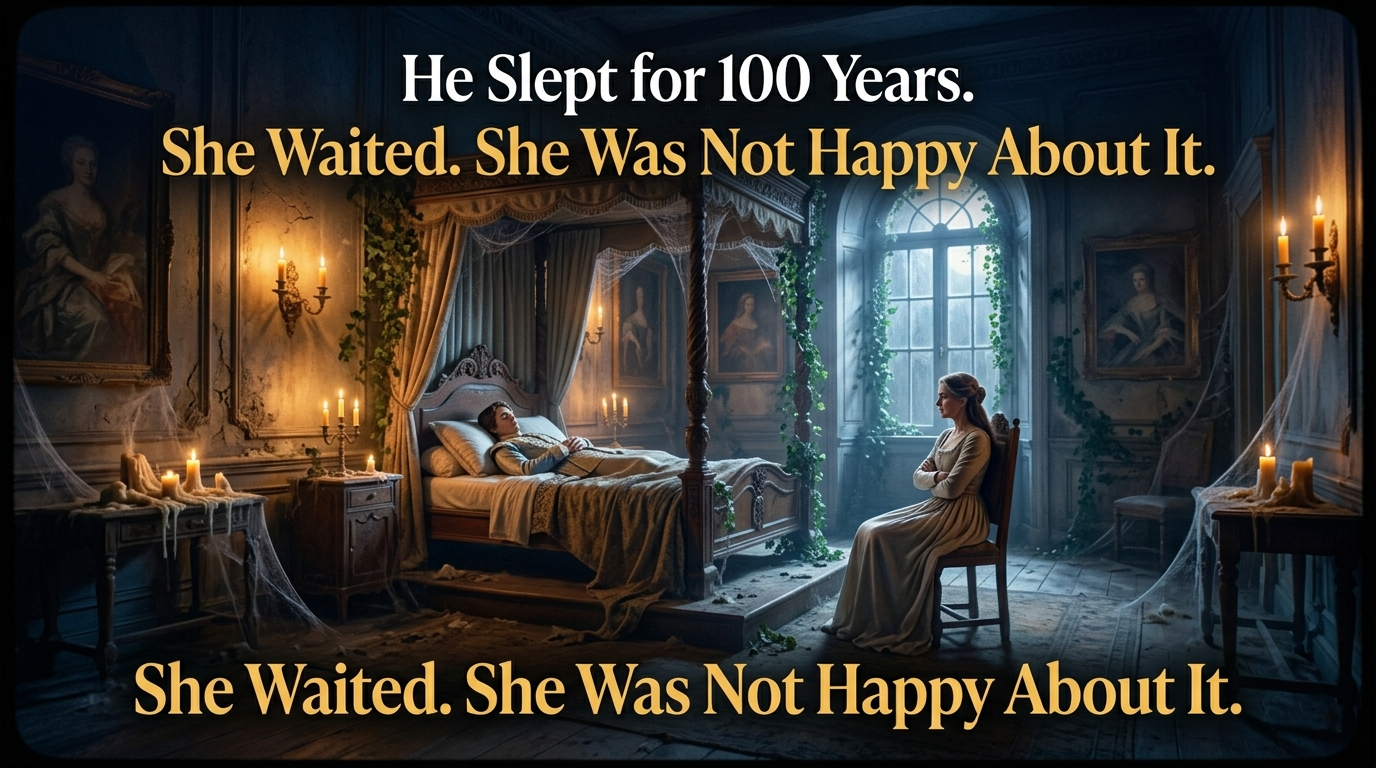
Mira pulled up a chair beside his bed, crossed her arms, and stayed.
“You said you loved me,” she told his sleeping face on the first night. “You do not get to say that and then simply opt out of consciousness. I will be here when you wake up. And you will have a great deal of explaining to do.”
That was one hundred years ago.
She was still there when he finally opened his eyes.
The first thing Prince Caspien saw when he woke after one hundred years was Mira’s face. The expression on it was not relief. It was not joy. It was the face of a woman who had been composing a speech for a very long time and was finally, at last, ready to deliver it.
Part 2: One Hundred Years of Things to Say
The first thing Caspien said, blinking at the candlelit ceiling of his bedchamber with the bewildered expression of a man who had just woken from the world’s longest nap, was:
“Is it Thursday still?”
“It is not Thursday,” Mira said.
“Friday, then.”
“It is the fourteenth of October,” Mira said, in a voice of extraordinary precision, “in the year one hundred and three of the Post-Caspien Restructured Calendar, which the kingdom invented because they got tired of counting from your birthday. You have been asleep for one hundred years, four months, and eleven days. I have been sitting in this chair for most of that time. You’re welcome.”
Caspien sat up slowly. He looked at her. He looked around the room — at the cobwebs, at the ivy curling through the cracked window frame, at the dust thick on every surface except the chair she sat in and the small table beside it, which held a teacup, a stack of books, and a list written in very small handwriting that appeared to be several pages long.
“What’s the list?” he asked.
“Things you owe me an explanation for,” Mira said. “I’ve had time to be thorough.”
Selected Items From the List
Item 7: You promised to finish the East Bridge in the spring of year one. It is year one hundred and three. The bridge remains unfinished. I have personally supervised three construction attempts in your absence. The fourth begins Tuesday — you will attend.
Item 23: On the night before the curse you told me, and I quote, “Mira, I will love you until I run out of time.” I would like to formally note that you then immediately ran out of consciousness, which I consider a technicality and not an acceptable substitute.
Item 41: You still owe me eleven gold coins from a wager we made in year one. With interest, compounded annually, this is now a sum that could purchase a small duchy. I have the calculations.
Caspien stared at the list. He looked up at her. He had the expression of a man simultaneously deeply remorseful and deeply, helplessly charmed.
“How long is the list?” he asked.
“Sixty-seven items,” Mira said. “I edited for brevity.”
“Mira—”
“You don’t get to say my name like that yet,” she said firmly. “You haven’t earned it. You get to say my name like that after item sixty-seven. We’ll work through them in order.”
He looked at her for a long moment — this woman who had sat beside him for a century with her arms crossed and her list growing and her loyalty so fierce and so steady that not even time itself had been able to move her from her chair.
“Alright,” he said quietly. “Item one.”
They worked through the list for three days. By item thirty-one, he was laughing. By item forty-four, she was trying very hard not to. By item fifty-eight — the one about the letter he’d written her and never sent, the one she’d found tucked inside his jacket on the first night of the curse — neither of them was laughing at all.
Part 3 of 4
Item Fifty-Eight
Publish on Website
The letter was folded into quarters and had been folded and unfolded so many times over one hundred years that the creases had gone soft as cloth.
Mira set it on the table between them without comment. She looked out the window. Outside, the kingdom of Aldenmere went about its morning — a kingdom that had rebuilt itself entirely in his absence, that had grown and changed and made its peace with the fact of a sleeping prince, that had named streets after him partly in honor and partly, she had always suspected, in gentle mockery.
“You found it the first night,” Caspien said. It was not a question.
“I found it the first night,” she confirmed.
“And you kept it.”
“For one hundred years, four months, and eleven days,” she said. “Yes.”
He picked it up carefully. He did not open it — he knew what it said. He had written it the morning of the day he was cursed, sitting at his desk in the early light, trying for the twelfth time to find the right words for a feeling he had been carrying so long it had become part of his architecture.
He had not sent it because he was afraid. He had been afraid she wouldn’t feel the same. He had been afraid of finishing something that mattered so much that getting it wrong would have been worse than not trying.
The witch, he now reflected, had been extremely perceptive.
What the Letter Said
Mira — I have started this letter twelve times. I keep stopping because I am afraid of it, which is absurd, because I have faced cursed forests and sea serpents and one very aggressive enchanted goose, and none of those things frightened me the way finishing this sentence does. But here it is: I love you. I have loved you since the morning you told me my plan for the northern road was, and I quote, “the single most confidently incorrect thing I have ever heard from a person in a position of authority,” and then proceeded to fix it in forty minutes. I should have said this years ago. I am saying it now. Please don’t make me wait too long for an answer.
The room was very quiet.
“You asked me not to make you wait too long,” Mira said, after a moment.
“I did,” Caspien said.
“One hundred years is quite long.”
“It is the longest,” he agreed. He looked at her then — really looked at her, the way he should have looked years before the curse, the way he had been too frightened and too unfinished to look. “I’m sorry, Mira. For all sixty-seven items. For the bridge and the wager and the seventeen unsent letters and a century of your life spent in a very uncomfortable chair. I am profoundly, specifically, itemized-list sorry.”
Mira looked at him for a long time.
“That,” she said finally, “was item sixty-six.”
“What’s item sixty-seven?”
She picked up the list. She turned it over. On the back, in handwriting slightly different from the rest — fresher, written more recently, the ink less faded — was a single line.
She slid it across the table so he could read it.
Item Sixty-Seven
Finish what you started.
He looked up from the list. She was watching him with the expression she’d had in the chair for a century — steady, certain, immovable — except that now, underneath it, was something else. Something that had been waiting just as long as she had, patient and bright, like a candle kept lit through a very long night.
Part 4: Item Sixty-Seven
He stood up from the bed for the first time in one hundred years.
His legs were, he discovered immediately, entirely unreliable after a century of disuse. He sat back down. He tried again. Mira, to her credit, did not help him. She watched with her arms crossed and the expression of someone who had waited this long and could wait another thirty seconds.
On the third attempt he made it upright and stayed there, swaying slightly, holding the bedpost with the dignity of a man who was a prince and was going to behave like one regardless of the fact that his feet had been asleep for longer than most kingdoms lasted.
“Right,” he said.
“Right,” she agreed.
He crossed the room. It took longer than it should have. She did not move toward him, because she was Mira, and she had done one hundred years of moving toward him, and she had decided some time around year forty that when he woke up he was going to have to cross at least one room under his own power.
He stopped in front of her chair. He looked down at her. She looked up at him.
“Mira,” he said — and this time she let him say it the way he meant it, low and careful and full of a hundred years of everything unsaid. “I love you. I have loved you since the morning you fixed my road plan in forty minutes. I should have said it before I fell asleep. I should have sent the letter. I should have finished approximately sixty-seven things I left half-done, and I intend to finish all of them, beginning with this one.”
She stood up from the chair.
She had sat in it for one hundred years. She unfolded from it now like someone setting down a very heavy thing they had carried a very long distance — with relief, and grace, and the quiet satisfaction of having carried it all the way to where it needed to go.
She was eye to eye with him. She had always been eye to eye with him.
“For the record,” she said, “my answer to your letter is yes. It has been yes for one hundred years, four months, eleven days, and” — she glanced at the window, where the morning light was just reaching the sill — “approximately six hours.”
“That’s a very long yes,” he said.
“You’re a very slow prince,” she said.
He laughed — and it was the same laugh she remembered, the one she had kept the memory of carefully through a century of waiting, the one she had been quietly afraid she had remembered wrong. She hadn’t. It was exactly right.
He kissed her. She kissed him back with the full force of one hundred years of patience finally, completely, gloriously spent.
Outside, the kingdom of Aldenmere went about its morning, entirely unaware that in the old tower room the most overdue kiss in recorded history had just occurred, and that the East Bridge construction — beginning Tuesday — would finally, this time, be completed.
The witch, wherever she was, presumably felt vindicated.
The chair sat empty by the bed for the first time in a century — its job done, its occupant elsewhere, its long and faithful watch finally, joyfully over.
✨ Some love stories take a lifetime. This one took a hundred years. Share this with someone whose love story is worth every bit of the wait. 💛