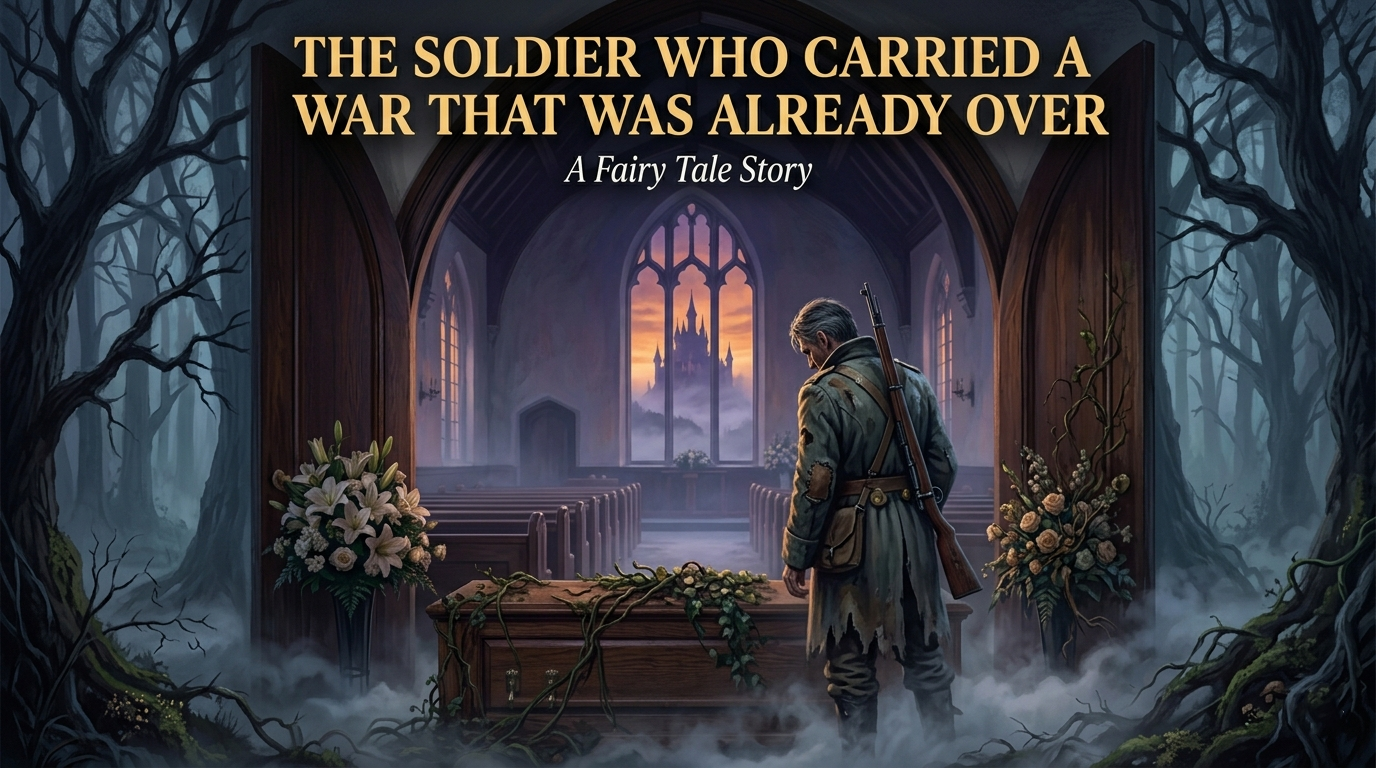
The Soldier Who Carried a War That Was Already Over !
Once upon a time, in a kingdom where the mountains kissed the clouds and the rivers sang lullabies to sleeping stones, there lived a soldier named Elias.
Elias had gone to war when he was seventeen — young enough that his mother still tucked rosemary into his coat pocket for luck, and old enough to hold a sword without trembling. The war was great and terrible, fought between two kingdoms over a river neither of them truly needed. Kings made speeches. Mothers cried. And boys like Elias marched into the smoke.
He fought bravely. He fought fiercely. He fought alone — cut off from his regiment during a great storm that swallowed the battlefield whole. When the fog lifted, there was no one left. No enemy. No allies. Just Elias, his sword, and the silent forest at the edge of the kingdom.
They must have retreated, he told himself. The war goes on. I must hold the line.
And so he did.
He built a shelter from fallen branches. He sharpened his sword on smooth river stones. He patrolled the forest border every dawn, watching for an enemy that never came. Seasons passed. Snow fell and melted. Birds flew south and returned. Elias grew older, though he refused to feel it.
Villagers at the edge of the forest began to whisper about a ghost — a weathered figure in a tattered uniform who watched the tree line with hollow, faithful eyes.
Children dared each other to leave bread near the forest path.
The bread always disappeared.
Years became a decade. A decade became twenty years.
Then one autumn afternoon, a young girl named Mira wandered too deep into the woods chasing a red fox. She stumbled into a small clearing and found a soldier sitting beside a fire, mending a boot with hands worn smooth as river stones.
He looked up. His eyes were the color of old winter — pale and deep and tired.
“Are you lost, child?” he asked, his voice rough from years of mostly silence.
“Are you?” she replied, because she was seven and had not yet learned to be afraid of honest questions.
Elias blinked. No one had asked him that before.
“I am a soldier,” he said carefully. “I guard this border. The war—”
“What war?” said Mira.
He opened his mouth. Then closed it.
“The war between the Kingdom of Aldenmoor and the Kingdom of Vel,” he said.
Mira tilted her head. “My grandmother talks about that war. She says it ended before my mother was born.” She picked up a pinecone and turned it in her fingers. “She says the kings shook hands and planted an apple tree together where the old battlefield was. The tree gives fruit every year. I’ve eaten the apples.”
The fire crackled between them.
Something in Elias’s chest — something he had kept tightly locked, wound like a clock spring, taut for twenty years — made a sound like a key turning.
“The war,” he said slowly, “is over?”
“It’s been over a very long time,” said Mira gently, in the way that children say the truest things — without cruelty, without ceremony. Just plainly, like stating that the sky is blue.
Elias sat very still.
Above them, a bird sang a note that seemed to last longer than it should.
He looked down at his sword. At his hands. At the uniform he had mended so many times it was more patch than cloth. He thought of his mother’s rosemary, long since crumbled to dust. He thought of the river neither kingdom needed. He thought of all the mornings he had risen to guard a border that no longer existed, fighting an enemy who had long since gone home, grown old, maybe grown kind.
He had been so faithful to something that had already ended.
A tear fell into the fire. It hissed like a secret finally spoken aloud.
“I didn’t know,” he whispered.
Mira sat down beside him — because she was seven, and seven-year-olds sit beside people who are sad without being asked.
“You know now,” she said.
That evening, Mira led Elias out of the forest. He walked slowly, like a man learning to trust solid ground again. The village watched him emerge from the trees — this ghost made suddenly real, this soldier blinking in the amber light of an ordinary evening.
An old woman near the well dropped her bucket.
“Elias?” she breathed.
He looked at her — at the lines time had drawn on a face he still recognized. His sister. Old now. But her eyes the same.
She crossed the distance between them in three steps and held him the way only someone who has grieved and then been given back something can hold a person — fiercely, quietly, completely.
“The war ended, brother,” she wept into his shoulder.
“I know,” he said. “I just learned.”
He laid his sword down in the grass that night. Not with bitterness. Not with shame. Simply — set it down.
And in the morning, for the first time in twenty years, Elias did not rise to patrol the border.
He rose, instead, to have breakfast.
And outside, on the village’s oldest apple tree — planted by two kings who had chosen peace — a single late blossom opened, white and small and quietly brave, as if it had been waiting all along for exactly this moment.
The End.
________________________________________
Some wars end on battlefields. Others end in quiet clearings, beside small fires, when someone young enough to ask the right question finally does.