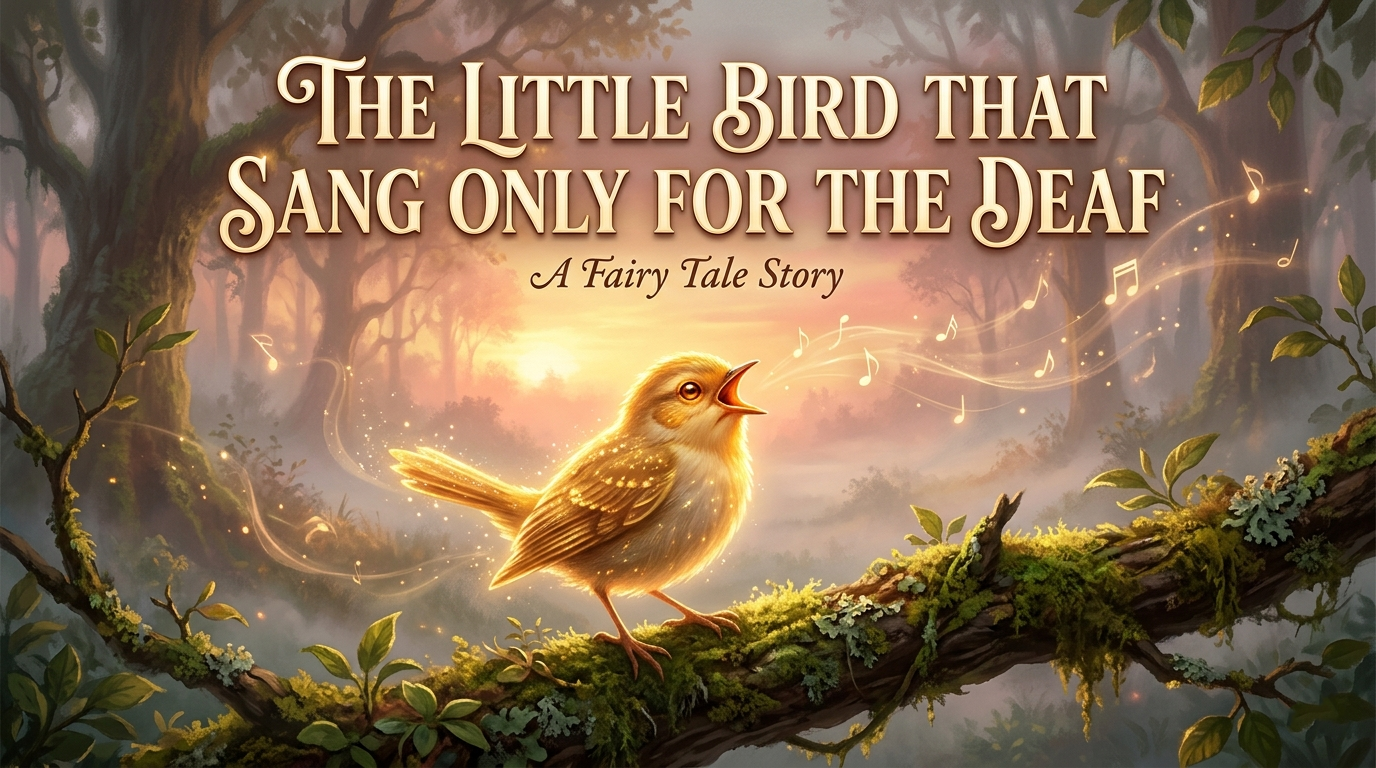
The Little Bird That Sang Only for the Deaf !
Once upon a time, in a kingdom tucked between two mountains that leaned toward each other like old friends, there lived a little bird with feathers the color of morning butter and eyes like polished amber.
Her name was Luma.
Luma could sing. Oh, how she could sing. Her voice carried the sound of rain tapping on lily pads, of rivers whispering secrets to sleeping stones, of wind threading itself through tall summer grass. The other birds in the Great Forest could hear her and would pause mid-flight, tilting their heads in something close to reverence.
But the people of the kingdom — the farmers, the bakers, the merchants, the lords — they never stopped to listen. They were too busy. Too loud. Too certain that anything small and golden perched on an ordinary branch had nothing important to say.
“A common bird,” they told their children. “Pay it no mind.”
So Luma sang, and the world rushed past her like a river past a stone.
Until the day she found the village of Alden.
Alden was a quiet place — quieter than most — because nearly everyone who lived there was deaf. They communicated in a beautiful language of hands and faces and the eloquent tilt of a shoulder. They had built their homes close together, their windows large, their doors always open, their eyes trained to catch every flicker of meaning the world offered.
Luma landed on a fence post at the edge of Alden one grey morning, cold and tired from a long journey. She opened her beak out of habit — not hope — and sang.
And something extraordinary happened.
A little boy named Fen, sitting on a doorstep nearby, looked up. Not because he heard the song. But because he felt it. The air around the bird trembled differently. The fence post hummed faintly beneath his fingertips. The very light seemed to lean in the direction of the sound.
He walked to the fence and held out one finger.
Luma stared at him for a long moment. Then she stepped onto it.
Fen felt the tiny rapid heartbeat through his fingertip like a secret being tapped in code. He smiled — slowly, the way people smile when they understand something they didn’t expect to.
He brought Luma inside.
Word spread through Alden in the way all important things spread there — swiftly, silently, hand to hand. By evening, a small crowd had gathered in the village square. Luma sat on a low branch of the elm tree at the center, and she sang with everything she had.
Nobody heard a single note.
And yet — a woman with silver hair closed her eyes and felt tears on her cheeks, though she could not explain them. An old man pressed his palm to the bark of the elm tree and stood very still for a long time, his face peaceful as a lake at dawn. Children placed their hands lightly in the air around the bird, eyes wide, laughing at something they couldn’t name.
They felt the song in their bones. In their chests. In the soft place behind the eyes where feeling lives before it becomes words.
Luma sang every evening after that. She stayed all through the summer and into the autumn, when the elm leaves turned the same color as her wings.
One day, a traveling merchant passed through Alden and heard — or rather, didn’t hear — the famous singing bird.
“Why do you all gather around a bird that makes no sound you can hear?” he asked Fen, who by then had learned enough of the merchant’s spoken language to answer.
Fen thought for a moment. Then he signed, and a woman nearby translated:
“You are thinking about it wrong. She makes a sound we cannot hear. What reaches us is something older than sound. Something that doesn’t need ears. We think perhaps this is why she came to us — because we were the only ones empty enough of noise to receive it.”
The merchant didn’t know what to do with that answer, so he wrote it in his journal and carried it with him for the rest of his life, taking it out on difficult evenings the way some people take out a smooth stone.
That winter, Luma fell ill. She grew thin and her feathers lost their luster. The people of Alden took turns keeping her warm, building her a small nest inside the warmest house, leaving tiny dishes of honeyed water and seeds beside her through the long cold nights.
She recovered in the spring — frail at first, then stronger, then bright as ever.
On the first true warm morning, she flew to the highest branch of the elm and sang the longest, most unguarded song she had ever sung in her life.
No one in Alden heard a single note.
Every single one of them wept.
Afterward, old Maren — the eldest woman in the village, who had not cried in forty years — signed something to Fen.
He translated it later, for the merchant’s journal, in a letter he sent to no one in particular but hoped the world might someday find:
“All our lives we were told we were missing something. That the world of sound was closed to us, and we stood outside it like children at a window. But Luma showed us that there is a music beneath music — felt before it is heard, understood before it is explained. She did not come to us despite our deafness. She came to us because of it. Because we had learned — as those who live in silence must — to listen with everything.”
Luma lived in Alden for seven more years. When she finally flew away one misty autumn morning, she left behind something that no one could see or measure or put a name to — only feel.
A warmth. A presence. The particular quality of air in a place where something beautiful once happened and left its shape behind, the way a hand leaves its impression in warm bread.
And in the years that followed, travelers came from distant lands to visit Alden — not for the famous bird, who was long gone, but because people said the village felt different. Gentler. More attentive. As if the people there had learned, somehow, to receive something the rest of the world kept missing.
They had.
The End.
The song that changes you most is rarely the one you were listening for. Sometimes it finds you only after you have grown quiet enough to feel it.