The Last Text
A Mystery & Thriller Short Story
PART 1: — 2:47 AM
Maya Chen hadn’t slept in three days. Not properly — not the kind of sleep that restores you. She’d been doing what she called “horizontal worrying,” lying in the dark with her eyes open, cataloguing the same small disasters on repeat: rent, the promotion she didn’t get, the plant on the windowsill she kept forgetting to water. The ordinary machinery of a life quietly coming apart.
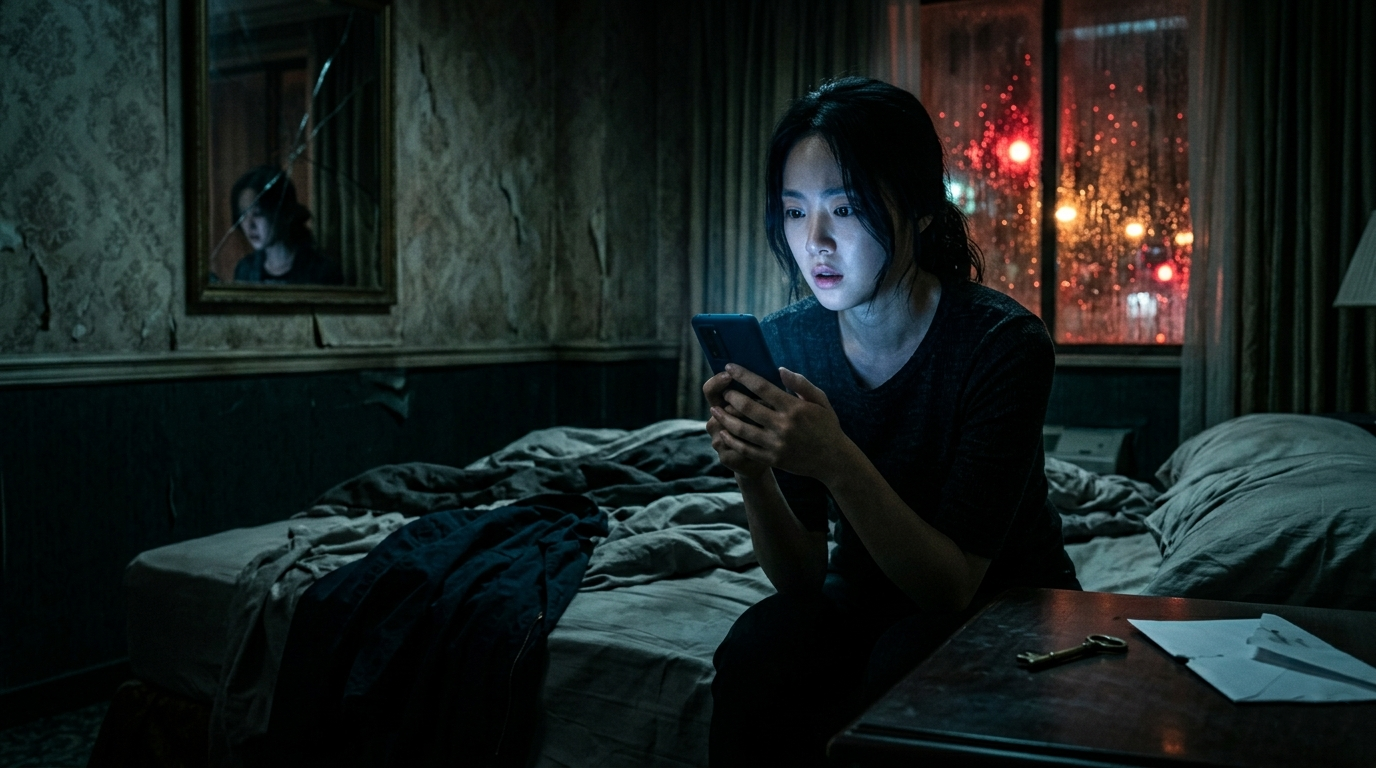
The text arrived at 2:47 AM on a Tuesday, while she was on her third glass of water and her second circuit of the apartment. Her phone lit up on the kitchen counter. One message. No name in the preview — just a number. A number she had deleted four months ago, on the advice of a grief counsellor who had said, gently but firmly, that holding on to the contact would not help her heal.
She picked up the phone. She read the message. Then she read it again.
“He knows. Don’t come looking for me. — L”
The number belonged to Lena Park. Her best friend since the second year of university, when they had shared a disastrous kitchen and a very good bottle of wine and talked until four in the morning about everything that mattered. Her best friend, who had been missing for four months. Whose phone had been found at the bottom of the Han River — shattered, waterlogged, dead — and whose case had been quietly reclassified by Detective Min-jun Wu from missing person to presumed deceased six weeks after she vanished.
Maya’s hand was shaking. She set the phone flat on the counter and stared at it as though it might say something else, explain itself, take it back.
Then she did all the right things. She took a screenshot. She called Detective Wu and left a message on his voicemail. She sent the screenshot to her own email address. She did everything a sensible, law-abiding person was supposed to do when they received an impossible message from a dead phone.
Then she poured the water down the drain and opened a bottle of wine.
Detective Wu called back at 8:15 AM. He sounded tired in the practiced way of someone who is always tired and has stopped noticing. He told her the message had almost certainly come from a cloned or spoofed number, that this kind of thing happened, that grief sometimes made people susceptible to reading meaning into coincidences. He told her he’d look into it. His tone suggested he would not look into it very hard.
Maya thanked him and hung up. Then she opened the screenshot and looked at the message again. She knew Lena’s number from memory — had known it for six years. She knew it wasn’t a coincidence.
She also knew that “He knows” was not the kind of phrase a ghost would use. Ghosts, as far as she understood them, did not concern themselves with what other people knew. The living did.
She was still staring at the screen when the doorbell rang. It was 9:03 AM. There was no one there — just the empty corridor, and on the doormat, a single white envelope.
Maya picked it up with two fingers, the way you handle something you’re not sure is safe. Inside was a brass key — old, warm-coloured, the kind that looked like it opened something that still mattered. And underneath the key, a folded piece of paper, cream-coloured, the same kind Lena used to buy in bulk from a stationery shop on Insadong-gil because she believed that handwritten letters deserved beautiful paper.
The handwriting was Lena’s. Unmistakably. Irrefutably. The particular slant of the L’s, the way the letters leaned into each other like they were cold.
Meridian Hotel. Room 404. Come alone. Come now. Don’t let them follow you.
No signature. No explanation. Just the key, and the note, and the sound of Maya’s own breathing in the empty hallway.
She grabbed her coat.
PART 2 — Room 404
The Meridian Hotel was the kind of place that had once been beautiful. Its lobby still had the bones of something grand — a vaulted ceiling, a chandelier that had probably been spectacular in 1987, marble floors patterned with a motif that someone had once thought was timeless and that now just looked old. The man at the front desk had the expression of someone who had seen enough to stop being surprised by anything. He didn’t look up when Maya walked past.
The lift groaned like an animal in a trap. Maya took the stairs.
The fourth floor smelled of cigarettes and damp plaster. She counted the door numbers — 401, 402, 403 — each one in tarnished gold. She stopped at 404. She listened. Nothing. Just the faint hum of the building’s bones.
The key slid into the lock with a soft, perfect click — the fit of something recently used, recently oiled. Maya pushed the door open with her shoulder and reached for the light switch before she could talk herself out of it.
The lamp on the bedside table was amber, warm, and dim. It took Maya three full seconds to understand what it was illuminating.
Lena Park was sitting on the edge of the bed.
Alive. Thin — considerably thinner than Maya remembered — with shadows carved under her eyes like something the light had given up on. She was wearing a grey hoodie two sizes too large and holding a paper coffee cup with both hands, as though warmth was something she needed to hold onto carefully.
Maya’s voice came out barely above a whisper. “You’re dead.”
Lena let out a long breath that was almost a laugh. “I know,” she said. “That’s the idea.”
Lena spoke in a low, careful voice — measured in the way of someone who has rehearsed what they’re going to say so many times that the words have worn smooth, like stones in a river. She did not fidget. She did not look away. She had been living inside this secret for four months and had learned to carry it very still.
She had not disappeared. She had vanished — deliberately, precisely, with the kind of planning that left no margin for sentiment.
Three months before she vanished, Lena had been working late on a Thursday when she found the records. She was a junior data analyst at a mid-tier logistics company — the kind of job that paid adequately and required her to care about shipping manifests and inventory databases, which she did not, particularly. But she was thorough. She was always thorough. And being thorough, on that Thursday, had led her down a chain of linked spreadsheets to a set of transactions that had no logical explanation inside a legitimate business model.
Shell companies. Layered transfers. Money that entered as one thing and emerged as something cleaner and untraceable. A name she recognised attached to a series of accounts she was not supposed to know existed: Marcus Ren. A philanthropist. A property developer. The kind of man who appeared at charity galas and had a foundation named after him and was photographed regularly shaking hands with people who had power. The kind of man who had, beneath all of that, built a very quiet and very efficient machine for moving money that did not belong to him through channels that did not officially exist.
“How did he find out you knew?” Maya asked.
“Forty-eight hours,” Lena said. “That’s how long it took. I went back to the office the next morning and there was a man in the car park I didn’t recognise. He was just standing there. Looking at the building.” She paused. “He was looking at it the way you look at something you already own.”
Lena had moved fast. She had a burner phone — the same model as her real one, the same colour case — that she had been carrying since she found the records, because she had understood, with the clarity of someone reading something they cannot unread, that she was now in a different kind of story than she had been before. She went to the river at night. She put the burner in the water. She walked north for six hours to a district she had never visited, to a woman named Soo-jin who had once owed Lena a debt of the kind that does not expire.
She had been moving ever since. Never the same place twice. Never a credit card. Never a face on a camera if she could help it. Six days ago she had arrived at the Meridian, because the Meridian was one of Marcus Ren’s hotels — and the one place she calculated he would never think to look for her was inside something he owned.
“It’s not a bad theory,” Maya said.
“It’s a desperate theory,” Lena replied. “There’s a difference.”
“But why me? Why now? Why go through all of it — the text, the key, the note — why not just call me four months ago?”
Lena set down her coffee cup. She looked at Maya the way you look at someone you have spent four months missing — carefully, from a distance, in the dark. “Because I needed you on the outside. Visible. Normal. Living your life in a way that would make them think I was really gone and you genuinely had no idea.” She reached under the mattress and pulled out a small drive — 32 gigabytes, no larger than a thumb. “And I needed you to carry this.”
Every piece of it — the impossible text, the white envelope, the brass key, the note in her own handwriting — had been Lena. She had been watching Maya from the dark for four months, waiting until the moment was exactly right. Not to be rescued. To finish what she had started.
PART 3 — The Journalist
The drive contained everything. Not just the records Lena had originally found — those were only the beginning. In four months of very careful, very patient work, using borrowed computers in public libraries and Wi-Fi signals from coffee shops she never entered twice, Lena had assembled a complete case. Seventeen shell companies. Forty-eight million in laundered currency spread across accounts in three countries. Invoices for shipping routes that did not exist. A payroll for employees who were not employees but names — names corresponding to accounts that received money, dispersed it, and vanished.
She had been building toward a journalist named Ha-eun Choi, who had been investigating Marcus Ren for two years without anything solid enough to publish. Choi had a reputation for sitting on a story until she had everything she needed, and for never burning a source. Lena had read every piece she had written.
“She’ll know what to do with it,” Lena said. “But it has to come from someone who isn’t dead. Someone with a face. Someone they can’t simply make disappear because they’ve already tried and it didn’t work.”
Maya turned the drive over in her hand. It was very small. It was very heavy in the way that small things sometimes are when you understand what they contain.
“You could have just called me,” she said. “Months ago. I would have helped you.”
Lena’s expression did something complicated. “I know. I’m sorry. I needed you to look like you didn’t know anything, because I wasn’t sure how long they’d be watching you.” She paused. “Were they watching you?”
Maya thought about the man she had seen twice near her building — forgettable, patient-looking, always with a phone in his hand. She had thought he was a delivery driver. “Possibly,” she said.
Lena closed her eyes briefly. “Then we don’t have much time. Go.”
What happened in the next four minutes, Maya would later struggle to reconstruct in the right order. There was a sound at the end of the hall — the stairwell door swinging shut with the careful slowness of someone who did not want to be heard. There was Lena, already moving, pulling on a jacket, reaching under the bed for a bag that had clearly been packed for days. There was the window, which opened onto a fire escape, which descended to an alley, which led two blocks north to a grey sedan with the keys under the mat and Soo-jin nowhere in sight.
They did not embrace. There was not time. Lena pressed Maya’s hand once, briefly, and then she was at the window, and then she was gone — down the fire escape, across the alley, into the city that had swallowed her once and would have to swallow her again.
Maya stood alone in Room 404, holding the drive, listening to the building settle around her. Then she put the drive in her inside pocket, picked up her coat, and walked out through the lobby past the man at the desk who still did not look up, and into the bright, unreasonable Seoul morning.
PART 4: Six Days Later
The story broke on a Friday. Ha-eun Choi published it in four parts across two days — a slow, meticulous demolition of a man who had spent twenty years building walls out of money and reputation. The first part ran at 6 AM and was the most-read article on the Seoul Dispatch website by noon. By evening, Marcus Ren’s lawyers had issued a statement that used the word defamatory four times and convinced no one.
He was arrested at Incheon Airport on Sunday morning, boarding a flight to Zurich with two carry-on bags and no checked luggage. The bags contained documents. The documents contained, among other things, evidence that he had begun to suspect Lena Park had not actually drowned — and had been paying someone to look for her. That investigation ended with his arrest.
Choi gave Maya’s name as a source. Maya said nothing about Lena. She said she had received information anonymously, that she had verified it to the best of her ability. Both of these things were true, if not the whole truth, and they were enough.
Two weeks after the story broke, a postcard arrived at Maya’s apartment. No return address. Postmarked from a small town on the coast of Portugal — a quiet place, unremarkable, the kind of town that asked nothing of you and let you be whoever you needed to be.
On the front, a photograph of the sea.
On the back, three words, in Lena’s unmistakable handwriting:
“The sea’s warm.”
Maya set the postcard on the kitchen counter, next to the brass key she hadn’t been able to bring herself to throw away. She made coffee. She stood at the window and watched the city move below her — indifferent, enormous, ordinary. Taxis and street vendors and a woman walking a very small dog with enormous ears. The machinery of everyone else’s Tuesday, grinding forward without her.
She thought about Lena on a beach somewhere, sitting with her feet in the water, finally allowed to be still. She thought that was probably the right ending — not the dramatic kind, not the kind with a speech or a reunion, but the quiet kind. The kind where someone who had been holding their breath for a very long time finally gets to breathe.
She drank her coffee. She looked at the key.
For the first time in four months, she went to bed before midnight.
For the first time in four months, she slept.
— The End —