My Wife Asked for a Divorce on a Monday. By Friday, I Understood Why She Was Right.
PART 1:
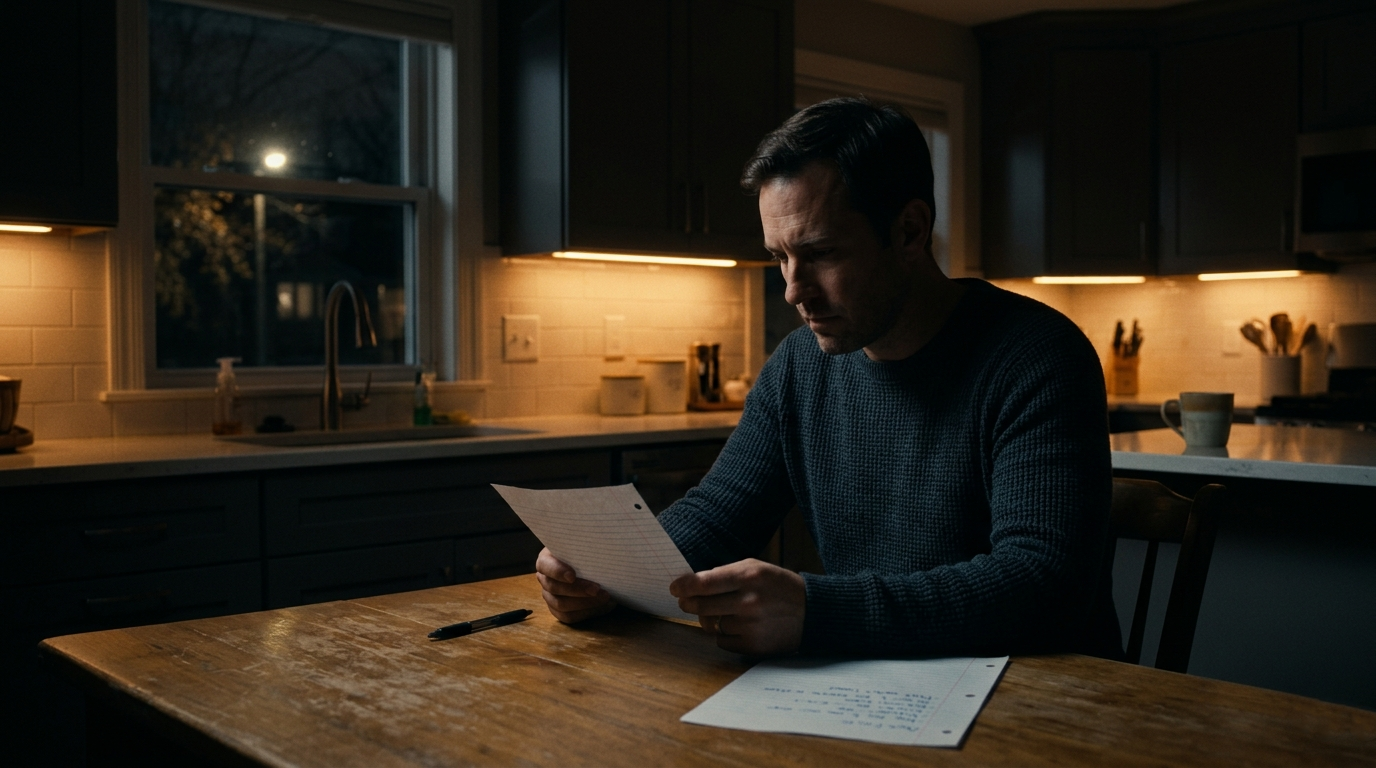
I want to tell you about the worst week of my life. And then I want to tell you why it was also the most important one. My name is Tom. I am forty-three years old. I live in Nashville, Tennessee, in a house that is quieter than it used to be and that I have spent the last year learning to inhabit differently — not as a place something was taken from, but as a place something was returned to me. Slowly. At considerable cost. In the way that the most important things tend to arrive. My wife — my ex-wife — her name is Rachel. We were married for nine years. We met at thirty-one, which feels, in retrospect, like exactly the right time to meet someone, when you are old enough to know something about yourself and young enough to still be capable of surprise. She was a physical therapist. She was patient in the particular and genuine way of someone who has chosen a profession that requires believing in the possibility of recovery, even slow recovery, even recovery that looks, from the inside, like nothing is happening. She was patient with her patients. She was patient with her friends. She was patient, for nine years, with me. On a Monday evening in October, she sat down across from me at our kitchen table with her hands folded in front of her and a stillness in her face that I did not recognize and said: “Tom, I need a divorce. I’ve been trying to tell you this in a hundred smaller ways for three years and I don’t think you’ve been able to hear it. So I’m saying it now, directly, because you deserve the direct version and so do I.”I did not hear it. Not really. Not that night. I heard it as an attack. I heard it as an accusation. I heard it as evidence of her failure to appreciate what I had provided, what I had built, what I had given — all the ways I had shown up that she was clearly not counting. I sat across that kitchen table and I made the specific argument of a man who has been told something true and cannot locate it as truth yet, because the truth would require him to look at himself in a way he has been successfully avoiding for a very long time. She listened to my argument. All of it. Without interrupting. When I finished, she said: “I know. I know you believe that. That’s part of it, Tom. “She went to stay at her sister’s that night. She left me a list — not of grievances, not of accusations. A list of things she needed me to do while she was gone. Practical things, mostly. But at the bottom of the list, in her handwriting, were four words that I read on Monday night and dismissed and then could not stop reading, on Tuesday and Wednesday and Thursday, until by Friday they had rearranged everything. Four words. I am not going to tell you what they were yet. I am going to tell you the week first — what I did with it, what I found inside it, what happened when a man who had never once sat quietly with himself was suddenly alone in his own house with nothing but silence and a four-word sentence he couldn’t put down. Because the week is the point. The week is everything. What happened between that Monday and that Friday — and what happened when Rachel came back — is the story I have been trying to figure out how to tell for a year. I think I’m ready now. Full story on the website. Link in the first comment.— Tom
PART 2:
The Four Words — and the Week That Finally Made Me Look
Let me tell you who I was before that Monday. Not who I thought I was — who I actually was. Because those two things, I have come to understand, were not the same person, and the distance between them is the entire story.
I grew up in a small town outside of Knoxville, the oldest of three boys, in a household run by a father who communicated primarily through action and almost never through words. He was not cruel. He was not absent. He was simply a man of his generation and his geography who had been raised to believe that what a man feels is considerably less important than what a man does, and that doing — providing, fixing, building, showing up in the physical and financial sense — was the complete definition of loving someone. You didn’t say the things. You did the things. The things were the language.
I absorbed this completely and without question. It seemed correct to me all the way through my twenties because I was, genuinely, good at doing. I was good at my job — I’m in commercial real estate, which rewards a specific combination of persistence and surface confidence that I had in abundance. I was good at the practical architecture of a life — the finances, the maintenance, the logistics, the forward planning. I was good at showing up in every way that could be measured and counted and pointed to.
What I was not good at — what I had never been required to be good at, had never been shown that I was supposed to be good at — was the interior work. The listening that goes beneath the surface of what someone is saying to what they actually mean. The willingness to be uncomfortable in a conversation instead of solving my way out of it. The capacity to say I don’t know or I was wrong or I’m scared without immediately converting those feelings into action items and moving on before anyone had to sit with them.
Rachel knew this about me when she married me. I want to be fair to her — she did not marry me under false pretenses about who I was. She married me because she loved me and because she believed, with the faith of someone who works daily in the field of recovery, that people are capable of growth. That the right environment and the right relationship and enough time can open parts of a person that have been closed.
She was right about that. She was just wrong about the timeline.
Rachel is the kind of person who fills a room in a way that has nothing to do with volume. She is quiet, physically small, and somehow the person everyone ends up talking to at a party — not because she seeks it out but because she has a quality of attention that makes people feel that what they are saying matters, that she is genuinely receiving it rather than waiting for her turn. People tell her things. They have always told her things. She has a gift for creating the conditions in which honesty is possible.
She tried to create those conditions with me for nine years.
I want to be specific about what that looked like, because I think it is important — important for me to say and perhaps important for someone reading this to recognize.
She would ask questions I did not answer. Not because I refused — I was not a man who refused questions, I was a man who answered the surface of them and felt that I had answered. She would say: How are you feeling about the Peterson deal? and I would say: It’s going to be fine, I’ve got Morris on the contracts and she would wait for a moment, the way she waited, and then she would say: I didn’t ask about the deal. I asked how you’re feeling about it. And I would look at her for a moment with the specific confusion of a man who does not understand the distinction and then I would say something like I’m fine, Rach, it’s a deal, deals happen and move to the next thing.
She brought up therapy twice. The first time was in year three — gently, framed as something for both of us, presented as a tool rather than an indictment. I said I didn’t think we needed it. I said things were good. I pointed to the things — the house, the vacations, the financial stability, the absence of serious conflict. I made the case for our marriage using evidence that had nothing to do with the interior of it, and I made it so confidently that I think she wondered, briefly, whether she was wrong about what she was feeling.
She was not wrong. She knew she was not wrong. She brought it up again in year six, less gently. I agreed that time — said yes, fine, we’ll look into it. We did not look into it. I let the suggestion dissolve into the business of our days, which I was very good at, and the dissolution was quiet enough that it could be mistaken for resolution.
By year seven, she had stopped suggesting therapy. She had started doing something else instead — something I noticed without understanding. She had started, very quietly, building a life that could exist alongside mine rather than inside it. She deepened her friendships. She started a pottery class on Thursday nights that she never invited me to join, which I told myself was because she valued having something of her own, which was true, but was also because she had stopped expecting me to be interested in things that were hers. She was not building a life without me. She was building a life that was prepared for the possibility.
I did not see this clearly until she was gone.
The Monday she asked for the divorce was ordinary up until the moment it wasn’t.
I came home at six-thirty. She had made dinner — pasta, the simple kind she made when she was tired, which I noticed and filed without remarking on. We ate. I talked about the Peterson deal, which was consuming most of my attention that week. She listened. She asked a question or two. We cleared the table.
And then she sat back down and folded her hands and said the thing.
I will not reproduce the full conversation because parts of it belong to her and I am not the only narrator of this story. What I will tell you is that she was clear and she was kind and she was absolutely, unmistakably done in a way that I had never seen in her face before. Not angry — past anger, which is worse. At the place that comes after you have been angry for a long time and the anger has burned down to something quieter and more permanent.
She said she had been trying to reach me for years. She said she had been saying things in different ways, with different words, at different volumes, and that none of it had landed where it needed to land. She said she was tired — not in the daily sense but in the deep sense, the cellular sense, the sense of a person who has been doing a thing for a long time that is not working and has finally run out of the belief that it will work if she just tries it differently.
She said: “I don’t think you’re a bad person, Tom. I think you’re someone who has never had to learn how to be known. And I think I have been trying to know you for nine years and I cannot reach the part of you that would let me. And I have to accept that either that part doesn’t exist or it exists and isn’t for me. Either way I can’t keep trying.”
I made my argument. I am not proud of the argument — it was the argument of a man who is being told a truth he cannot receive yet and so converts it immediately into something he can defend against. I cited evidence. I listed things. I spoke in the language my father had given me — the language of action and provision and showing up — and I could hear, somewhere underneath my own voice, that it was the wrong language entirely and that I did not yet know what the right one was.
She listened to all of it. Then she said, quietly: “I know. I know you believe that. That’s part of it, Tom.”
She went upstairs and packed a bag. She came back down and set the list on the counter. She looked at me for a moment — a long, clear look, without anger and without coldness, the look of a woman saying goodbye to something she had loved — and then she said: “Read the bottom of the list” and she went out the door.
The list was practical. Call the insurance company about the renewal. The gutter on the east side needs clearing before the rain on Thursday. The leftover soup is in the blue container, third shelf. Her mother’s birthday was Wednesday — she had already ordered the gift, I just needed to sign the card.
At the bottom, below a small space she had left, were four words.
Ask yourself honest questions.
That was it. No explanation. No list of what the questions should be. No directive about what to do with the answers.
Four words.
I read them on Monday night and I thought: I do ask myself honest questions. I am an honest person. I have always been honest.
I folded the list and put it on the counter and made myself a drink and sat down in front of the television and watched something I cannot now remember and went to bed.
Tuesday was work. The Peterson deal, three calls, a site visit in the afternoon. I moved through the day the way I moved through most days — efficiently, purposefully, from task to task with the forward momentum of a man who is good at his job and knows it. I did not think about Rachel more than I could help. I told myself this was healthy. I told myself I was giving her space. I told myself we would talk when she was ready and things would be sorted out.
Tuesday night I was alone in the house for the first time without the distraction of work and I picked up the list and read the bottom again.
Ask yourself honest questions.
I put it down. Made dinner. Cleaned up. Went to bed.
I did not sleep.
Wednesday I worked from home. This was a mistake and also, I understand now, a necessary mistake — because working from home meant the house was around me all day in a way it had not been before, and houses, when you are paying attention, tell you things.
I noticed, from my desk in the study, that the pottery Rachel had made in her Thursday class was arranged on the shelf in the living room in a particular order she had decided on and that I had never asked about. There were eight pieces. I could not have said, before that Wednesday, whether there were eight or four or twelve. I had looked at them hundreds of times and registered them as decoration and moved on.
I got up from the desk and stood in front of the shelf and looked at each one. A small bowl, uneven at the rim, glazed in a blue-gray that looked like morning fog. A taller piece, narrow, that she had told me something about once — I could not remember what she had told me. A plate with a deliberate texture pressed into the clay that I had never thought to ask about.
I stood in front of my wife’s shelf for fifteen minutes and understood, for the first time, that I had been living in the same house as her creative inner life for three years and had never once asked it a question.
I sat back down at my desk.
I picked up the list.
Ask yourself honest questions.
I took out a piece of paper. I wrote at the top: Honest questions. And then I sat there with the pen in my hand and I tried to figure out what an honest question actually was.
I want to tell you what I wrote, because writing it down was the thing. I have a theory, now, about why Rachel left it as she did — not a list of accusations, not a list of grievances, not her own answers to the questions she wanted me to ask. She left the instruction and trusted me to do the work, which was itself an act of faith in a man she had decided to leave, and the faith was not lost on me.
Here is what I wrote.
When was the last time Rachel told me something and I asked a follow-up question?
I tried to remember. I genuinely tried. I went back through my memory of recent weeks and I could not locate a single specific instance of Rachel telling me something — something about her day, her patients, her Thursday class, her friendship with Anna who was going through a hard time — where I had asked a question that went deeper than the surface. I could locate plenty of instances of nodding. Of saying yeah and uh-huh and that’s tough and then moving the conversation forward to something I wanted to say.
I wrote: I don’t think I have asked Rachel a real question in months. Maybe longer.
I looked at that sentence. I wanted to argue with it. I couldn’t.
What do I actually know about what Rachel is afraid of right now?
I sat with that one for a long time. Rachel was a private person — she did not broadcast her fears. But nine years. Nine years should have given me something. I wrote down three things I thought she might be afraid of and then I sat back and looked at them and understood that all three of them were things she had been afraid of years ago, that I had retained from a time when I had been more attentive, and that I had no idea whether they were still true. I had not updated my knowledge of my wife’s interior life in a very long time. I had been running on old information and calling it knowing her.
Have I been happy?
This one stopped me. Because my immediate answer was yes, obviously, of course — and then I held the question longer than I wanted to and the yes became less certain. I had been satisfied. I had been successful. I had been — and I kept coming back to this word from Rachel’s conversation — fine. But happiness, the real kind, the kind that comes from being genuinely seen and genuinely connected, from the intimacy of being known by someone who has chosen you — had I felt that? Recently? In the last few years?
I wrote: I don’t think I have let myself be happy in a way that required anyone else. I think I decided, somewhere, that needing happiness from another person was a liability. And I think I called that independence.
I looked at that sentence for a long time.
What has Rachel been trying to tell me?
I filled half a page. I went back through the years and I wrote down every version of the conversation she had tried to have — every question I had answered shallowly, every therapy suggestion I had dissolved, every moment she had waited in the particular way she waited and I had moved past it. It took forty minutes. By the end of it I was looking at a document that was, functionally, the record of a man who had been loved patiently and extensively and had not known how to receive it.
And then I wrote the last question.
Who have I been to her?
Not who I had intended to be. Not who I believed myself to be. Who I had actually been — the version of me she had been married to, the version she experienced from the inside of our life rather than the outside.
I sat with that question for a long time.
The answer, when it came, was not comfortable.
I had been present without being available. Dependable without being open. Loving in the way my father had taught me — through action, provision, the doing of things — without ever learning to be loving in the way Rachel needed, which was through presence, through listening, through the willingness to be vulnerable enough to let her see the places I was uncertain and afraid and unfinished.
I had given her the surface of me for nine years and called it intimacy.
I had built a marriage out of the things I was good at and avoided, systematically and without fully realizing it, the things I was not.
She had been trying to reach the rest of me.
I had not let her.
Thursday I called my brother. Not the brother I talk to easily — the other one, the middle one, James, who is three years younger and who has always had an uncomfortable gift for saying the thing no one wants to hear.
I told him about Monday. I told him about the list. I told him what I had written on Wednesday and I read some of it to him, which cost me something to do, because reading it out loud made it real in a way that writing it had not.
He was quiet for a moment when I finished.
Then he said: “Tom, I love you. And I need to ask you something.”
“Okay,” I said.
“Have you ever — in your adult life — sat down with another person and told them something true about yourself that scared you? Something you didn’t know how they were going to respond to?”
I thought about it. Genuinely tried to locate an example.
“I’m not sure,” I said.
“That’s the thing,” he said. “That’s what she’s been missing. You can build things. You can solve things. You can show up in every way that can be photographed. But you have never, in the entire time I’ve known you as an adult, let anyone see you when you didn’t know the answer. When you were lost. When you were afraid. You perform competence the way other people breathe. And at some point the people who love you stop being able to reach you because there’s nowhere to get in.”
I did not say anything.
“I’ve thought this for years,” he said. “I’m sorry I didn’t say it sooner. You might have punched me.”
“I might have,” I said.
“Do you still want to?” he said.
“No,” I said. And I meant it.
Friday morning I called a therapist. Not couples therapy — my own. I found a man named Dr. Gregory Hale, who had availability the following week and a phone manner that was direct without being clinical, and I made an appointment before I could rationalize myself out of it.
Then I called Rachel.
She answered. I was not sure she would.
I said: “I’m not calling to make my argument again. I don’t have an argument. I’m calling because I read the bottom of the list and I spent the week asking myself honest questions and I want you to know what I found.”
She was quiet. Then: “Okay.”
I told her. Not everything — not the full document, not every question and answer. But the core of it. What I had found on the shelf with her pottery. What I had written about not asking her real questions. What my brother had said. What I had understood, sitting alone in a house that was showing me things I had not been looking at, about the man I had actually been versus the man I had believed myself to be.
I told her I had made an appointment with a therapist.
She did not say anything for a moment. I heard her breathe.
“Why are you telling me this?” she said. Not coldly. Carefully.
“Because you deserve to know,” I said. “Not because it changes your decision — that’s yours and I’m not calling to change it. But because you spent nine years trying to reach this version of me and you could not, and it seems right that you should know it exists. That there was something here to find. That it wasn’t — that the wall wasn’t because there was nothing on the other side of it.”
A long silence.
“Tom,” she said.
“Yeah.”
“That’s the most honest thing you’ve ever said to me.”
I sat with that.
“I know,” I said. “I’m sorry it took me this long.”
I want to be truthful about what happened after, because this is not the story where the man has his revelation and the woman comes back and everything is repaired. That story would be tidier and less true.
Rachel and I are divorced. The papers were finalized in March. She was right to ask for it — I understand that fully now, without qualification. The man she had been married to was not capable, in that form, of giving her what she needed, and she had waited long enough to know that the capability was not coming on its own. Staying would have required her to keep shrinking. She was right to stop.
What happened instead is this.
I went to therapy. Every week, without missing, for a year. Dr. Hale is a quiet man who asks questions that take days to answer and does not seem troubled by the silence. He has dismantled, over twelve months, a series of beliefs I had held so long I did not know they were beliefs — I thought they were simply the structure of reality. The belief that feelings are a liability. The belief that vulnerability is weakness. The belief that being known is dangerous because being truly known means someone can truly leave. That one took the longest. That one is still in progress.
I have called my brother more than I have in the previous decade combined. I have told him things that scared me to say and he has not used them against me and I have had to update my internal model of what happens when you let someone see the unfinished parts. It turns out what happens is usually nothing catastrophic. Usually it is just a person saying yeah, me too or I’ve thought about that differently or simply listening without the world ending.
I have become a person who asks questions. This sounds small and is not small. I am forty-three years old and I am learning, with the difficulty of someone acquiring a skill late, to be interested in people in the interior sense rather than just the functional one. To ask the follow-up. To wait when someone is speaking instead of preparing my response. To let a conversation go somewhere unresolved rather than driving it to a conclusion.
It is harder than anything I have built or sold or solved. It is also the most important work I have ever done.
Rachel and I have a functional relationship now — not friendship exactly, but something respectful and without rancor. We have no children together so the occasions are limited, but when they occur she is kind to me in the way of someone who does not have room for bitterness and has chosen, deliberately, not to make room.
She is seeing someone, I have heard. I hope he deserves her particular quality of patience. I hope he knows what it costs her and what it is worth. I hope he asks follow-up questions.
I told her that once — said: I hope he asks you questions. We were at a mutual friend’s gathering, brief and slightly awkward as those things are. She looked at me for a moment with an expression I could not fully read. Then she said: He does. And she moved away into the party.
I stood there for a moment.
Then I went and found someone I didn’t know and introduced myself and asked them something real.
I want to end with the thing I have thought about most, in the year since that Monday.
On the Friday when I called Rachel and said the most honest thing I had ever said to her, she told me that. She said: That’s the most honest thing you’ve ever said to me.
And I thought about how long I had been married to her. Nine years. Three thousand two hundred and eighty-five days, roughly. And in all of those days, in all of that time, in all of the conversations and arguments and ordinary Tuesday evenings and vacations and dinners and years of building a life together — I had not said the most honest thing.
I had been too afraid of what it would cost me.
What it actually cost me was my marriage.
What the honesty cost me was a version of myself I did not need and should have left behind long before a woman with folded hands at a kitchen table made the decision for me.
I think about men who are where I was. I know there are many. Men who were raised in the language of action and provision and who have never been told — or been able to hear — that the people who love them are not asking for more doing. They are asking for the inside of you. The uncertain parts. The places you don’t have answers. The capacity to sit with another person in something unresolved and let it be unresolved and let them see you in it.
That capacity can be built. I am building it at forty-three. It is late and it is not too late.
The four words are still on my refrigerator. I moved them there from the counter weeks after Rachel left, when I realized I was not done with them yet.
Ask yourself honest questions.
I ask them every day now. Some of them I can answer. Some of them I’m still working on.
The working on is the point. The working on is the whole thing.
I just wish I had known that before Monday.
— Tom
A note: I shared this with Rachel before publishing. She read it and said I could post it. She also said — and I’m including this because it matters — that she does not regret the marriage. She said nine years of trying to reach someone is not wasted time if the reaching eventually works, even if it works after the marriage ends. She said: “I’m glad you found it, Tom. I’m just sad it took a goodbye.” I told her I was too. She said that was enough.
If any part of this story sounds like your own, I’d ask you one thing: don’t wait for the Monday. Ask the questions now, while there is still time to hear the answers together.