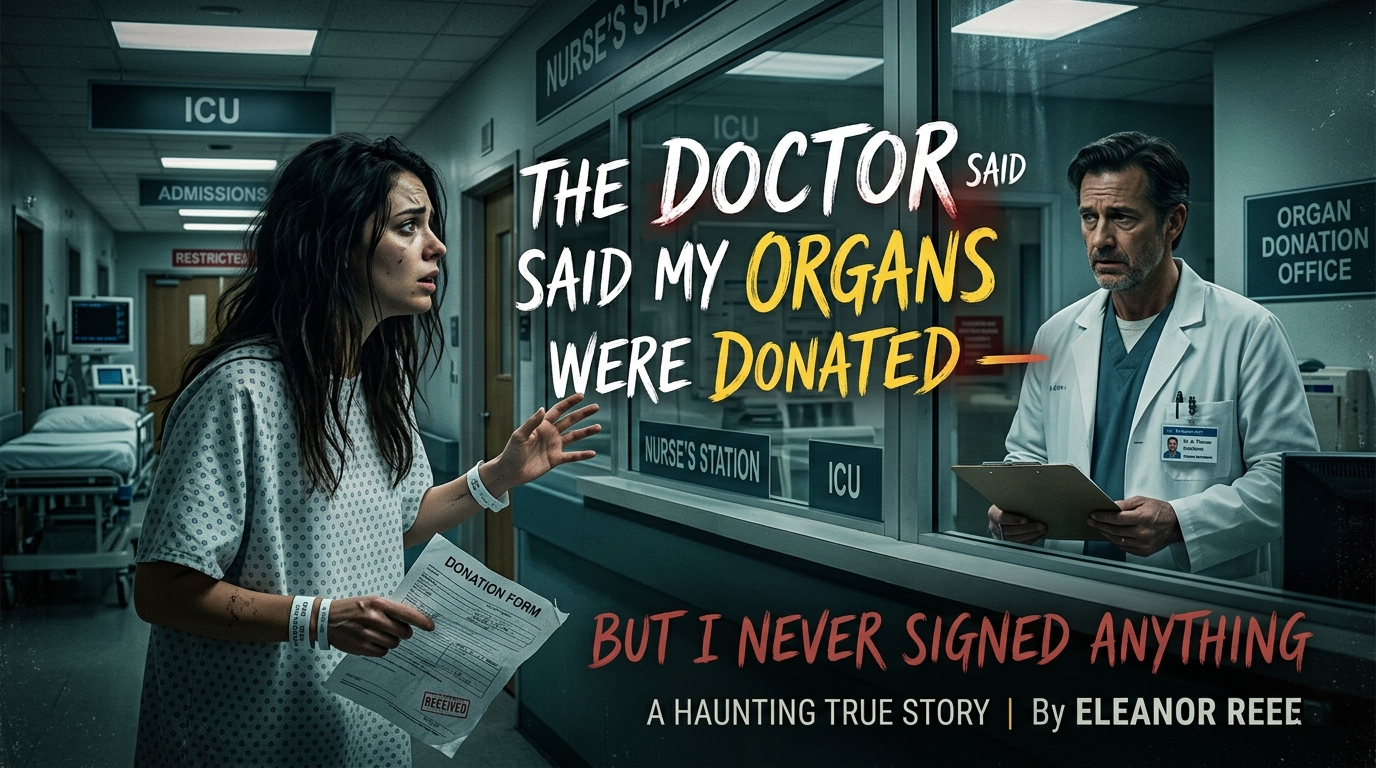
“The Doctor Said My Organs Were Donated — But I Never Signed Anything”
I want to start by saying I am not a conspiracy theorist.
I recycle. I trust my dentist. I got every recommended vaccine on schedule and I have never once believed that the government was hiding something in the water supply. I am, by every measurable standard, a reasonable person. I work in logistics. I own a sensible car. My most controversial opinion is that airport sushi is underrated.
I tell you this because what I’m about to describe will make me sound like someone who absolutely is a conspiracy theorist, and I need you to understand that I came to this the hard way — not through a rabbit hole, but through a hospital room, a manila folder, and a conversation that I replay in my head every single night before I fall asleep.
It started with the accident.
March 14th. I was driving home from my brother Kevin’s place, about forty minutes outside Columbus, Ohio. It had been raining since noon — that flat, gray, indifferent Ohio rain that doesn’t know when to quit. I remember the road. I remember the song on the radio (something classic rock, something with a guitar solo I was half-singing along to). I remember the deer.
And then I don’t remember anything for eleven days.
I woke up in a private room at Meridian General Hospital with tubes in my arm, a dull roaring in my skull, and my mother sitting in the chair beside the bed holding a paper coffee cup with both hands like it was keeping her alive.
“Oh,” she said when she saw my eyes open, and it was the smallest, most devastated syllable I have ever heard a human being produce.
The doctors explained it in careful, modulated tones. Traumatic brain injury. Medically induced coma. Swelling that had since resolved. Remarkable recovery — “truly remarkable,” said Dr. Harlan Osei, a calm man with reading glasses perpetually on top of his head, “given the severity of the initial presentation.”
I asked what that meant.
“You were unresponsive for the first seventy-two hours,” he said. “Your GCS was very low. We weren’t certain—” He paused. “We prepared your family for several outcomes.”
I nodded slowly. My head felt like a snow globe that someone kept shaking.
“Okay,” I said. “Okay. How long until I can go home?”
“We’d like to keep you for observation another week,” he said. “There’s also some paperwork we should discuss.”
I assumed he meant insurance forms. Bills. The administrative machinery of American healthcare grinding forward regardless of whether you are conscious to participate in it.
That was not what he meant.
He came back the next morning with a woman I hadn’t seen before — mid-fifties, dark blazer, the practiced neutral expression of someone trained to deliver difficult information without flinching. She introduced herself as Patricia Welles, the hospital’s patient advocate.
She set a manila folder on the tray table in front of me.
“We want to make sure you have access to all documentation related to your care,” she said. “Standard procedure when a patient regains capacity after an extended incapacitation.”
I opened the folder.
The first few pages were what I expected — admission forms, scan results, medication logs. I skimmed them with the detached curiosity of someone reading their own Wikipedia article. Interesting in an abstract way. Slightly surreal.
Then I turned to a page headed: ORGAN DONATION CONSENT — SURROGATE AUTHORIZATION.
I read it three times.
According to the document, on March 17th — three days into my coma, when my prognosis was apparently at its bleakest — my next of kin had authorized the donation of my organs in the event of brain death. The form was signed. The witness line was signed. The attending physician’s acknowledgment was signed.
The next-of-kin signature line read: Kevin Calloway (brother).
My brother Kevin.
Who I had just been visiting the night of my accident.
I looked at Dr. Osei. I looked at Patricia Welles. I kept my voice very steady because I have always been a person who keeps their voice very steady when things are going wrong, which is perhaps a character flaw.
“I never registered as an organ donor,” I said. “Not on my license. Not on any form. I’ve actually thought about it and just… never done it.”
“Your brother indicated—” Patricia began.
“I’d like to speak with my brother.”
Kevin came that afternoon.
He is three years older than me, an electrician, a man who has cried exactly twice in my presence — once when our father died and once when the Browns came close in 2016. He is not a complicated person. He is steady and practical and he fixes things. I have always trusted him completely.
He sat down across from me and he looked at his hands for a long time.
“They said you weren’t going to make it,” he said finally. “The first doctor — not Osei, the one before him — he came out and he said the brain activity was… he said it wasn’t looking survivable. Those were the words he used. Not survivable.”
“Kevin.”
“Mom was — she couldn’t even — I had to make the call, Danny. Someone had to be the one to—”
“Kevin.” I waited until he looked at me. “Did they pressure you? Did someone at this hospital sit you down and walk you through that paperwork?”
He was quiet for too long.
“There was a coordinator,” he said. “She came in about an hour after the doctor talked to us. She was very kind. She explained everything. She said if there was going to be any chance to help other families, the timing was—” He stopped. “She said it was what most people would want, even if they hadn’t written it down.”
“Did she ask whether I had ever expressed a preference?”
He looked at the wall.
“Kevin.”
“She asked. I said I didn’t know.”
I want to be careful here, because I am not a lawyer and I am not telling you this story to make a legal argument. What I am telling you is what I found when I started asking questions — and what I stopped finding when certain people realized I was asking them.
I requested my complete medical records. What I received was thorough, except for a thirty-six-hour gap in the nursing notes between March 16th and March 18th — the exact window during which the donation consent was obtained.
I contacted the organ procurement organization listed on my paperwork. They confirmed a referral had been made. They could not confirm who had initiated it, or when, because that information was “managed by the hospital’s clinical team.”
I filed a formal complaint with the Ohio Department of Health. I received a letter fourteen weeks later informing me the matter had been reviewed and no violations of protocol were identified.
I hired an attorney who specialized in medical cases. She reviewed my file, grew very quiet, and told me that while she found several things “concerning,” the legal threshold for proving coercion in surrogate consent cases was “extraordinarily difficult to meet” and she did not think we would win.
“But something happened,” I said.
“Something may have happened,” she said carefully. “That’s different from something we can prove.”
I still don’t know the name of the coordinator who sat with my family on March 17th.
I still don’t know which physician told my brother my prognosis was “not survivable” approximately sixteen hours before a different physician, Dr. Osei, would tell me my recovery was “truly remarkable.”
I still drive past Meridian General twice a week on my way to work. Every time, I think about a version of me that didn’t wake up on day eleven — that stayed under, that slipped away quietly — and a coordinator in a kind blazer with a folder of paperwork, turning to my family in a waiting room and saying:
It’s what most people would want.
I carry my wishes in writing now. Notarized. Copies with my attorney, my doctor, and my best friend.
I signed them myself.
That part matters more than I can explain.