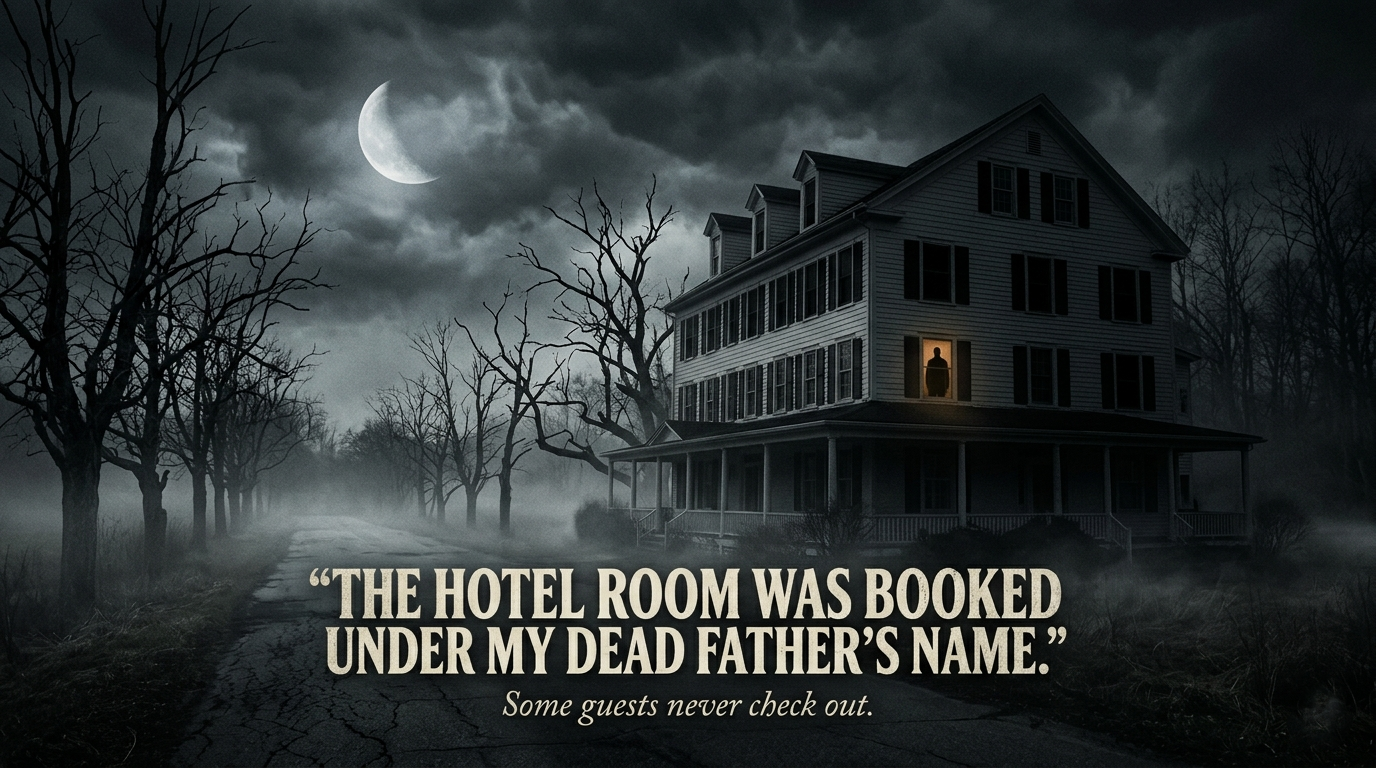
“The Hotel Room Was Booked Under My Dead Father’s Name” !
I almost didn’t go on that trip.
My therapist called it “avoidance behavior.” My sister called it grief. I called it common sense — why would I drive four hours to a forgettable town in rural Pennsylvania just to speak at a regional insurance conference? But my boss had already booked everything. The hotel. The rental car. The dinner reservation at some steakhouse where the steaks were supposedly famous but the tablecloths were suspicious.
So I went.
It was already past eleven when I pulled into the Hargrove Inn. The kind of place that looked charming in photos and exhausted in person — colonial-style facade, a flickering porch light, window boxes that hadn’t seen flowers since the Obama administration. The parking lot was nearly empty. The kind of quiet that isn’t peaceful so much as held.
The woman at the front desk had silver hair pinned tight and reading glasses that she never actually used to read anything. She looked up when the door chimed.
“Reservation?” she asked.
“Calloway,” I said. “Daniel Calloway.”
She typed. Frowned. Typed again.
“Hmm,” she said, in the way that people say hmm when something is wrong but they don’t want to say so yet. “I’m showing a reservation here under… Robert Calloway?”
I went very still.
“That’s my father’s name,” I said.
She looked at the screen. Then at me. Then back at the screen. “It was booked about three weeks ago. Single occupancy. Paid in full — cash payment processed through our mail-in system.” She tilted her head. “We don’t get many of those anymore.”
My father’s name is — was — Robert Allan Calloway. He died six years ago from a heart attack in his home office while I was two states away and didn’t find out until my sister called me crying so hard I couldn’t understand her for three full minutes. He had been sixty-one years old. He had been in the middle of a crossword puzzle. Seven across was still blank.
He had also, I now remembered with a slow and nauseating clarity, traveled to Pennsylvania for work. Frequently. For decades. I had no idea where.
“Can I ask,” I said carefully, “if your hotel has records going back… a while?”
The woman — her name tag said HELEN — considered me with the particular wariness of someone who has heard too many strange things at hotel front desks to be surprised anymore, but is still choosing caution.
“How far back?” she asked.
“Twenty years. Maybe more.”
She looked at me for a long moment. Then she did something unexpected — she came out from behind the desk, gestured for me to follow, and led me down a narrow hallway that smelled like cedar and old paper, past a vending machine and a door marked STAFF, to a small room with floor-to-ceiling shelving crammed with binders and cardboard boxes.
“We’re family-owned,” she said. “We keep everything.”
She found it in forty minutes. I found it in thirty seconds after she handed me the binder.
Robert A. Calloway. Room 114. Check-in: March 4th.
The year was nineteen years ago. I would have been twelve.
Robert A. Calloway. Room 114. Check-in: October 9th.
Eighteen years ago.
Robert A. Calloway. Room 114.
Again. And again. And again.
My father had stayed at this hotel — this exact, specific, middle-of-nowhere hotel — fourteen times over the course of a decade. He had never once mentioned it. Not to me. Not to my mother, who I called from the parking lot at midnight, my voice perfectly calm in that horrible way it gets when I’m not calm at all.
“Pennsylvania?” my mother said. “He went to Pennsylvania twice a year for something. He always said it was actuarial conferences.”
“Did you ever look into it?”
Silence.
“He was your father, Daniel. I trusted him.”
I went to room 114.
Of course I went to room 114. Helen had offered me a different room — something on the second floor with a better view — and I had declined in a way that left no room for discussion. I needed to see it. I needed to stand in the space he had occupied and understand something, anything, about why.
The room was ordinary. Two double beds. A landscape painting in muted greens. A desk by the window with a lamp that hummed faintly. A bathroom with hexagonal tile and a single bar of wrapped soap.
I sat on the edge of the bed and I waited for something — a feeling, a sign, a rational explanation that would unscramble everything. None came.
I opened the desk drawer.
Inside, beneath the Gideons Bible and the laminated room service menu, was a photograph.
It was my father. Younger — maybe late thirties — standing in front of this hotel, this exact building, in summer. He was smiling. Not his regular smile, the careful one he wore at family gatherings and church. This was something else. He looked happy. Unguarded. Like a man who existed differently in this place than he did anywhere else.
He wasn’t alone in the photo.
Standing beside him, close enough that their arms were touching, was a woman I didn’t recognize. She was laughing at something. She had dark hair and a yellow scarf and she was holding the hand of a small child — a boy, maybe four or five — who was squinting into the sun and grinning with his whole face.
I turned the photograph over.
On the back, in my father’s handwriting — I know his handwriting the way I know my own, it’s the same handwriting — were four words.
Our favorite place. Always.
I sat with that photograph for a long time.
I didn’t sleep that night. I lay in the bed where my father had slept, in the room he had returned to again and again for reasons I was only beginning to understand, and I stared at the ceiling and I thought about the word always. About what it promises. About how the dead can reach forward through the simplest things — a reservation, a photograph, four words on the back of a picture — and undo everything you thought you knew about a life.
In the morning, I called my sister.
And then I started making some very different phone calls.
I’m still making them.
Some doors, once opened, don’t close again. But sometimes — sometimes — what you find on the other side isn’t a monster.
It’s just a person you never got to meet.
END