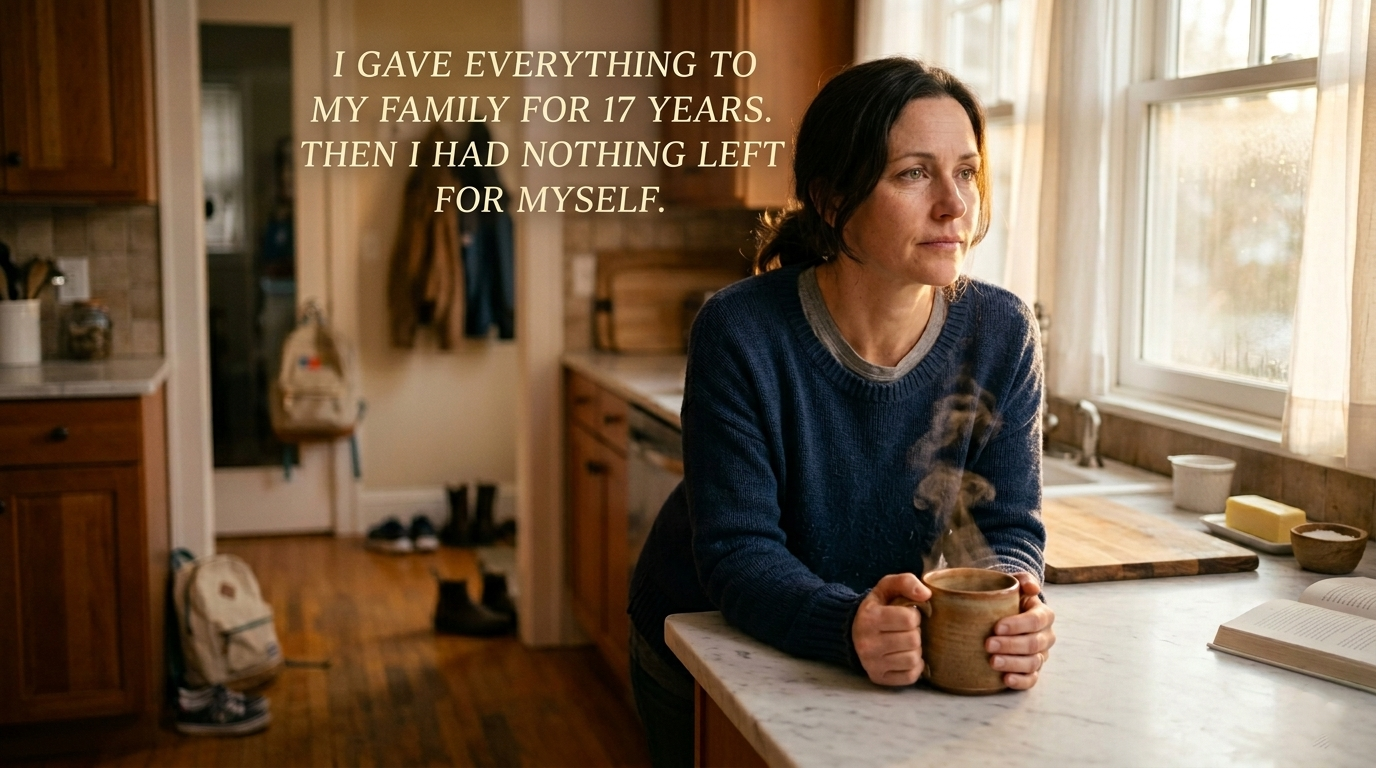
I Gave Everything to My Family for 17 Years. Then I Had Nothing Left for Myself.
Part One: The Morning Everything Became Clear
The coffee was still hot when Margaret realized she couldn’t remember the last time she had drunk a full cup while it was warm.
She was forty-three years old. Standing in her kitchen in a suburb outside of Columbus, Ohio, at six forty-five in the morning, in the same spot she had stood in every morning for the past seventeen years. Packing lunches. Signing permission slips. Locating the single missing cleat that belonged to her son Tyler’s soccer uniform. Moving through the familiar choreography of a household that ran, by every visible measure, because she made it run.
Her husband David was upstairs getting ready for work. Her three kids — Tyler, fourteen, Lily, eleven, and Noah, seven — were in various stages of being awake and not yet functional. The dog needed to go out. The dishwasher needed to be emptied. There was a parent-teacher conference at two that she had rearranged her entire week around.
And Margaret stood at the counter with her hot coffee and felt, for the first time in longer than she could place, absolutely nothing.
Not tired. Not resentful. Not even sad, exactly.
Just — empty.
Like a house where the lights are on but no one is home.
She had not always been this way.
There was a version of Margaret that existed before the marriage and the children and the suburb and the seventeen years — a woman who had opinions about things that had nothing to do with school schedules or grocery lists. Who had wanted, at one point, to open her own interior design studio. Who had laughed loudly and taken weekend trips on impulse and stayed up until two in the morning talking about nothing and everything with people she loved.
She could remember that woman the way you remember a place you visited once as a child — warmly, imprecisely, with the nagging sense that it was real but that you could no longer quite find your way back to it.
At twenty-six she had married David, who was steady and kind and loved her in the uncomplicated way of a man who knew exactly what he wanted and was grateful every day that he had it. At twenty-seven she had their first child and left her job at the design firm, temporarily, with every intention of returning when the time was right.
The time had never been right.
Not because anyone told her so. Not because David asked her to stay home — he hadn’t, not explicitly. But because the children needed her, and then the next child needed her, and then the house needed managing and the schedules needed coordinating and there was always something that needed her specific and immediate attention, and somewhere in the middle of all of that constant and legitimate need, the question of what Margaret needed had simply stopped being asked.
By anyone. Including Margaret.
The morning of the empty coffee cup was a Wednesday in March.
By Friday she was doing something she hadn’t done in years — sitting alone in her car in the parking lot of the grocery store, engine off, not going in, not going anywhere. Just sitting. Trying to locate, somewhere inside herself, some answer to a question she was only beginning to understand how to ask.
Who are you when no one needs anything from you?
She stayed in that parking lot for forty minutes. She was late for nothing. She told no one where she was. And for forty minutes she simply sat with the discomfort of her own company — a company she had been avoiding, she now understood, for a very long time.
What she found there, in the quiet of that parking lot, was not an answer.
It was something more useful than an answer.
It was the right question.
And the right question, she was about to discover, had the power to change absolutely everything.
She didn’t tell David that night. Or the next night. She carried the question with her for three weeks, turning it over in the small spaces of her day — in the shower, on school runs, in the ten minutes between when the last child fell asleep and when she was too exhausted to stay awake herself.
She started writing things down. Not a journal exactly. More like an inventory. A careful, honest accounting of what she had given away over seventeen years and what, if anything, remained.
The inventory took two weeks to complete.
When she finished it, she sat with it for a long time.
Then she went downstairs, where David was watching television, and she sat beside him on the couch, and she said:
“I need to tell you something. And I need you to really hear me.”
David muted the television.
He turned to look at her.
And what happened in the next two hours changed the course of both of their lives.
Continue reading Part Two below.
Part Two: What Happens When You Finally Tell the Truth
David had always been a good listener.
It was one of the first things Margaret had loved about him — the quality of his attention when she spoke, the way he didn’t formulate his response while she was still talking but actually waited, actually heard, before he said anything at all. In the early years of their marriage she had told him that listening was his best quality. He had laughed and said she was setting a low bar. She had said no, you’d be surprised.
She thought about that exchange as she sat beside him on the couch that Thursday night and tried to find the beginning of what she needed to say.
She started with the coffee.
The full cup gone cold. The way that small, daily thing had become a kind of symbol for something much larger — the way everything she did was done in service of someone else’s need, right down to the cup of coffee she poured for herself every morning and then forgot about because something always needed her attention more urgently than her own warmth did.
She told him about the parking lot. About the forty minutes sitting alone with the engine off, trying to remember who she was when no one was asking anything of her. About the inventory she had been writing for two weeks — the careful, painful accounting of what seventeen years of giving everything had left behind.
She told him she loved him. She said it clearly and first because it was true and because she needed him to hold onto it through everything that came after.
She told him she loved their children so completely that the love itself sometimes felt like a physical thing, a weight she carried in her chest wherever she went.
And then she told him that she had disappeared.
Not dramatically. Not all at once. But slowly and steadily and so quietly that she herself had not noticed it happening until one Wednesday morning in March when she stood in her kitchen feeling nothing and understood that the nothing was not a mood. It was a condition. The result of seventeen years of pouring herself into everything around her without ever once stopping to ask what was left.
“I don’t know who I am anymore,” she said. “Outside of being your wife and their mother. I genuinely do not know. And I think I have to find out. I think if I don’t find out now I may never get the chance.”
The room was quiet for a long time after she finished.
David sat with it. The way she had always loved about him — he sat with things. He didn’t rush to fix or minimize or redirect. He let what she had said take up the space it needed.
Then he said something she had not expected.
“I know,” he said. “I’ve known for a while. I just didn’t know how to bring it up without making it worse.”
She stared at him.
“You’ve watched me disappear and you didn’t say anything?”
“I didn’t know what to say. I didn’t want to make you feel like I was criticizing you. You work so hard for this family. Every single day. I didn’t know how to say — I see you working hard and I also see you fading — without it sounding like an accusation.”
He reached over and took her hand.
“I should have found a way. I’m sorry I didn’t.”
That apology opened something in her.
Not because she had been waiting for it. Not because she needed him to be wrong in order for her to be right. But because it meant she had not been invisible. She had been seen — not clearly enough, not spoken to clearly enough — but seen. And there was a specific grief in that, and also a specific relief, and for a few minutes she simply sat with both of them at once, her hand in his, the television dark and muted beside them.
They talked until midnight.
It was the most honest conversation they had managed in years. The kind of conversation that is only possible when both people have run out of reasons to protect themselves from the truth — when the truth, uncomfortable as it is, has simply become more necessary than the comfort of avoiding it.
By the end of the night they had made a set of decisions that were, in the context of their ordinary life, quietly radical.
Margaret would enroll in an interior design certification course she had been looking at online for two years and never signed up for. Not because she was definitely going to open a studio. But because she had wanted to, once, and wanting was reason enough. The wanting itself deserved to be honored.
She would have three mornings a week — non-negotiable, protected, belonging to no one but herself — to do whatever she needed to do. Walk. Read. Sit in parking lots if that’s what it took. No agenda, no productivity requirement, no explanation owed to anyone.
David would handle school drop-offs on those mornings. He would rearrange his schedule to make it possible. He did not offer this reluctantly. He offered it the way a man offers something when he understands he is participating in something important.
They would see a therapist. Together. Not because their marriage was in crisis but because they had both been operating inside it with assumptions about each other that had quietly calcified over seventeen years, and examining those assumptions with someone skilled enough to help them see clearly seemed not just useful but necessary.
And Margaret would start asking herself, every day, the question she had stopped asking somewhere around year three of their marriage:
What do I need today?
Not as an indulgence. Not as selfishness. As maintenance. The same maintenance she performed daily for everyone else in her household, applied — finally, deliberately — to herself.
The interior design course began six weeks later.
It met twice a week at a community college twenty minutes from their house. Margaret drove there the first morning with the particular feeling of a person doing something slightly illicit — something that was entirely hers and entirely for no one else’s benefit — and sat in a classroom for the first time in seventeen years surrounded by people who did not need her for anything.
She was the oldest student in the class by nearly a decade.
She was also, by the end of the second week, the most engaged.
Something unlocked in those classroom hours that she had not known was locked. The part of her that had opinions, that got excited, that leaned forward in her seat when something interested her and didn’t edit the enthusiasm before it showed on her face. The part that had been so thoroughly buried under the daily weight of managing everyone else’s needs that she had begun to mistake its absence for evidence it was gone.
It was not gone.
It had simply been waiting.
The three free mornings reshaped her entirely.
She used them in ways she couldn’t have predicted. Long walks without headphones — just her own thoughts, which turned out to be better company than she remembered. A sketchbook she filled and then started over in. Two novels read in a single week, sprawled on the couch at ten in the morning with nowhere to be and no guilt permitted. A solo drive to a botanical garden an hour away that she had been meaning to visit for six years and had simply never prioritized because there was always something more urgent.
There was always something more urgent.
Until she decided that she was also urgent.
That her restoration was not a luxury. It was a requirement. And that a woman who had given seventeen years to the people she loved most in the world was not being selfish by taking three mornings a week to remember who she was. She was being, finally, honest.
The couples therapy lasted five months.
Their therapist was a woman named Dr. Patricia Howe, who had a way of asking questions that made both of them see things they had been standing too close to for too long. In one session she asked them each to name three things they admired about the other that they had never said out loud. It seemed simple. It was not simple. By the end of that hour they were both slightly undone in the specific way of people who have been reminded of something they had let become invisible through familiarity.
They drove home separately — they had taken two cars that day — and Margaret sat in the parking garage for a few minutes before starting her engine.
Not because she was sad.
Because she was full.
For the first time in years, she was genuinely, quietly full.
Her daughter Lily asked her something last month that she is still thinking about.
They were baking together on a Sunday afternoon, one of those slow weekend hours that belongs to no schedule, and Lily looked up from the mixing bowl and said, completely unprompted:
“Mom, you seem happier. Like actually happy, not just fine.”
Margaret asked her when she had noticed.
Lily thought about it and said: “I think around Christmas. You started laughing differently.”
You started laughing differently.
Margaret has thought about that sentence almost every day since. About what it means that her eleven-year-old daughter could track the quality of her mother’s laughter and identify the moment it changed. About what it says — about how present a child is to a mother’s interior life, and how much it matters, and how the work Margaret did to come back to herself was not work she did alone or only for herself.
Her children got a mother who was actually there.
David got a wife who knew, again, what she wanted — and was not afraid to say so.
And Margaret got herself back.
Not the twenty-six-year-old version with different circumstances and the luxury of fewer responsibilities. The forty-three-year-old version. Wiser, more tired in some ways, and more certain than she had ever been about what actually matters and what does not.
She drinks her coffee hot now.
Every morning. Without exception.
It is a small thing she guards ferociously — the ten minutes between when the house starts waking up and when the needs of the day begin arriving. Ten minutes that belong entirely to her. A full cup, drunk warm, in the quiet kitchen before everything begins.
It is a small thing.
And it is the first thing she protected when she decided that she was also worth protecting.
She gave everything to her family for seventeen years.
She does not regret a single moment of it.
But she knows now — with the certainty that only comes from having lost something and found it again — that giving everything is not the same as giving well.
You cannot pour from a cup that has gone cold.
She had let hers go cold for a very long time.
She will not make that mistake again.
If this story found you at the right moment, share it with someone who needs to read it today. And if you see yourself in Margaret — the woman who gave everything and forgot to keep something for herself — know that it is not too late. It is never too late to come back to yourself.