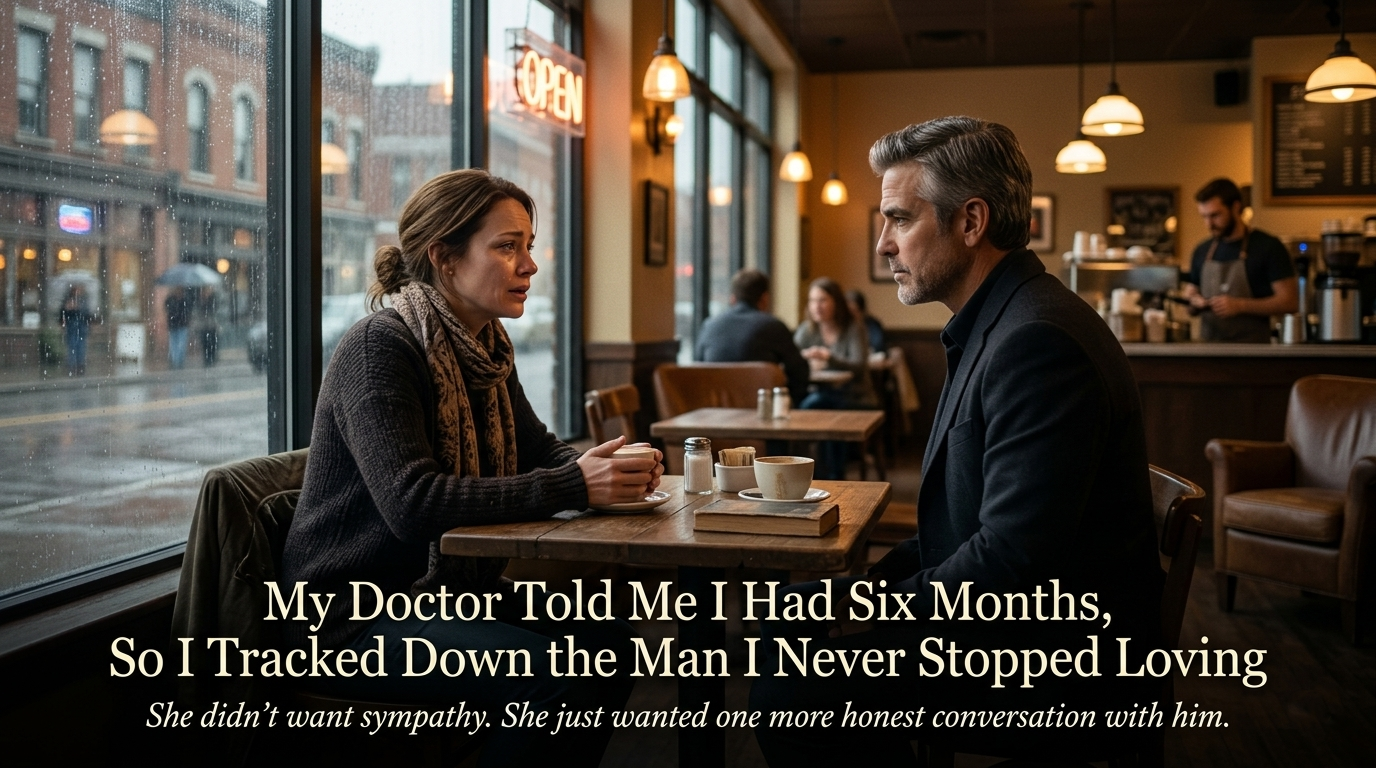
My Doctor Told Me I Had Six Months, So I Tracked Down the Man I Never Stopped Loving !
Part One: The Number That Changes Everything
My doctor used the word “months” and I heard it the way you hear something in a dream — clearly, and then not at all.
I drove home. I sat in my car in the driveway for forty minutes. I did not cry. I made a list instead — the way I always make lists when life gets too large for feelings — and somewhere between “call insurance” and “tell Mom,” I wrote a name I had not let myself write in eleven years.
James Calloway.
I didn’t want his pity. I didn’t want a reunion or a miracle or a movie ending. I just wanted to look at him one more time and say the thing I left unsaid when I was twenty-nine and too proud and too afraid and so completely wrong about how much time I had.
So I found him. And what happened next was nothing like what I planned — and everything I didn’t know I needed.
Part Two: What the Diagnosis Gave Her
Claire Morrow had always been the kind of person who managed things. She managed her small interior design firm in Nashville with quiet efficiency. She managed her friendships — rotating dinners, remembered birthdays, the kind of reliable presence people leaned on without realizing how much. She managed her mother’s anxiety, her younger brother’s financial crises, the perpetual negotiations of being the person everyone assumed was fine.
She was forty years old. She had good bone structure and a chaotic bookshelf and a cat named Willa who slept on her feet every night and an apartment with plants she’d kept alive for six years, which she considered one of her greater achievements.
She had not been in a serious relationship since James. She had dated — a landscape architect for eight months, a kind and boring accountant for almost a year, a man she met at a friend’s wedding who was funny and attentive until he wasn’t. None of them had reached the place inside her that James had reached, which she had long since concluded was simply the way certain people were built. Some people fell in love completely every few years. Claire fell in love once, all the way, and had been quietly managing the remainder ever since.
* * *
The diagnosis was ovarian cancer, stage three. Her oncologist — a soft-spoken woman named Dr. Reyes who delivered hard news with the steady grace of someone who had done it many times and never once stopped feeling the weight of it — told her that with aggressive treatment, the prognosis was uncertain but not without hope. Without treatment, she was looking at six months, perhaps eight.
Claire had listened carefully. She had asked three questions — practical ones, about timelines and logistics and what her body would feel like at each stage. She had thanked Dr. Reyes, shaken her hand, and walked to the elevator with the same composure she brought to every difficult meeting.
She sat in her car for forty minutes.
Then she made her list. And she wrote James Calloway’s name at the bottom of it, almost as an afterthought, in the small handwriting she used for things she wasn’t sure she meant yet.
By the time she started the engine, she was sure.
Part Three: Eleven Years of Distance
She had ended it. That part is important. She had ended it, not him, and she had done so with the particular cruelty of someone who believed they were being kind — quickly, cleanly, with reasons that sounded reasonable and were not entirely honest.
They had been together for three years. He was an emergency medicine physician finishing his residency in Nashville; she had just launched her firm. The relationship had the specific, beautiful intensity of two driven people who recognize something essential in each other — a shared seriousness about their work, a matching hunger for life done right, a way of talking through the night about everything and nothing that felt, to Claire, like the most alive she had ever been.
But his residency ended and a fellowship offer came — Johns Hopkins, Baltimore, two years minimum, possibly more. He had told her with a face full of barely contained joy, and she had smiled and said she was proud of him, and later that night, alone in her apartment, she had looked at her fledgling firm and her Nashville life and her deep, bone-level terror of needing someone so much that losing them would undo her — and she had made a decision that had nothing to do with geography and everything to do with fear.
She told him she couldn’t do long distance. She told him they wanted different things. She told him she thought they should end it cleanly before it got harder.
He had looked at her for a long time without speaking. Then he’d said, very quietly: “Is this actually what you want?” And she had said yes, because she was very good at managing things, including the truth.
* * *
She found him in twenty minutes online — which was both easier and more disorienting than she’d expected. He was the attending director of emergency medicine at Vanderbilt University Medical Center. He had come back to Nashville four years ago. He had a profile on the hospital’s website with a photo that showed him older, steadier, with silver beginning at his temples that somehow made him look more completely himself than she remembered.
There was no wedding ring visible in the photo. She told herself this was irrelevant. It was not irrelevant.
She wrote a letter. Not an email — a real letter, on the cream stationery she kept for client correspondence. She wrote four drafts. The fifth one said simply:
James — I know this is unexpected and I understand completely if you choose not to respond. I’m not writing to reopen anything or ask anything of you. I just found out I’m sick, and when I made my list of things I didn’t want to leave undone, your name was on it. I’d like to buy you a cup of coffee and say something I should have said eleven years ago. That’s all. — Claire
She mailed it to the hospital. She expected silence. She told herself she was prepared for silence.
He called three days later.
Part Four: The Coffee That Lasted Four Hours
He suggested a coffee shop on Belmont — neutral ground, public, the kind of place with exposed brick and too many succulents and a menu written on a chalkboard. She arrived eight minutes early and chose a table by the window and ordered a latte she barely touched and watched the door with a stillness that cost her more than she showed.
He was exactly on time. He walked in and found her immediately, the way he always had — James had a gift for locating her in a room that she had once found romantic and now found simply true, like gravity. He looked exactly like his photograph and nothing like her memory, which is the way people always are after enough time.
He sat down. He looked at her steadily.
“You look well,” he said.
“I’m told that’s deceptive,” she said.
“How bad is it?”
“Stage three. I’m deciding about treatment.”
He absorbed this with the particular composure of a doctor — not cold, just practiced at receiving difficult information without flinching, which she had always respected in him and respected now more than ever.
“You said you had something to say,” he said. “I’m here.”
She had rehearsed this. She had the words organized and ordered and ready. But sitting across from him in the thin November light, all of it rearranged itself into something simpler.
“I lied to you,” she said. “When I ended it. I told you I couldn’t do long distance and that we wanted different things, and neither of those was true. The truth was that I was terrified of how much I loved you. I had built my whole life around being the person who managed everything and needed nothing, and you made me need something, and I didn’t know what to do with that. So I chose the one thing I knew how to do.” She paused. “I managed you out of my life. And I have regretted it every year since.”
The coffee shop moved around them — the hiss of the espresso machine, a couple laughing near the door, a barista calling out a name. James was very still.
“Why didn’t you call me?” he said finally. “After. Any of those years.”
“Pride,” she said simply. “And the certainty that you’d moved on and I had no right.”
“I hadn’t,” he said. Then, more quietly: “I haven’t.”
The words landed with a softness that was almost unbearable. She had not come here for this. She had come to deliver the truth and leave cleanly, to check one final thing off a list, to give him something she owed him and ask nothing in return. She had not accounted for the possibility that eleven years had not moved him as far as she assumed.
They stayed for four hours. They talked the way they used to talk — without performance, without the social editing that most conversations require, two people who had once known each other completely and were discovering that the knowledge had not entirely expired.
He walked her to her car in the cold evening air. She turned to say goodbye and he said:
“I want to see you again.”
“James—”
“Not out of pity. Not out of obligation.” His voice was even and sure. “Because I’ve had eleven years to wonder what I should have fought harder for, and I’m not going to spend whatever time we have wondering the same thing again.”
She looked at him for a long moment in the cold Nashville night.
“That could be a short amount of time,” she said.
“I know what time is,” he said quietly. “I’m a doctor.”
She laughed — a real laugh, startled out of her — and it rose into the cold air like something freed. He smiled, and it was exactly the smile she remembered, and she understood in that moment that she had been wrong about so many things, and right about one: his name had belonged on that list.
Part Five: The Six Months She Chose to Live
She started treatment in December. Not because of James — she wants to be clear about that, with the same clarity she applies to everything — but because sitting across from him in that coffee shop had reminded her what it felt like to want a tomorrow. She had gone home and called Dr. Reyes the following morning and said she was ready.
The treatment was hard. It was hard in the specific, unglamorous, relentless way that illness is hard — not cinematic suffering but the grinding daily reality of a body being asked to fight. There were weeks she barely left her apartment. Weeks the nausea won. Weeks she looked in the mirror and did not fully recognize the face looking back.
James came every week. Not every day — she had set that boundary firmly, because she would not be anyone’s project, not even his — but every week, reliably, with food she could actually eat and the ability to sit in silence beside her without making the silence feel like something that needed filling. He had spent years in emergency medicine; he knew how to be present in rooms where presence was everything and words were very little.
He read to her when she was too tired to hold a book. He brought her soup from a Vietnamese place on Charlotte Avenue that she had mentioned once in passing and which he apparently memorized. He fell asleep on her couch twice and she let him both times, listening to his breathing in the dark apartment and feeling something she recognized as joy — not the uncomplicated joy of easy times, but the harder, realer kind that knows what it’s standing next to.
* * *
In February he told her he loved her. Not dramatically. They were watching an old film on her couch — Willa arranged between them, the Nashville winter pressing against the windows — and he said it the way he said most important things: quietly, without decoration, as a simple statement of fact.
“I love you,” he said. “I want you to know that regardless of how any of this goes.”
She kept her eyes on the screen for a moment. Then she looked at him.
“I love you too,” she said. “I think I always have. I was just very slow at saying it.”
“Eleven years slow,” he said.
“Exactly eleven,” she agreed.
He reached over and took her hand. The film kept going. Willa purred. Outside, Nashville was cold and dark and entirely indifferent to the small, enormous thing happening on a worn-out couch in a woman’s apartment — two people who had wasted eleven years and were determined not to waste a single day more.
Part Six: More Than Six Months
At her eight-month scan, Dr. Reyes looked at the results for a long time before she looked up.
“The tumor has reduced significantly,” she said. “This is better than we projected.”
Claire sat with that sentence for a moment the way you sit with something you’re afraid to believe.
“How much better?” she asked.
“Significantly,” Dr. Reyes said again, and this time she was smiling.
* * *
She called James from the hospital parking lot. He answered on the first ring — he always answered on the first ring, which was one of the thousand small things she had stopped taking for granted.
“The scan was good,” she said.
The silence on the other end lasted exactly two seconds. Then she heard him exhale — long, slow, the sound of someone releasing something they had been quietly holding for eight months.
“How good?” he said, his voice low and careful.
“Dr. Reyes used the word ‘significantly,'” she said. “Twice.”
Another silence. And then, very quietly, she heard him make a sound she had never heard from him before — not quite a laugh, not quite a sob, but something that lived in the exact space between them, the sound of a man who had spent eight months being strong and steady and present and was finally, in a hospital parking lot through a phone, allowing himself to come slightly undone.
She sat in her car and cried too — not the managed, private tears she was accustomed to but the open, unguarded kind, the kind that acknowledges how close it all came and how grateful you are for every ordinary day that remains.
James proposed six months after the good scan. Not with elaborate planning — he was not an elaborate man — but on a Tuesday evening on her apartment balcony with a ring he admitted he had been carrying in his jacket pocket for three weeks waiting for a moment that felt right, and the moment had apparently been a Tuesday evening with takeout containers on the table and Willa batting at his shoelace and the Nashville skyline glittering in the distance.
She said yes before he finished the sentence.
* * *
They married the following spring — small, intentional, only the people who mattered — in a garden ceremony with no string lights and no elaborate arrangements, just flowers from a local market and a late afternoon sun that turned everything it touched to gold.
Her mother cried. James cried. Claire — who had spent a lifetime managing her feelings into neat and governable shapes — stood at the edge of the garden in a simple ivory dress and let herself feel every single thing without editing a single one of them.
At the reception, someone asked her — kindly, curiously — what had made her reach out to James after so many years.
She thought about the parking garage. The list. The name she had written almost as an afterthought at the bottom of it. She thought about all the ways fear disguises itself as practicality and all the years she had believed the disguise.
“I finally ran out of reasons not to,” she said.
It was the truest thing she had ever said in a room full of people.
My doctor told me I had six months.
What she gave me instead was a reason to stop waiting.
What I found was the rest of my life.
— The End —