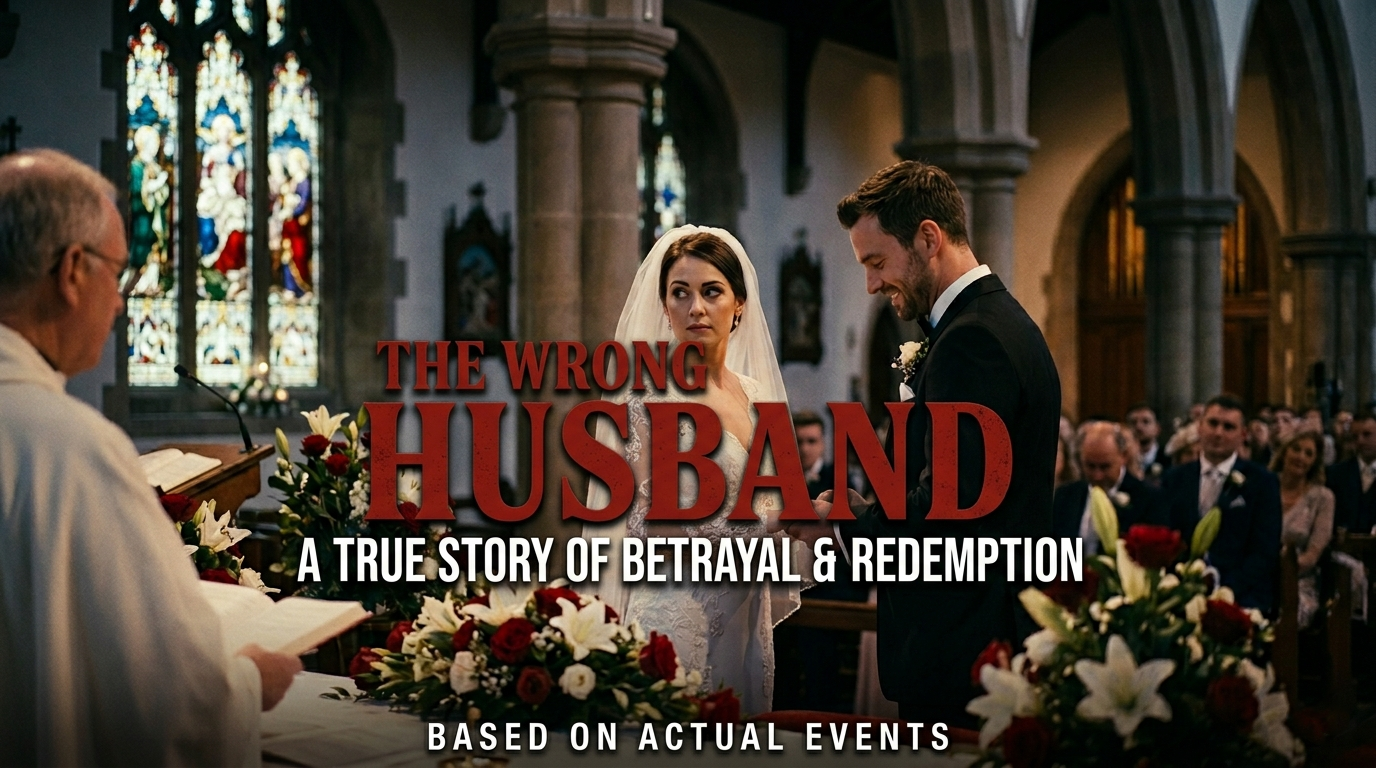
The Wrong Husband !
Romance / Drama
Part one: The Man Standing Next to the Groom
The dress was perfect. That was the one thing Natalie kept telling herself as she stood in the vestibule of St. Andrew’s Church, bouquet trembling slightly in her hands, organ music drifting through the old wooden doors like something from another lifetime.
The dress was perfect. The flowers were perfect. Three hundred people were seated in those pews, and every single one of them had traveled to be here, some from as far as Portland, some from Atlanta, and her grandmother — bless her — all the way from Savannah with a bad hip and a new hat she’d bought specifically for this day.
Everything was perfect. Natalie just needed to remember that.
The doors opened.
She walked.
The aisle felt longer than she remembered from rehearsal. The faces on either side blurred into a soft watercolor of smiles and happy tears, and she focused on what was ahead — on David, waiting at the altar in his charcoal suit, his sandy hair freshly cut, his eyes warm and steady and full of the kind of love that never asked too much of you.
Safe. That was the word she always used when she thought about David. He was safe. And she had decided, two years ago, that safe was exactly what she needed.
She was ten steps from the altar when she saw him.
Cole.
Standing to David’s left, as best man, in a matching charcoal suit, hands clasped in front of him, jaw sharp, eyes dark — and fixed entirely on her.
She had known he would be there. Of course she had known. Cole and David had been best friends since college, long before Natalie had ever entered the picture. She had prepared herself for this moment. She had rehearsed walking past him without flinching, had practiced the pleasant, neutral smile she would offer him at the reception — the smile that said: we are adults, this was a long time ago, I have moved on completely.
She had not prepared for the way he was looking at her.
Not like someone who had moved on. Not like someone neutral or pleasant or adult about any of this.
He was looking at her the way he had looked at her the last night she ever saw him — three years ago, standing in the rain outside her apartment, saying things she had made herself forget.
Natalie reached the altar. She took David’s hands. They were warm. Steady. She made herself look at him and only him.
“You look incredible,” David whispered, eyes shining.
She smiled. She meant it — she did. She loved David. She had built something real with him, something solid, something that didn’t shake you apart the way the other thing had.
The minister began to speak.
And then, from her left — close enough that she could feel it more than hear it — came the quietest exhale. Almost nothing. Barely a sound at all.
But she knew his breathing. God help her, she still knew his breathing.
She did not look. She kept her eyes on David, on his kind face, on the man she had chosen deliberately and carefully and with her whole rational mind.
“Do you, Natalie Ann Reeves, take this man—”
Cole shifted his weight. She felt it.
“—to be your lawfully wedded husband—”
She looked.
She couldn’t help it. For just one half-second, she looked.
Cole’s expression had not changed. He was still watching her with those dark, unreadable eyes, and the corner of his mouth was doing the thing it always did when he was trying very hard not to say something.
Natalie turned back to David.
“I do,” she said clearly. Firmly.
The minister smiled. The crowd breathed a collective sigh of warmth. David’s eyes went wet at the corners.
And somewhere just behind her left shoulder, Cole Whitfield said absolutely nothing — which, she had learned the hard way, was always when he was the most dangerous.
The reception hadn’t even started yet. And already, Natalie could feel the careful architecture of her new life beginning to crack — one hairline fracture at a time.
Part two: The Toast
The Hargrove Ballroom was everything Natalie’s mother had dreamed of — draped in ivory and candlelight, round tables set with crystal glasses that caught the light like small fires. The band was playing something soft and jazzy in the corner, and the champagne was cold, and by all outward appearances, the night was exactly what it was supposed to be.
Natalie had not been alone with Cole for a single moment. She had been careful about that.
She had circulated, she had laughed at her uncle’s jokes, she had danced with David’s father and thanked the florist and hugged seventeen people whose names she was too overwhelmed to remember. She had been a perfect bride.
She had also, in the process, tracked Cole’s location in the room the way you track a storm on the horizon — not because you want it to come, but because you need to know exactly where it is.
He was at the bar. Then talking to David’s college roommate. Then standing near the door to the terrace with a glass of something amber, looking out at the darkened garden.
He had not approached her. He had barely even looked at her since the ceremony.
Good, she told herself. That was good. That was what grown adults did.
Then the best man speech began.
Cole stepped up to the microphone with the ease of someone who was never nervous, which had always been one of the things about him that drove her absolutely insane — in both senses of the word. He straightened his jacket. He looked out at the crowd. He smiled.
“I’ve known David Mercer for fourteen years,” he began, his voice low and unhurried, the kind of voice that made rooms go quiet without trying. “And in that time, I’ve watched him become one of the finest men I’ve ever known. Patient. Loyal. Exactly the kind of person who deserves something real.”
Applause. David grinned.
Natalie held her champagne glass very still.
“When he told me he’d met someone,” Cole continued, “I’ll admit I was skeptical. David falls for people easily. He always has. He sees the best in everyone.” A pause. “But then I met Natalie.”
He looked at her then. Directly. Unhurried.
“And I understood immediately why he wasn’t letting her go.”
The room went soft with appreciation. Natalie’s mother pressed a hand to her heart. David reached over and squeezed Natalie’s fingers.
She squeezed back. She kept her face perfectly composed.
“To David and Natalie,” Cole said, raising his glass. “May you always choose each other.”
Everyone drank.
Natalie drank.
She told herself it was a beautiful toast. She told herself there was nothing underneath the words, that she was looking for things that weren’t there, that this was her own guilt manufacturing meaning where there was none.
Then the dancing started, and David was pulled away by his mother for the traditional first family dance, and Natalie was standing at the edge of the room alone for exactly forty-five seconds before she felt someone appear beside her.
She didn’t have to look.
“That was a lovely speech,” she said carefully.
“I meant every word,” Cole said.
A silence stretched between them — thin and taut as wire.
“Natalie.” His voice dropped. Just her name. Nothing else.
“Don’t,” she said quietly.
“I’m not doing anything.”
“You don’t have to.”
Another silence. On the dance floor, David was laughing at something his mother said, his whole face open with it.
“He loves you,” Cole said. It didn’t sound like an accusation. It sounded like something worse — like a concession.
“I know,” Natalie said.
“Good.” He took a slow breath. “Then I’m happy for you both.”
He walked away before she could respond. She watched him go. She watched him set his glass down on a passing tray, straighten his jacket once, and disappear through the terrace door into the dark.
She looked back at David. He caught her eye across the room and mouthed: you okay?
She smiled. She nodded.
She was fine. She was absolutely fine.
She was also, without letting herself think about it too hard, already moving toward the terrace door.
She told herself she just needed air. That it had nothing to do with him. She had almost convinced herself of that by the time she pushed through the door — and found Cole standing in the garden, waiting like he had known she would come.
Part three: What the Garden Heard
The night air was cool and smelled of jasmine and the faint distant salt of the ocean two miles away. String lights ran along the garden wall in a long amber line. Inside, the band had shifted to something slower, and the music drifted out through the glass doors like breath.
Cole was standing near the stone fountain at the center of the garden, jacket open, one hand in his pocket, looking up at the sky.
He heard her before she spoke. He always had.
“You knew I’d come,” she said. Not a question.
“I hoped you wouldn’t,” he said. “But yes.”
She stopped a few feet away. Safe distance. She had learned the hard way that safe distance mattered with Cole — that something happened to her thinking when he was too close, like interference on a signal.
“This can’t happen,” she said.
“Nothing is happening, Natalie.”
“You know what I mean.”
He finally looked at her. The amber light caught the planes of his face, and for a moment he looked exactly like the person she had tried for three years to file away into the past — someone she once knew, someone who no longer had anything to do with the life she was building.
The filing system had never really worked.
“Why did you come back?” she asked. “You told me you were leaving Chicago. You said you were taking the position in London.”
“I turned it down.”
“Why?”
He didn’t answer immediately. He looked back at the sky.
“David asked me to be his best man,” he said finally. “He’s my oldest friend. What was I supposed to say?”
“You were supposed to say no,” Natalie said, and her voice came out softer than she intended. “You were supposed to make it easier.”
Cole turned to face her fully then, and something in his expression shifted — the careful, measured composure he’d worn all evening giving way to something rawer underneath.
“I know,” he said. “You’re right. I should have said no.” He paused. “I couldn’t.”
The music from inside changed keys. Someone laughed through the glass. Natalie was very aware of the wedding ring on her finger — an hour old, still unfamiliar in weight.
“Tell me you’re happy,” Cole said quietly. “Tell me that honestly, and I’ll let this be the last conversation we ever have. I’ll move to London tomorrow. You’ll never have to think about me again.”
She opened her mouth.
She had been happy. She was certain she had been happy — or close enough to it that the distinction hadn’t seemed to matter. David was good. Their life was good. She had chosen this, deliberately and with her eyes open, because what she had felt for Cole was the kind of thing that burned beautiful and then burned everything else.
She had not wanted to burn.
“I am happy,” she said.
“Natalie.”
“I am.”
“You looked at me on that altar,” he said gently. “You looked at me and you couldn’t look away. And I’ve been standing in that ballroom all night watching you be perfect and wonderful and exactly who David thinks you are — and I need to know.” His voice dropped to almost nothing. “Is any part of you still—”
“Don’t finish that sentence.”
“—still in love with me?”
The jasmine. The string lights. The muffled band. The sound of three hundred people celebrating inside, none of them knowing that out here in the garden, Natalie Mercer — married fifty-seven minutes — was standing in front of the only man who had ever made her feel like the ground might give way beneath her.
She looked at him for a long time.
Then the terrace door opened behind them.
“Nat?” David’s voice, warm and easy, carrying across the garden. “They want us for the cake cutting, sweetheart.”
She turned. David stood in the doorway, backlit by the golden ballroom, smiling at her with his whole face — open, trusting, completely unaware.
“Coming,” she called. Her voice didn’t shake. She was proud of that.
She turned back to Cole. One last moment.
His jaw was tight. His eyes said everything he wasn’t going to say.
She walked past him toward the door. She felt his hand — the briefest, lightest touch on her wrist, gone before it could mean anything.
She didn’t stop. She went back inside. She took her husband’s hand.
She smiled for the cameras.
And deep in the part of her she’d tried to wall off and plaster over and paint something sensible on top of, the answer to Cole’s question sat like an ember — quiet, stubborn, refusing to go out.
She had said “I do” to David. Every word of it was true. But the thing she hadn’t said — the thing she’d pressed her lips together and swallowed back at the altar — was still true too. And Cole Whitfield’s flight to London was suddenly, quietly, no longer booked.