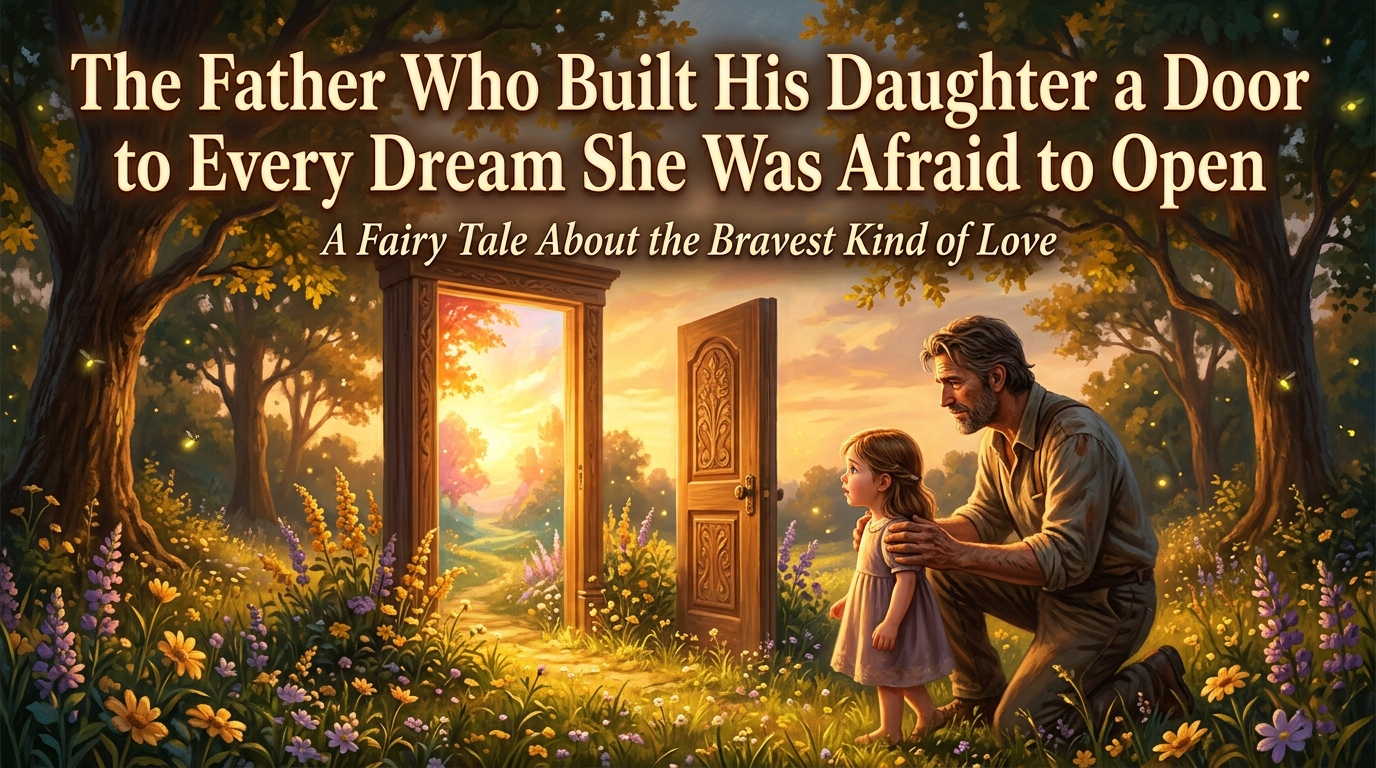
The Father Who Built His Daughter a Door to Every Dream She Was Afraid to Open !
There was once a carpenter named Eli who lived at the edge of a quiet town where the oak trees grew so tall they seemed to be whispering to the clouds.
Eli was not a famous man. He was not wealthy or decorated or written about in any book. He had rough hands and sawdust on his boots and a laugh that was bigger than he was. But he had one thing that made the angels stop and take notice — a daughter named Clara, and a love for her so wide it had no edges he could find.
Clara was seven when Eli first noticed it.
She had stood at the bottom of the old oak tree in their yard — the one she had always wanted to climb — and stared up at it with fire in her eyes and fear in her feet. She wanted to go up. Every part of her wanted to go up. But she stood there, and she stood there, and she never moved.
That night, after she had gone to sleep, Eli went to his workshop.
He worked until the birds started arguing about the sunrise. And when Clara came down for breakfast, there was a small wooden door leaning against the base of the oak tree. It was painted soft green, the color of new leaves. On it, in careful letters, her father had carved: The door to the treetops. You are brave enough.
Clara laughed — the way children laugh when something is silly and wonderful at the same time. She touched the door. She opened it. And somehow, in the opening of it, her feet found the courage her heart already had. She climbed that tree before noon.
She never forgot the feeling.
When Clara was eleven, she wanted to audition for the school play. She had practiced her lines until she knew them in her sleep, until she whispered them to her pillow and performed them for the cat. But on the morning of auditions, she sat at the kitchen table and said, very quietly: “I don’t think I’ll go.”
Eli said nothing at breakfast.
But that afternoon, there was a new door standing in the hallway of their home — slim and tall, painted theater-red, with a brass handle shaped like a star. On it he had carved: The door to the stage. Your voice was made to be heard.
Clara stood in front of it for a long time. Then she picked up her script, walked to school, and sang so clearly that the teacher asked her to do it twice.
She got the lead.
The doors kept coming. A blue door the summer she was fourteen and too afraid to introduce herself to the new girl in town — the girl who would become her best friend for the next forty years. A gold door when she was seventeen and holding a college application she was convinced she wasn’t smart enough to submit. A white door, simple and undecorated, the night before her wedding, when she sat on the porch and shook with doubts she couldn’t name.
Each one said something different. Each one was built just for her, just for that moment, carved in her father’s careful, unhurried hand.
She never asked him how he always knew.
He never told her.
When Clara was thirty-four, Eli grew sick. It happened slowly, the way winter comes — first just a chill, then one day you look up and everything has changed. She drove home every weekend. She sat beside him and held his rough hand and refused to talk about endings.
One morning she arrived to find him in his workshop, thinner than she remembered, moving slowly but moving with purpose. He was building something.
She stood in the doorway and watched him work.
“Papa,” she said. “What is this one for?”
He kept his eyes on the wood. Ran his thumb along the grain the way he always did when he was choosing his words carefully.
“This one,” he said at last, “is for after.”
She didn’t ask him to explain.
He finished it on a Tuesday. It was the most beautiful door he had ever made — dark walnut, warm as a held hand, with carved flowers along the edges that looked like the ones her mother used to grow. In the center, in letters she had to press her fingers to in order to read, he had written:
The door to everything I could not stay to see. I will be on the other side. Keep going.
Eli passed away that winter, peaceful, with Clara’s hand in his.
She brought the door home. She stood it in her hallway, between the coats and the photographs and the ordinary beautiful mess of her living life. And every morning, on the way out to face whatever the day required of her, she touched it.
Just touched it.
And every time, without fail, she felt brave enough to open whatever came next.
Years later, when Clara’s own daughter stood frozen at the bottom of an oak tree — staring up with fire in her eyes and fear in her feet — Clara smiled a smile that carried forty years of doors in it.
“Come with me,” she said.
And she took her daughter to the workshop.
— The End —