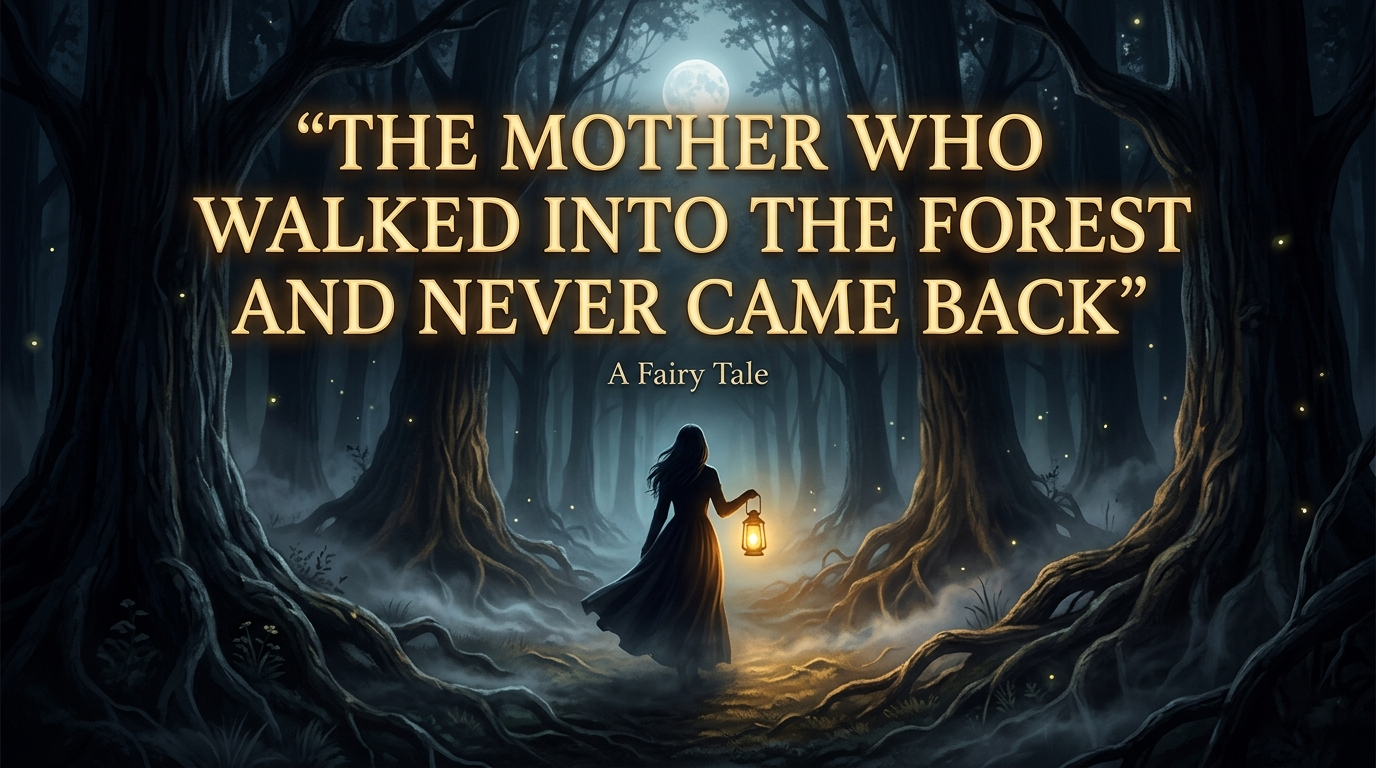
The Mother Who Walked Into the Forest and Never Came Back !
There was once a village nestled at the edge of a great forest so old that no one remembered who had planted it — only that it had always been there, breathing slowly in the dark like something that was almost alive.
The people of the village had a rule: do not enter the forest after the first frost.
Everyone obeyed. Everyone, that is, except for a woman named Maren.
Maren had two children — a boy named Eli, age seven, with dirt always under his fingernails, and a girl named Solen, age five, who collected stones she believed were sleeping. Their father had died the previous spring, taken by a fever that swept through the valley like a whispered secret, and since then, Maren had held the world together with her two hands and the sheer force of her refusal to fall apart.
She baked bread before dawn. She mended fences. She sang her children to sleep with songs she invented on the spot, because she could never quite remember how the real ones went, and somehow her made-up songs were better anyway.
She was the kind of woman people called strong without realizing they meant carrying more than her share.
The frost came early that year.
And with it came the coughing — first Eli, then Solen, then worse in both of them, the kind that shook their small bodies like windows in a storm. The village healer shook her head and spoke of a root that grew only deep in the forest, at the base of the oldest trees, where moonlight pooled in winter like silver water.
“No one goes in after the frost,” said the healer.
“I know,” said Maren.
She kissed Eli on his warm forehead. She pressed her cheek against Solen’s. She lit a lantern. She walked to the edge of the forest and she stepped inside — because there are some decisions a mother doesn’t make with her head.
The forest received her the way deep water receives a stone: quietly, completely, without argument.
She found the roots. She dug them with her bare hands in the frozen earth, filling the pouch she had tied around her waist. She found more than she needed, and still she kept digging — for the winters that hadn’t come yet, for the fevers she had not yet seen, for every future danger she could not name but had already decided to fight.
And that is when the forest made its offer.
It spoke not in words but in a feeling, the way forests do — a warmth in her chest that had nothing to do with the cold, a sudden understanding that she could stay. That the forest needed tending. That something ancient and aching at its heart had been waiting for someone who loved the way she loved: fiercely, practically, without needing to be thanked.
Your children will be well, the feeling said. The roots will find their way to them. But you — you are needed here.
A weaker love might have said no.
A smaller love might have simply run.
Maren stood very still in the moonlit dark, holding her lantern in one hand and a fistful of frozen earth in the other. She thought of Eli’s fingernails. She thought of Solen’s sleeping stones. She thought of all the made-up songs she hadn’t finished yet.
And then she set the lantern down at the base of the oldest tree, and she became part of the forest.
The pouch of roots appeared on the healer’s doorstep before morning.
By the week’s end, Eli and Solen were well. They grew up tended by neighbors and the entire village, which is what villages are for, and they were loved fiercely and raised with great care.
But they never forgot their mother.
And on the coldest nights of winter, when the forest went absolutely silent and even the wind held its breath — they would see it. Far between the trees. A soft, golden light, steady and unhurried, moving slowly through the dark.
Not lost.
Not searching.
Keeping watch.
Eli grew old and told his grandchildren the story. Solen spent her whole life collecting stones she believed were sleeping, and she placed one at the edge of the forest every year on the first frost, a small gift for a love that never left.
The village still has a rule: do not enter the forest after the first frost.
But they added something to it, in the years that followed.
Leave a light at the tree line.
So she knows we remember.
And somewhere in the breathing dark, a lantern that was set down long ago still glows — and the oldest tree in the forest grows a little warmer every winter, as if something at its very roots has a heartbeat.
🌿 The End.