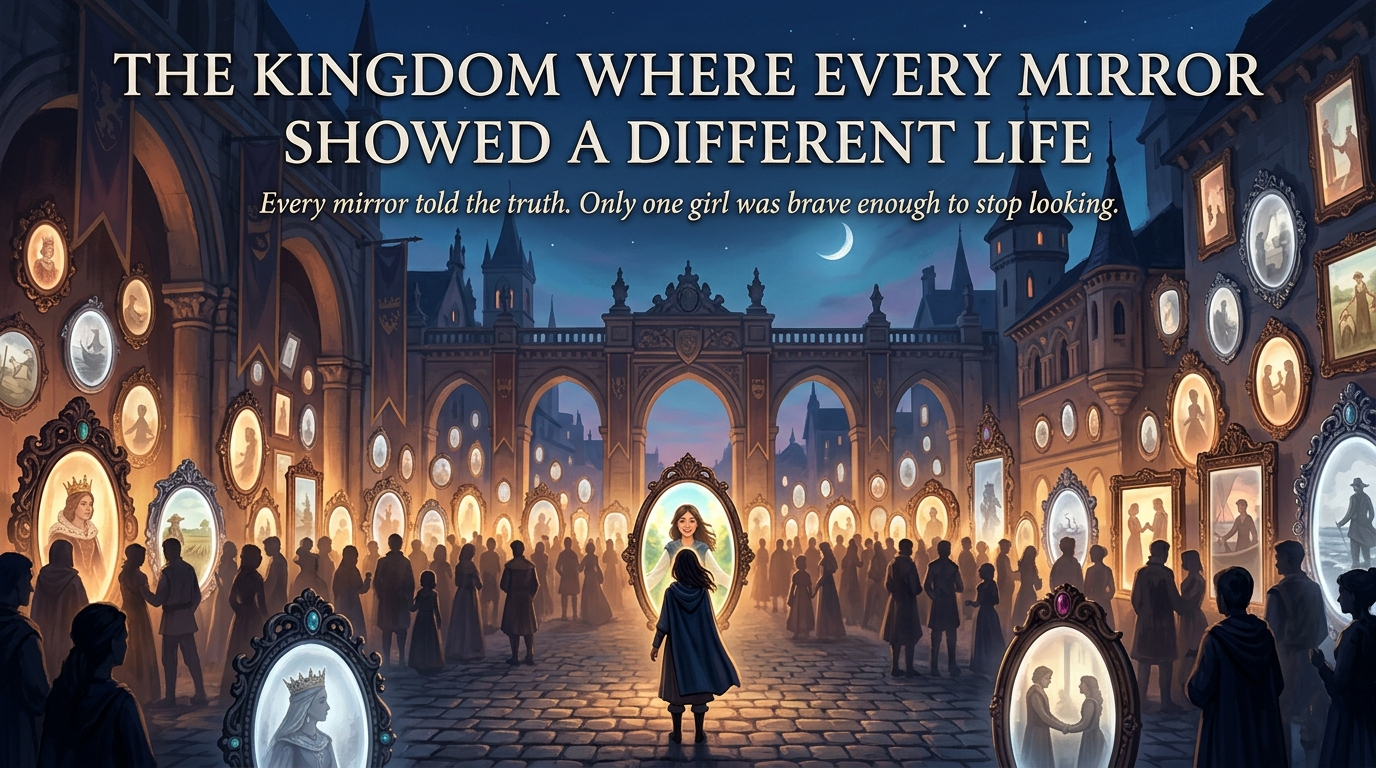
The Kingdom Where Every Mirror Showed a Different Life !
Part One: The Kingdom of Glass
The kingdom of Vael had more mirrors than any other kingdom in the known world.
This had not always been true. Once, Vael had been ordinary — farmland and fishing villages and a modest capital city with a modest royal palace and people who lived their lives without particular enchantment or particular grief. But three generations ago, a glassmaker named Soren had discovered something in the sand along Vael’s northern shore — a particular mineral, colorless and fine as powder, that when mixed into molten glass produced something no glassmaker anywhere had ever produced before.
Mirrors that told the truth.
Not the truth of your face — any polished silver could do that. The truth of your life. Specifically: the life you had not lived. The turn not taken at the crossroads. The letter never sent. The hand you had reached for and then, at the last moment, pulled back. Every mirror in Vael, made from Soren’s glass, showed the viewer something different — and that something was always, precisely, the version of their life in which they had chosen otherwise.
Soren himself had looked into the first mirror and seen a life in which he had stayed in his home village and married his childhood sweetheart and never discovered the mineral at all. He had stood in front of that mirror for six hours. His apprentice had found him there and pried him away, and Soren had been quiet for a week afterward — not sad, exactly, but somewhere far off, the way people are when a part of them has gone traveling without the rest.
He should have destroyed the formula. He knew this, later.
Instead he sold mirrors to the palace. And then to the nobility. And then, because beautiful things that reveal terrible truths are always the most irresistible things, to everyone.
By the time Maren was born — three generations later — there were mirrors in every home, every tavern, every public square. Covered with cloth during the day by people who knew better, uncovered at night by the same people who could not help themselves. The kingdom of Vael was prosperous and well-governed and quietly, persistently, devastatingly haunted by itself.
Part Two: Maren
Maren was seventeen and had never looked into a mirror.
This was not an accident. Her mother, who had lost two years of her life to the mirror above their fireplace — two years of standing before it every evening watching the life in which she had become a sailor, which was what she had wanted before she had wanted a family — had covered every mirror in their house with black cloth before Maren was old enough to reach them and made her daughter promise, with the seriousness usually reserved for promises about fire and deep water: you do not look.
Maren had not looked. Not because she was obedient — she was not, particularly — but because she was afraid. Not of what she would see. Of what she would feel about it.
She was, she understood about herself, someone who felt things at full volume. Joy went all the way through her. Grief did too. She had watched what the mirrors did to people — the faraway look, the slight unmooring, the way they touched their real lives afterward with hands that felt they were handling something secondhand — and she had understood, with the self-knowledge of someone who knows their own weaknesses, that she would not survive a mirror the way others barely survived it. It would pull her under.
So she didn’t look.
She looked at everything else instead, with the ferocious attention of someone who has decided that what is actually in front of them is going to have to be enough. The way light moved on the river. The way her mother laughed when she forgot to guard it. The way bread smelled when it was new. She collected the real world deliberately, the way you save things when you understand they might be taken.
And then the king announced the lottery.
Part Three: The Lottery of Mirrors
The king of Vael was a good king in most respects and a foolish one in this: he loved his mirror.
He had looked into it at nineteen — just once, he told himself, just to know — and seen the life in which he had not been born a prince. A carpenter’s life, in a small town near the coast, with sawdust on his hands and a view of the sea from a workshop window and a simplicity to everything that the palace, with its weight of governance and ceremony and expectation, would never give him. He had looked away. He had done his duty. He had been, by most measures, a good king.
But the carpenter’s life lived in him like a splinter — not painful, just present, always present, a small foreign thing his body had never fully absorbed.
Now he was sixty and he had one year left, the physicians said, and he had made a decision that the kingdom called generous and his advisors called catastrophic: every mirror in Vael would be brought to the palace square. A lottery would be held. One person, chosen by chance, would be given the chance to step through.
Not to look. To step through.
Because Soren’s formula, it turned out — and this was the thing the glassmaker had known and never told, the thing that had been whispered in the glassmakers’ guild for three generations — did not only show the other life. For one person, once, under specific conditions of the maker’s own devising, it opened.
A door. A real door. One way, one time, no return.
The king wanted someone to have what he had not taken. He called it a gift. He called it freedom.
Maren called it a catastrophe waiting to happen.
She went to the lottery anyway. Not to enter. To watch.
Part Four: What She Saw
The mirrors filled the palace square on a Tuesday in October — hundreds of them, dragged from homes and taverns and public squares, propped and stacked and leaning against each other in the grey morning light, their faces covered with cloth. An enormous, silent crowd. Children on shoulders. Old men weeping already, for reasons no one asked about.
The king stood on the palace steps and read the proclamation. One lottery. One passage. One life fully lived instead of just glimpsed.
Maren stood at the back of the crowd and watched the faces. She was not watching the mirrors.
What she saw was this: everyone in the crowd was looking at the covered mirrors the way thirsty people look at water. That particular combination of longing and dread that is the most human of all expressions — the face of someone who wants a thing and knows the wanting is dangerous and cannot stop wanting it anyway.
She saw her mother in the crowd. Her mother’s hand was half-raised toward the nearest covered mirror. Not reaching — just raised, the way a hand rises toward warmth before the mind catches it.
And Maren understood something she had not understood before.
The mirrors were not the problem.
The longing was not the problem.
The problem was what the kingdom had done with it — had given it glass and put it on walls and let people stand before it indefinitely, feeding a hunger that had no bottom, building a relationship with a life they didn’t have at the expense of the life they did.
The other lives in the mirrors were real. She didn’t doubt that. Every road not taken does lead somewhere. Every choice unmade is also, somewhere, a choice made. The grief of that — the beautiful, unbearable grief of that — was real and legitimate and deserved to be honored.
But it did not deserve a door.
She walked to the front of the crowd.
Part Five: What She Said to the King
The king was surprised to be interrupted. Kings generally are.
Maren was not arrested immediately because she spoke before the guards understood she was speaking — she simply walked to the base of the palace steps and said, in a carrying voice: “Your Majesty. I need to say something before you open the lottery.”
The king looked at her. He was old and tired and his carpenter’s hands — the hands he had never had — were folded in front of him.
“Say it,” he said.
She said: “The person who steps through that mirror will live their other life. And it will be real, and it will be theirs, and they will love it, because it will be the thing they always wanted. But they will also — somewhere in it, on some Tuesday morning when the light comes through the window a certain way — wonder about this life. The one they left. And there will be no mirror there to show them. There is only ever one mirror. Only ever one door. And they will have used it.”
Silence in the square.
“What we are afraid of,” Maren said, more quietly, “is not that we chose wrong. What we are afraid of is that choosing meant losing. That every yes is also a no. That we are only ever one life out of all the lives we could have been.” She paused. “But the mirror doesn’t fix that. It just makes the losing visible. And you can’t step through grief. You can only — ” she stopped, found the word, ” — carry it forward.”
The king looked at her for a very long time.
“Then what do we do with them?” he said. He gestured at the covered mirrors. He meant: with all of this. With three generations of longing and glass and lives half-lived in the reflection.
Maren thought about it. She thought about her mother’s half-raised hand.
“Uncover them,” she said. “Let everyone look. All at once, together, in the open, in the daylight. Not in secret. Not alone at night. Let the kingdom grieve together what it didn’t choose — and then cover them again. And then go home.”
“And the door?” the king asked.
“Close it,” she said. “Or give it to no one. The other lives are not prizes. They are just — the rest of us. The parts we had to leave behind to be who we are.” She met his eyes. “You were a good king. Whatever the mirror says.”
Something moved across the old man’s face — not absolution, exactly, but something adjacent to it. The easing of a long-held tension.
He nodded once.
He said: “Uncover the mirrors.”
Part Six: The Great Uncovering
They uncovered them all at once, on the count of three, in the grey October morning light.
And the kingdom of Vael looked.
They looked at sailors and carpenters and mothers and wanderers and the people they had almost been and the hands they had almost held and the doors they had almost walked through. They looked at the lives that had continued without them in the vast parallel country of roads not taken.
Some people wept. Some laughed, surprised. Some stood very quietly with a particular stillness that was not devastation but was close to it — the stillness of someone setting something heavy down after a very long time of carrying it.
Maren looked too.
She had promised herself she would, when the time was right. She stood before a mirror smaller than she had expected — oval, silver-framed, the glass slightly warped at the edges — and she looked.
She saw a girl who had never been afraid to look. Who had seen the other life at fourteen and made peace with it then and spent the years since neither haunted nor unburdened but simply — whole. Living one life all the way through, without the exit of the mirror’s promise, without the consolation of the other road. Just this road. Just this one.
The girl in the mirror looked back at her.
And then she smiled.
It was her own face, and her own smile, and the life in the mirror was not another life at all.
It was this one.
Seen clearly, from the outside, for the very first time.
Maren pressed her hand against the glass.
“Hello,” she said.
Then she stepped back. And looked around at her kingdom, and her people, and the grey October light, and the whole improbable ordinary extraordinary fact of being alive in this particular version of everything.
And she thought: yes.
This one.
This one is enough.
— The End —
Epilogue: The Kingdom After the Mirrors
They covered the mirrors again that evening, as she had said.
Most people took them home. Some left them in the square. A few broke theirs — not in anger, but with the careful deliberateness of someone choosing, finally and for real, not to look back.
The door the glassmaker’s formula had made was sealed. Not destroyed — Vaelians were too honest for that, and knew that the longing itself deserved to be honored even if the door did not. It was sealed and placed in the palace archive with a placard that said only: here is the other road. It is real. You do not have to take it to know it exists.
Maren became, eventually, the kingdom’s counsel — not a queen, not a minister, just the person people came to when they needed someone who had looked in the mirror and chosen the real over the reflected and could talk about what that cost and what it gave.
She was not without grief. She had her own roads not taken, as everyone does. On certain evenings she felt the pull of the covered mirror in the corner of her room — the particular quiet ache of all the lives that had not been lived.
She let herself feel it.
Then she went back to her life — her one, real, irreplaceable, entirely sufficient life — and she lived it as deliberately as she knew how.
Which is all any of us can do.
Which is, it turns out, enough.