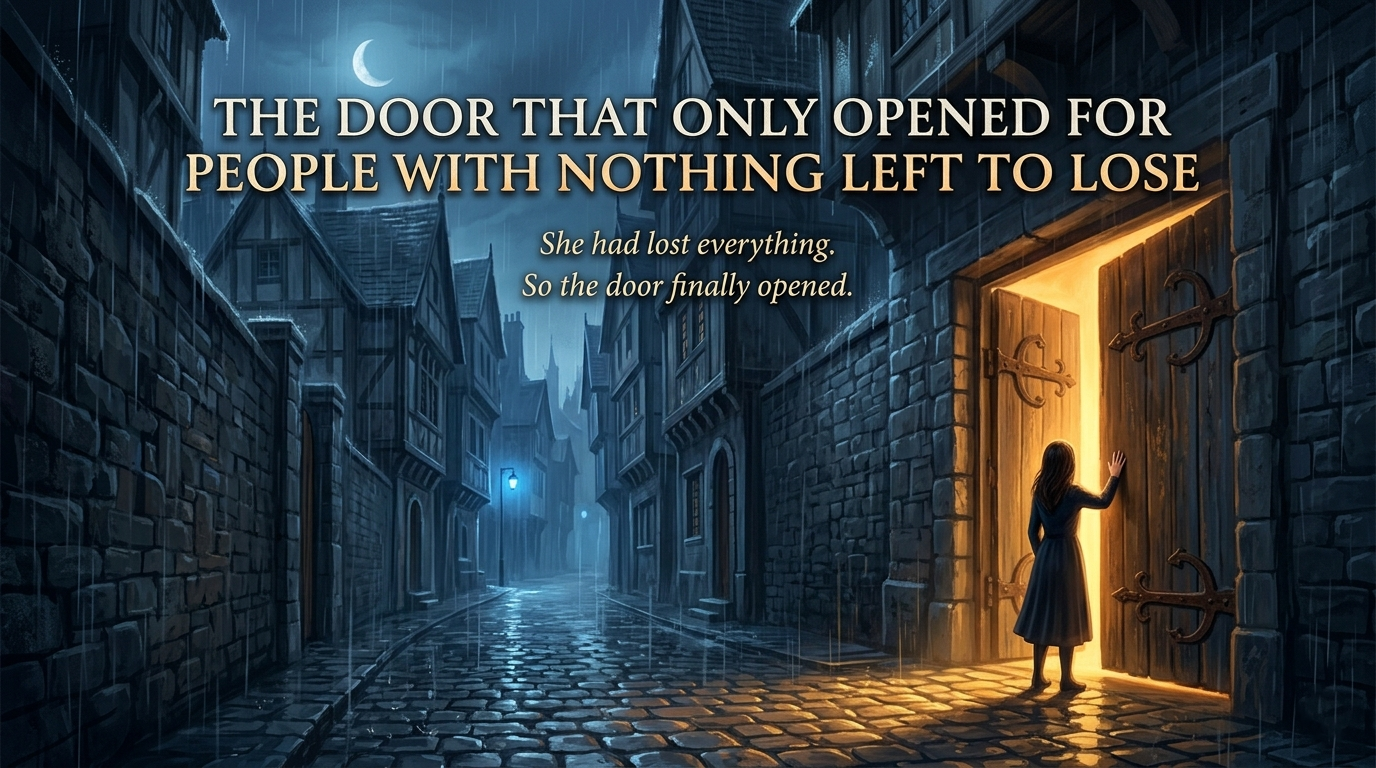
The Door That Only Opened for People With Nothing Left to Lose !
Part One: The Door
Nobody built it. Nobody owned it. Nobody could explain it.
The door simply appeared — had always appeared, as long as anyone could remember, in the places where people ended up when everything else had ended first. At the bottom of a ravine road where a man had walked after his farm burned. In the narrow space between two buildings in a city where a woman had wandered after her third night with no money and no roof. At the edge of a frozen lake in midwinter where a boy had gone because he could not think of anywhere else to go.
It was always the same door. Plain wood, dark with age, iron hinges gone rough with rust. No handle on the outside — just a flat, smooth surface, as though the concept of opening had been forgotten. No keyhole. No knocker. No sign.
And yet.
The people who found it — and they always found it, or it found them, which amounts to the same thing — knew immediately what it was. Not from any description, because nobody described it. Because you do not describe a door like that. You either go through it or you don’t, and if you go through it you don’t come back, and if you don’t go through it you spend the rest of your life not talking about the night you stood in front of it with your hand flat against the wood and felt it — the warmth, faint and impossible, coming from the other side.
The door opened, as everyone somehow knew, for only one kind of person.
Someone with nothing left.
Not poor — poverty is not nothing. Not lonely — loneliness is not nothing. Not grieving — grief is not nothing; grief is enormous, grief is proof of love, grief is something.
Nothing. The specific and terrible condition of having exhausted every option, every hope, every version of the future you had been able to imagine. The place past the last place. The hour after the last hour.
The door found those people.
And it opened for them.
And they went through.
And no one who went through ever came back.
Part Two: Sera
Sera was thirty-four when she found the door, and she had arrived at nothing by a route so gradual and so ordinary that it barely felt like a story at all.
No single catastrophe. No dramatic villain. Just the slow accumulation of ordinary losses the way snow accumulates — each flake weightless on its own, and then one morning you look up and the roof has caved in. Her daughter, born too early, gone in three days — the same three days that broke her marriage, or revealed that it was already broken, or both. Her work, which she had loved, restructured out from under her in the language of budgets and efficiencies. Her apartment, then her savings, then the last of the carefully maintained fictions about how she was doing, actually, when people asked.
She was not suicidal. This matters. She had thought about it and decided against it with the flat practicality of someone clearing a debt — she had considered the option, declined it, moved on. What she was was emptied. Scraped clean. A vessel that had held things and been relieved of them one by one until holding itself upright took everything she had.
She found the door on a November night at the end of an alley she had walked into by accident, looking for a shortcut home.
She stood in front of it for a long time.
She was not afraid. That surprised her. She had expected fear and found instead something very quiet — the particular quiet of a person who has nothing left to protect and therefore nothing left to be afraid of losing.
She put her hand flat against the wood.
It was warm.
She pushed.
It opened.
Part Three: The Other Side
She had expected darkness. Or light. Or something dramatic — a landscape, a void, a presence with a voice like thunder.
What she found was a room.
An ordinary room, warm and low-ceilinged, with a fire in a stone hearth and a wooden table with two chairs and a window that showed a sky the color of late afternoon in early summer — the particular blue that exists for perhaps forty minutes a day and makes everything it touches look like it is being seen for the last time, in the best possible sense.
At the table sat a woman. Old — or not old, exactly, but the kind of ageless that some people achieve, the kind that means they have been paying attention for a very long time. She had white hair and dark eyes and hands that were doing nothing, resting open on the table, in the posture of someone who has been waiting without impatience.
“Sit down,” she said.
Sera sat.
“You have nothing left,” the old woman said. It was not a question.
“Yes,” said Sera.
“Good,” said the old woman. And then, at Sera’s expression: “Not good that you lost it. Good that you know it. Most people spend tremendous energy pretending they still have something when they don’t. It costs them everything and buys them nothing. You’re not doing that.”
Sera looked at the fire.
“What is this place?” she asked.
“The space between,” said the old woman. “Between the end of one thing and the beginning of whatever comes after. It has no name. It has been here longer than the language you would name it in.”
“What happens here?”
“That depends entirely on you,” the old woman said. “But I should tell you something first, before you decide.” She folded her hands. “The door did not open for you because you are broken. It opened for you because you are empty. Those are not the same thing. A broken thing cannot hold anything new. An empty thing —” she paused, “— can hold everything.”
Sera was very still.
“I have been waiting,” the old woman said, “for someone empty enough.”
“For what?” Sera asked.
The old woman reached into the pocket of her coat and placed something on the table between them.
It was a seed.
Unremarkable. Brown and small and dry, the kind of seed that could have come from anything.
“What is it?” Sera asked.
“The beginning,” said the old woman. “Of what, I don’t know. That’s not mine to know. That’s yours.”
Part Four: The Choice
Sera looked at the seed for a long time.
“If I take it,” she said slowly, “I go back.”
“Yes.”
“Back to all of it.”
“Yes.”
“The empty apartment. The gone job. The — ” she stopped. Started again. “Everything I lost doesn’t come back.”
“No,” said the old woman, simply and without apology. “What’s gone is gone. The door is not a reversal. It’s not a restoration.” She met Sera’s eyes steadily. “It’s a beginning. And beginnings are not the same as returns.”
Sera looked at the seed. She looked at the fire. She looked at the window and the forty-minute summer blue of the sky outside, which was still there, patient as anything, asking nothing of her.
“What if I stay?” she asked. “What happens if I don’t go back?”
The old woman was quiet for a moment.
“You rest,” she said. “As long as you need. And then, when you are ready, you begin something here. Something also real, also valid, also a life.” She paused. “Many people stay. There is no shame in it. The world you came from is hard and it took a great deal from you and you are not obligated to return to it.”
Sera thought about her daughter. Three days old and gone. She thought about the weight of that and the permanence of it and the way she had carried it so long it had become her posture — the slight hunch, the held breath, the body braced against the next loss.
She thought about what it would mean to put it down.
Not to forget. To put down. To carry it differently — in the hands instead of on the back, where you can see it, where it can be set on a table when you need to rest, where you can pick it up again when you are ready but it is no longer the thing holding your entire shape.
She thought about empty.
She thought about what empty could hold.
She picked up the seed.
Part Five: What She Sent Back
She did not go back immediately. The old woman had not lied — the space between had its own time, and Sera stayed as long as she needed, which turned out to be not as long as she had feared.
She slept, deeply and without dreams, for what felt like the first time in years. She ate at the table by the fire — simple food, the kind that tastes like being taken care of. She sat at the window and watched the summer sky cycle through its forty minutes of perfect blue, again and again, unhurried, as though the world had agreed to hold that particular moment open until she was done with it.
She talked to the old woman. Not about plans or futures or the practical architecture of a rebuilt life — just talked, the way you talk when you are not performing recovery for anyone, when there is no one watching and nothing to prove. She talked about her daughter. She said her name — Willa, her name had been Willa — out loud, in this room, without the weight of other people’s discomfort pressing against her.
The old woman listened. She was, Sera understood, extraordinarily good at listening.
On the last day — and she knew it was the last day the way you know it, without explanation — Sera asked: “The people who came before me. Did any of them go back?”
“Some,” said the old woman.
“What did they do with it? With the empty?”
The old woman smiled — the first time, in all the days, that she had smiled. “Everything,” she said. “Slowly. Imperfectly. With frequent rest and the occasional return to despair, because that is how humans build things.” She looked at Sera with those dark, patient eyes. “But they built.”
Sera held the seed.
She stood up.
She found the door on the far wall — same door, same iron hinges, but with a handle now on this side. Always a handle on the inside.
She stopped.
She turned back to the old woman.
“I want to send something back,” she said. “Before I go. For the next person who comes through. So they know — so they know what this place is, and that there’s a table and a fire and someone who listens, and it’s not — it’s not the end. I want them to know before they’re afraid.”
The old woman looked at her for a long moment.
Then she slid a piece of paper across the table.
Sera wrote. She did not write long — there wasn’t much to say, and the truest things rarely need many words. She folded the paper and left it on the table where the seed had been.
Then she opened the door.
And went back.
Part Six: The Return
The alley was exactly as she had left it. Cold November, same damp cobblestones, same distant sound of a city doing its city things without waiting for her.
The door was already gone.
She stood in the alley for a moment with the seed in her closed fist and the cold on her face and the whole enormous, difficult, irreplaceable fact of being alive in this particular life pressing in on her from every direction.
She opened her hand and looked at the seed.
The beginning, the old woman had said. Of what, I don’t know. That’s yours.
She closed her fingers around it.
She walked out of the alley.
She did not know what the seed would grow. She did not know what the empty would hold. She did not know how long it would take or how many times she would sit on a floor in the dark before the floor stopped being the only place that made sense.
She knew she had a name to say out loud whenever she needed to.
She knew she had rested.
She knew she was empty in the way that could hold things, not the way that couldn’t.
She walked home through the November cold with her fist around a seed and her daughter’s name in her mouth and the particular posture of someone who has set something down and picked up something else — not lighter, not heavier, just different.
Just hers.
Just beginning.
— The End —
Epilogue: The Note on the Table
They say the door still appears.
At the bottom of ravine roads and the ends of empty alleys and the edge of frozen lakes in midwinter. Always the same door. Always the same warmth through the wood. Always opening for the same kind of person — the emptied ones, the scraped-clean ones, the ones who have arrived at the last place and found it quieter than they expected.
And they say — the ones who go through and come back, which is more of them now, slowly, over time — that there is always a note on the table when they arrive.
Folded paper, slightly worn at the creases. Different handwriting each time someone adds to it, because others have left their own words alongside the first. A growing document, passed from empty hand to empty hand across whatever distance the door crosses.
The first words are always the same.
Sera’s words, written on a November night at a table by a fire, left for the next person so they would not be afraid:
You are not broken. You are empty. Those are not the same.
There is a table here and a fire and someone who will listen.
Rest as long as you need.
Then go back, if you can.
The seed is real.
The beginning is yours.
I promise it is yours.