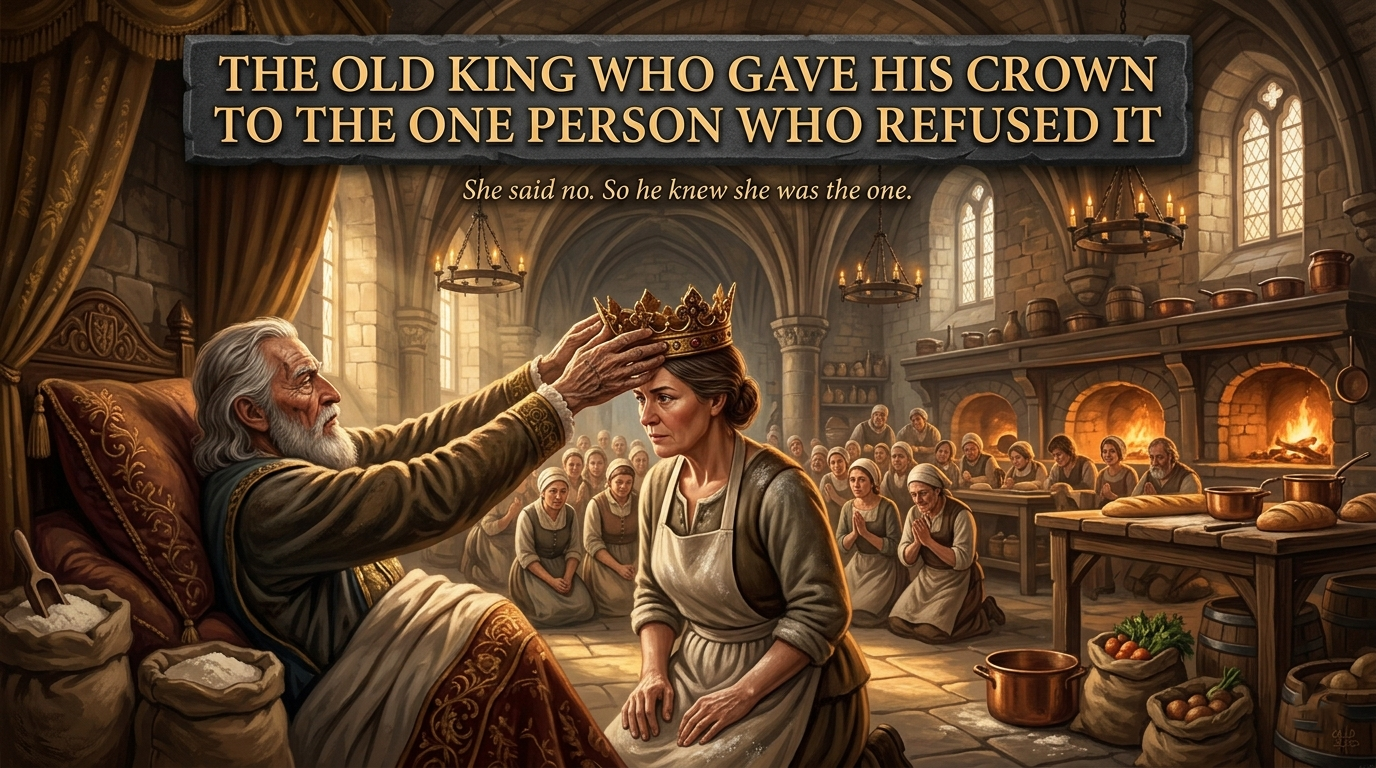
The Old King Who Gave His Crown to the One Person Who Refused It !
Part One: The King at the End of Things
King Aldric had ruled the kingdom of Sonnfeld for fifty-one years, and he had been, by most measures that matter, a good king.
Not a perfect one. He had made wars he should not have made and avoided wars he perhaps should have fought. He had trusted the wrong advisors twice and the right ones not often enough. He had loved his people in the abstract and failed them occasionally in the specific, which is the particular failure of rulers who are better at policy than at presence. He had been proud and then humbled and then proud again in the way that power cycles through people who are trying, imperfectly, to be worthy of it.
Now he was eighty-one and dying and he knew it with the calm clarity that comes, sometimes, to people at the end of long lives — the clarity of a sky after a storm, everything washed clean, the world suddenly precise and vivid and exactly itself.
He had one thing left to do.
The crown of Sonnfeld was old — older than Aldric, older than his father, older than the dynasty itself, forged from iron and gold in a time when those two metals meant something more than wealth and utility, when they meant earth and sun, permanence and light, the weight of the world and the promise of what could grow in it. It sat on a cushion in his chamber and he looked at it every morning and thought about what it had cost him and what it had given him and what it needed now, at the end, from him.
He needed to give it to the right person.
He had, in fifty-one years, learned exactly one thing about power with absolute certainty:
The right person never wanted it.
Part Two: The Procession of the Wanting
He called them all.
Lords and generals and ministers and nobles and merchants who had married into titles and scholars who had earned them and distant cousins of the royal line who had been waiting, with varying degrees of patience, for exactly this moment. They came from every corner of Sonnfeld, filling the palace in their finest clothes, wearing their ambitions the way they wore their jewelry — openly, proudly, as if wanting were its own credential.
Aldric received them one at a time in his chamber, propped up on pillows, the crown on its cushion on the table beside him. He asked each one the same question.
If I gave you this crown, what would you do with it?
They answered. At length. With preparation and polish and the particular fluency of people who had been rehearsing this answer their entire lives. They spoke of reform and expansion and justice and prosperity and the consolidation of Sonnfeld’s borders and the improvement of its roads and the modernization of its laws. Several wept — genuine tears, Aldric thought, of genuine desire. A few were honest enough to say they wanted it because they had always wanted it, because power was the thing they were built for, because ruling was the only shape their ambition knew how to take.
He listened to all of them.
He thanked all of them.
He offered the crown to none of them.
His chief advisor, a careful woman named Renn who had served him for twenty years, watched this procession with the expression of someone doing difficult arithmetic.
“You will run out of candidates,” she said, after the forty-third.
“I know,” said Aldric.
“Then what?”
“Then I go further,” he said. “Smaller. Closer to the ground.”
Renn looked at him for a long moment.
“How far down?” she asked.
“As far as it takes,” said the king.
Part Three: Marta
He found her on a Tuesday.
Or rather — she was found, which is different, because she was not looking to be found and would not have presented herself if she had known what was coming.
Her name was Marta. She was fifty-three years old and had worked in the palace kitchens for thirty-one of those years, beginning as a girl hauling water and working her way, through the patient accumulation of skill and the quiet authority of someone who simply knew how to do things well, to the head of the bread ovens. She was known in the kitchen for three things: her bread, which was extraordinary; her fairness, which was absolute; and her complete and total lack of interest in anything that happened above the kitchen floor.
She was not political. She was not ambitious. She held opinions about the kingdom’s governance the way she held opinions about weather — noted, considered, filed away, not worth arguing about because she had bread to make.
She was called to the king’s chamber on a Tuesday morning without explanation and arrived with flour on her hands because she had not been given time to wash it off, which she noted with mild annoyance.
Aldric looked at her for a long moment.
She looked back with the direct, unimpressed gaze of a woman who has spent thirty years feeding powerful people and noticed that hunger makes everyone the same.
“Sit down,” he said.
She sat.
“I’m going to ask you something,” he said, “and I need you to answer honestly.”
“I generally do,” she said. “It saves time.”
He almost smiled. “If I gave you this crown,” he said, nodding toward the cushion, “what would you do with it?”
Marta looked at the crown. She looked at it the way she looked at an unfamiliar ingredient — with assessment, without hunger, asking simply: what is this and what does it require?
Then she looked back at the king.
“I wouldn’t take it,” she said.
“Why not?” he asked.
She considered the question seriously, which he appreciated.
“Because I know what I’m good at,” she said. “And ruling a kingdom is not it. I’m good at bread. I’m good at knowing when someone in my kitchen is struggling before they say so. I’m good at making sure thirty people work in a small hot room without killing each other.” She paused. “Those are real skills. Useful ones. But they’re not that.” She nodded at the crown again. “That needs someone who understands law and war and the way power moves between people, which I don’t, and I’d do more harm than good pretending otherwise.”
Aldric was quiet for a moment.
“Everyone else I’ve spoken to believes they can learn what they don’t know,” he said.
“Everyone else you’ve spoken to,” Marta said, carefully, “wanted the crown before they considered whether they should have it. I’d have to consider whether I should have it before I could want it. And the answer is no.” She looked at him steadily. “Is that the honest answer you wanted?”
“Yes,” said Aldric.
“Good,” said Marta. “Then I’ll go back to my bread.”
She stood up.
“Wait,” said the king.
She waited.
“What if I told you,” he said slowly, “that the answer you just gave me is the only answer I’ve heard in six weeks that makes me believe the person giving it could actually do the job?”
Marta looked at him.
“I’d say,” she said, after a pause, “that sounds like a problem for both of us.”
Part Four: The Argument
She did not agree easily. He had not expected her to.
She came back to his chamber every day for two weeks — not because she wanted to, but because he kept sending for her and she was, under everything, a woman who took duty seriously and an old man asking her to listen was a duty she couldn’t dismiss.
He did not argue that she was secretly ambitious. He did not argue that she was destined or chosen or that the kingdom needed her specifically. He had too much respect for her honesty to meet it with flattery.
He argued this instead: “The kingdom does not need someone who wants to rule it. It has had sixty years of those and they have been adequate and occasionally good and never quite enough. What it needs is someone who will ask, every single morning, whether they should still be doing this — whether they are the right person, whether the decisions they’re making are actually good or only feel good, whether the power has started to work on them the way it works on everyone eventually.” He paused to breathe — he was dying, and breathing cost him something now. “You already ask those questions. About your kitchen. About your people. I’ve watched you for years without you knowing it. You have never once stopped asking.”
Marta was quiet.
“You’re afraid,” he said. “That’s correct. Fear of power in the hands of someone who understands it is not weakness. It’s the only appropriate response.”
“I don’t know the law,” she said.
“Renn knows the law. She will stay.”
“I don’t know the generals.”
“The generals know themselves too well already. They need someone who doesn’t.”
“I don’t know diplomacy.”
“You kept thirty people in a small hot room from killing each other for thirty years,” he said. “That is diplomacy. The rest is vocabulary.”
Marta looked at the crown on its cushion.
It looked back at her the way heavy things look at you — without expression, without pleading, simply present, simply waiting, simply itself.
“If I do this,” she said, very quietly, “and I find I’m doing it wrong — I need to be able to say so. And stop.”
“Yes,” said Aldric.
“No king has ever stopped.”
“No king has ever started for your reasons,” he said. “I think that changes the stopping.”
She was silent for a long time.
Outside the window, Sonnfeld went about its Tuesday business — market sounds, cart wheels, someone’s child laughing at something in the street below.
“I’ll need new ovens in the kitchen,” she said finally. “The east ones have been broken for three years and nobody above the kitchen floor has cared.”
Aldric looked at her.
“Done,” he said.
“I’m not saying yes,” she said.
“I know,” he said.
“I’m saying I’ll think about it.”
“That’s all I asked.”
Part Five: The Crowning
She said yes on a Friday.
Not dramatically — she came to his chamber in the morning with flour on her hands again, which he was beginning to think was intentional, and she stood at the foot of his bed and said: “I’ve thought about it. I’ll do it. I want it on record that I think this is a significant mistake and that I reserve the right to say so publicly at any point.”
“Recorded,” said Aldric.
“And the ovens.”
“Already ordered.”
She looked at the crown.
“How does this work?” she asked.
“However you want it to,” he said. “It’s your coronation.”
She thought about it.
“Small,” she said. “In the kitchen. The people who work there should be the first to know, before the lords and the generals and everyone who’s going to have opinions about it. They fed this kingdom for thirty years without anyone noticing. They should notice first.”
Aldric smiled — fully, for what felt like the first time in months.
“Yes,” he said.
The coronation of Queen Marta of Sonnfeld took place on a Friday morning in the palace kitchen, between the bread ovens and the long wooden worktables, in front of thirty-one people who smelled of flour and woodsmoke and had opinions about everything and were the first in the kingdom to kneel.
Aldric placed the crown on her head himself, sitting up in the bed they had carried down for him because he could not stand for long.
She held very still under its weight.
“Heavy,” she said.
“Yes,” he said.
“Good,” she said. “It should be.”
He died four days later, quietly, in the same bed, with Renn on one side and the window on the other showing a Tuesday morning in Sonnfeld going about its business exactly as it always had.
He died, those who were there said, looking satisfied.
The way a man looks who has finished a thing properly.
— The End —
Epilogue: The Queen Who Asked Every Morning
Marta ruled Sonnfeld for nineteen years.
She was not a perfect queen. She made mistakes — moved too slowly on some things, too quickly on others, trusted the wrong minister once and spent two years correcting it. She never fully learned to love the ceremonies, though she performed them faithfully, and she never stopped finding the throne room cold in a way the kitchen never was.
But every morning, without exception, she asked herself the question Aldric had described — am I still the right person? Are these decisions actually good or do they only feel good? Has the power started to work on me?
Some mornings the answer was uncomfortable. On those mornings she called Renn and they talked until the answer was clearer.
She never stopped asking.
She fixed the east kitchen ovens on her first day. It was the first decree of her reign, and historians would later argue about what it meant — a symbol of the common people, a statement of priorities, a deliberate provocation to the nobility.
Marta herself said it meant the ovens were broken and needed fixing and she knew how to fix them and so she did.
Which is, perhaps, the whole of good governance, stated plainly.
The thing is broken.
You know how to fix it.
So you do.
Not because you wanted the power to fix it.
Because the thing needed fixing and you were there.
That is the only crown worth wearing.
That is the only reason worth having it.
That is what the old king knew, at the end of fifty-one years, that he had been trying to learn from the very beginning.