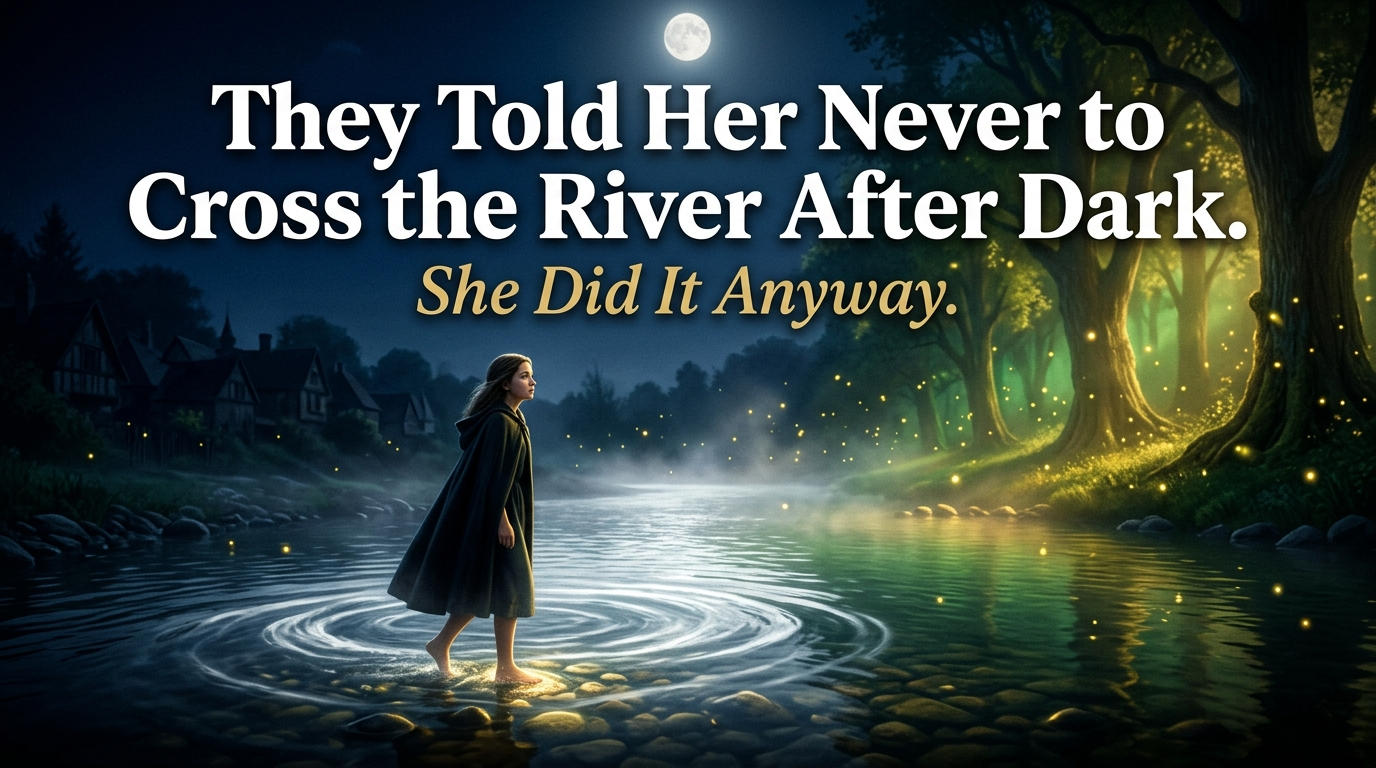
They Warned Her Not to Cross the River After Dark. She Did It Anyway — and Found What the Town Had Been Hiding for a Hundred Years.
Part 1: The Rule Nobody Ever Explained
In the town of Vellowmere, there was only one rule that every child learned before they learned anything else.
Not the rule about respecting your elders. Not the rule about keeping your gate latched so the Fenwick goats didn’t wander. The rule. The only one that was said in a particular tone — low, flat, final — the tone adults used when they did not intend to explain themselves.
Do not cross the river after dark.
No reason was ever given. No story was ever told. Every child who asked why received the same answer from every adult in Vellowmere: a look. Just a look — steady, unreadable, faintly afraid — and then a subject change so swift it left you dizzy.
Sera had been asking why since she was four years old.
She was seventeen now, and she had still never received an answer. What she had received, over thirteen years of asking, was a growing and detailed collection of evidence that the adults of Vellowmere knew exactly what was on the other side of that river — and had made a very deliberate decision, a very long time ago, that no one would ever find out.
She had a notebook. She had observations. She had the fact that every elder in town went pale at the mention of the river’s name after sunset. She had the locked room in the town hall that no one acknowledged existed. She had her grandmother’s whispered words on her deathbed three months ago — the words no one else in the family had heard, meant only for Sera’s ears:
“The river isn’t dangerous, my love. The crossing is. There’s a difference. And someone needs to know what’s on the other side before the ones who remember are all gone.”
That was enough for Sera.
On the night of the autumn equinox, when the moon was full and the river ran silver and every adult in Vellowmere was locked in the town hall for their annual Closed Meeting that no child had ever been permitted to attend, Sera walked to the river’s edge.
She took off her shoes. She stepped in.
The water was cold and clear and came up to her knees and felt like absolutely nothing dangerous at all.
She crossed.
The other side of the river was not dark. It was not frightening. It was not empty. It was lit — softly, impossibly — by something she had no word for. And standing at the tree line, watching her with an expression of profound relief, was a woman who had the same eyes as Sera’s grandmother. Who introduced herself as someone who had crossed this river one hundred years ago. And who said: “We’ve been waiting for someone to come.” 🌊
Part 2: The World the Town Forgot to Mention
The woman’s name was Isoline. She was — or appeared to be — somewhere in her sixties, with silver hair loose around her shoulders and the unhurried bearing of someone who had stopped measuring time the ordinary way.
She led Sera through the tree line without touching her, only beckoning, and Sera followed because her grandmother had told her to come and because the light through these trees was the most beautiful thing she had ever seen and because she had been asking why for thirteen years and the answer was apparently right here.
What lay beyond the tree line was not a wild wood. It was a settlement — old, living, luminous with the kind of quiet industry that comes from people who have built something entirely their own over a very long time. Stone cottages with moss rooftops. Gardens that grew things Sera had no names for, silver-leafed and tall. Children running between buildings — actual children, which surprised her — who stopped to stare at Sera with wide, curious eyes.
“How many people live here?” Sera asked.
“Three hundred and twelve,” Isoline said. “As of last Tuesday, when the Alderly twins arrived.”
“Where did they all come from?”
Isoline looked at her steadily. “From Vellowmere,” she said. “Every one of us. Over the last hundred years. We crossed the river — most of us at night, most of us young, all of us asking the same question you were asking — and we found this place, and we stayed.”
Sera stopped walking. “You all left,” she said slowly. “You crossed and you just — left. And the town never told anyone you existed.”
What Isoline Said
“The town didn’t leave us. We left the town. And when we left, the town decided — the elders decided — that it was easier to make the river into a monster than to explain that some people had chosen something different. Every generation since, the warning has gotten darker, the look has gotten colder, and the truth has gotten further away.” She paused. “Your grandmother was the last person in Vellowmere who knew the whole story. She sent you here, didn’t she.” It was not a question.
Sera thought of her grandmother’s papery hand in hers. The whispered words. The specific, deliberate way she had made sure no one else was in the room.
“She said someone needed to know before the ones who remembered were gone,” Sera said.
Isoline nodded slowly. “There are four of us left who were born in Vellowmere and remember crossing. The youngest is seventy-nine.” She looked at Sera with her grandmother’s eyes — the same particular quality of seeing, the same refusal to look away from difficult things. “We have been waiting for someone to come and carry the truth back. We cannot cross back ourselves. The river only flows one way — toward choosing. But a message can cross. A person who crossed voluntarily and freely can return.”
She let that settle.
“You came freely,” she said. “You can go back.”
She spent three days on the other side of the river. Three days that changed the shape of everything she thought she knew — about her town, her family, and the grandmother who had loved her enough to send her alone into the dark toward the truth.
Part 3: Three Days in the True World
On the first day, Isoline showed her the Archives.
Every person who had crossed the river in a hundred years had left a record — a name, a date, a reason. Sera ran her fingers down the pages slowly. Farmers and weavers and a town doctor who had crossed in 1962 with her whole family. A boy of fifteen in 1978 who had simply written beside his name: I kept asking why and no one would tell me. A woman in 1989 whose entry read: I was told this side was dangerous. I think they meant inconvenient.
On the second day, she met the four elders — the ones who still remembered Vellowmere from the inside. They were old and clear-eyed and they told her everything. The original crossing, one hundred years ago, had been an accident — a group of young people who had crossed on a dare and found not danger but wonder, a place where the land itself was generous, where the old ways of growing and building and living together still worked, where no one told you the river was a monster because no one needed you to be afraid of it.
They had sent word back. Vellowmere’s elders at the time had not welcomed the news. A place where people could simply leave — freely, easily, at will — was a place that threatened the careful order of a town that ran on staying put and not asking questions. So they had built the warning instead. Monster by monster, year by year, look by look.
What the Eldest Said
“We do not blame them entirely,” said the oldest of the four, a woman of ninety-one named Corra, whose hands shook but whose voice did not. “Fear makes people build walls. And walls, once built, become the only world their builders know. Vellowmere has been living inside a wall for a hundred years. We only want them to know the wall is not the world. We want them to know the river is safe. We want them to know — ” she stopped, pressed her lips together, looked out toward the river. “We want them to know they can come if they want to. And stay if they want to. And go back if they want to. We only ever wanted them to have the choice.”
On the third day, Sera sat alone by the river and thought about everything she was going to have to say when she crossed back.
She thought about the town hall and the Closed Meeting and the locked room. She thought about the look — that flat, frightened look — and understood now that it was not cruelty but the expression of people who had been tending a lie so long they had forgotten it was one.
She thought about standing up in Vellowmere and telling the truth to people who had spent their entire lives being told the truth was dangerous.
She was seventeen years old. She was about to walk back across a river and dismantle a hundred years of fear with nothing but a notebook and a dead woman’s last instructions.
She picked up a smooth river stone from the bank and put it in her pocket. A reminder. Proof. Something real to hold when the words got hard.
Then she stood up and crossed back.
She walked into the town hall at sunrise, while the elders were still inside from their overnight meeting, and she set her notebook on the head table and she said: “I crossed the river last night. I know what’s on the other side. And I think it’s time everyone in this room did too.”
Part 4: The Girl Who Brought the River Home
Publish on Website
The town hall went absolutely silent.
Twelve elders. Three council members. The town recorder, who stopped writing mid-sentence and put down her pen. Every face in the room turned toward Sera — some white with shock, some rigid with something older and more complicated than shock, one or two with an expression she hadn’t expected at all.
Relief.
She told them everything. She spoke for a long time — clearly, carefully, the way she had rehearsed it on the riverbank — and she did not raise her voice and she did not accuse and she did not perform the anger she had every right to feel. She simply told the truth, piece by piece, the way you lay stones across a river to make a crossing: one at a time, solid, going somewhere.
The Head Elder — a man named Orren, seventy years old and the keeper of the Closed Meeting for thirty of them — sat very still through all of it. When she finished, he did not speak immediately. He looked at his hands on the table. He looked at the locked door in the far wall. He looked at the other elders, and in that look passed something that Sera understood was the weight of a hundred years of knowing, finally, mercifully, being set down.
“How many people are there?” he asked at last. His voice was very quiet.
“Three hundred and twelve,” Sera said. “As of last Tuesday.”
Something moved across his face. “My father crossed in 1959,” he said. “I was told he drowned.”
The room went very still.
“There’s an archive,” Sera said carefully. “Every name. Every date.”
He closed his eyes for a moment. Nodded once. Then he stood, walked to the locked room in the far wall, and opened it with a key he wore around his neck — a key, Sera now understood, that had been passed from Head Elder to Head Elder for a hundred years, locking away the truth generation after generation until someone finally came along who had crossed the river and come back and refused to let the lie continue.
Inside the locked room were documents. Names. Records of every crossing, kept secretly, evidence that the elders had always known exactly where those people had gone.
He handed the documents to Sera without a word.
The warning came down that afternoon — the carved wooden sign at the river’s edge that said DO NOT CROSS AFTER DARK in letters so old no one remembered who had made them. Sera pulled it up herself. The wood was rotten at the base. It came out of the ground easily, as if it had always known it was temporary.
By evening, the first families were crossing. Not all of them — not everyone was ready, not everyone would ever be ready, and that too was a choice the river allowed. But some. Enough. A stream of lanterns moving to the water’s edge, stepping in, wading across to the light on the other side.
Sera stood at the bank and watched.
Isoline was waiting on the far side. When she saw the lanterns coming she pressed both hands to her mouth. Behind her, three hundred and twelve people who had been living beyond a warning for a hundred years came to the tree line and stood in the light and watched their home come, finally, to find them.
Sera did not cross again that night. She stayed on her side of the river, on the bank, holding her smooth stone in one hand and her grandmother’s memory in the other.
She had done what she was sent to do.
The river ran between the two worlds — not a border anymore, not a warning, just water, cold and clear and silver in the moonlight, flowing freely in both directions now.
As rivers, when you let them, always do.
✨ The most dangerous thing a frightened town can do is call the truth a monster. Share this story with someone who has been warned away from something that might set them free. 🌊
-END-