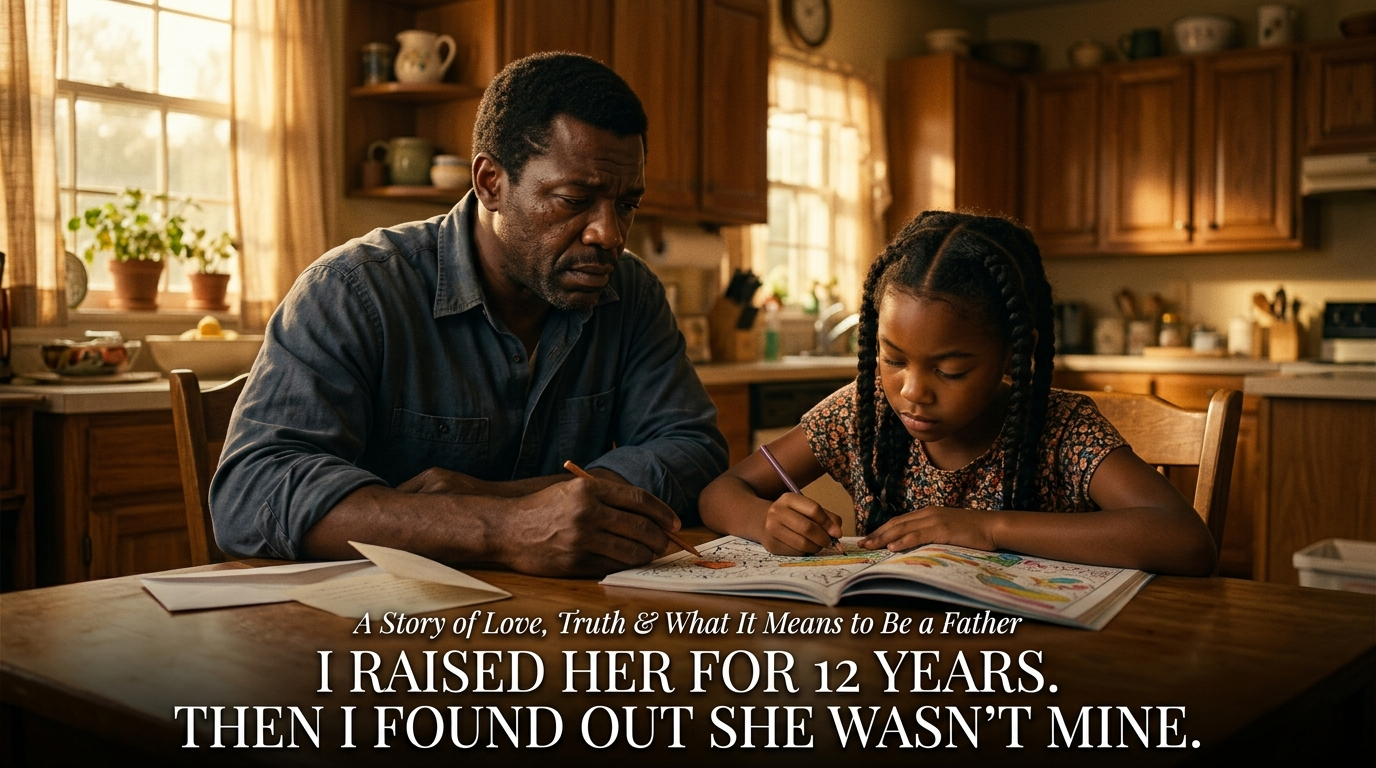
I Raised Her for 12 Years. Then I Found Out She Wasn’t Mine.
*A Romance & Drama Story*
—
## Part 1 — Still My Daughter
The DNA results came back on a Wednesday morning.
I was sitting in my car in the parking lot of a Walgreens, three blocks from the house I had lived in for fourteen years, engine off, phone face-down on the passenger seat. I had been sitting there for twenty-two minutes before I finally turned it over and opened the email.
I read it once.
Then I sat there for another forty-five minutes and did not move.
When I finally walked through the front door, Emma was at the kitchen table. Twelve years old, hair in two uneven braids she had done herself that morning because she liked doing them herself even though they were never quite even. Coloring. One of those intricate adult coloring books she had asked for at Christmas, a thin line of concentration between her brows, tongue pressed to the corner of her lip the way she does when she is focused.
She looked up when I came in. Smiled that crooked smile.
The one that looks nothing like me.
The one I had spent twelve years not noticing, or noticing and not understanding, or understanding somewhere deep and quiet and choosing, without words, not to look directly at it.
My wife was already in the hallway. She had known the results were coming today. She had known — I would learn this later — for much longer than today. The way she looked at me from the hallway told me everything before either of us said a word.
I looked at Emma.
Then I walked to the kitchen table. I pulled out the chair beside her. I sat down.
And I kept coloring.
—
### Part 2 — How It Started
The test had not been my idea, not originally.
It started with a comment. One of those offhand, meaningless things people say without thinking — my brother-in-law, Terrence, at a family cookout in July. We were standing by the grill watching Emma chase her cousins around the yard. He laughed at something she did and said, “She doesn’t look a thing like you, man. Must’ve skipped a generation.” Then he went back to his burger.
He hadn’t meant anything by it. I knew that. Terrence was the kind of man who said whatever crossed his mind and moved on without understanding that some things, once said, do not move on with you.
I moved on. Or I tried to.
But something in me that had always been very quiet and very still on this particular subject woke up that afternoon and would not go back to sleep.
Emma had my wife Diane’s coloring. Her height. Her way of tilting her head when she was thinking. But the eyes — the shape of the face — the particular way she laughed, too big for the room, like she didn’t know how to be smaller — none of that was Diane. None of it was me.
I had always filed it under: *kids don’t always look like their parents.* I had filed it, and moved on, and loved my daughter, and not looked too closely at the drawer I had put it in.
After Terrence’s comment, I started looking.
—
I didn’t tell Diane. I’m not proud of that. I told myself I was being rational — gathering information before drawing conclusions, the way I would handle anything at work. I ordered the kit online. I told myself if it came back what I expected it to come back, I would throw the envelope away and never think about it again.
I used a strand of Emma’s hair from her hairbrush.
I sent it in on a Tuesday and then tried to live my life.
For six weeks I tried to live my life.
—
### Part 3 — Wednesday
The result was not what I expected.
0.00% probability of paternity. The language was clinical and final and left no room for error or interpretation.
I sat in that Walgreens parking lot for an hour and I went through the stages of something that doesn’t have a clean name. It wasn’t grief exactly. It wasn’t rage, not yet. It was more like the sensation of the ground shifting — not collapsing, just moving, everything you had stood on for twelve years revealing itself to be a different shape than you had believed.
I thought about Emma.
Her first steps, in the living room, on a Sunday afternoon in September. She had made it four steps before sitting down hard and laughing. I had been on the floor with her, arms out, and when she made it to me I had held her like she had just crossed an ocean.
Her first day of school. The way she had held my hand in the car and then let go at the classroom door with a seriousness that broke my heart. *I’m okay, Dad. You can go.*
The night she had a fever of 104 and I had sat on the edge of her bed until four in the morning putting cold cloths on her forehead, afraid in the specific helpless way you are only afraid when it is someone you would do anything to protect.
None of those moments had a DNA test in them.
All of those moments were real.
I drove home. I walked inside. I saw my wife’s face in the hallway and I understood immediately that she knew exactly what the results said. Not because she had seen the email. Because she had always known there was a question to be answered.
I looked at Emma coloring at the kitchen table.
I sat down. I picked up a green pencil. And I colored.
—
### Part 4 — That Night
Emma went to bed at nine-thirty.
We listened to her move around upstairs — bathroom, bedroom, the specific creak of her mattress when she settled in. We had listened to that same sequence of sounds for twelve years. I knew every one of them.
Diane and I sat at the kitchen table after. The coloring book still open. Two mugs of tea neither of us touched.
She talked for a long time.
His name was Robert. They had worked together, briefly, the year before Emma was born — Diane had been at a different company then, a job she left when she got pregnant. It had been, she said, three months. It had ended before she knew she was pregnant. She had not known, when Emma was born, whether the baby was mine or his. She had looked at Emma’s face and told herself she didn’t know and that not knowing was the same as it not being true.
She had chosen, she said, not to find out.
She had chosen it every day for twelve years.
I listened to all of this. I kept my hands flat on the table because I needed something to press against. When she finished, the kitchen was very quiet.
“Does he know?” I asked. My voice came out steadier than I expected.
“No,” she said.
“Does anyone?”
“No.”
I nodded. I looked at my hands on the table.
“I need you to leave tonight,” I said. “Go to your sister’s. I need to be here with Emma and I need you not to be here.”
She started to say something. Then she stopped. She nodded. She went upstairs. I heard her pack a bag. I heard the front door close at ten forty-five.
I sat at the kitchen table until midnight.
Then I went upstairs. I pushed open Emma’s door — the one with the ceramic letters spelling her name that she had painted herself at a craft fair when she was seven — and I stood in the doorway and listened to her breathe.
Even breathing. Deep sleep. Safe.
*I’m okay, Dad. You can go.*
I pulled her door halfway closed the way she liked it and I went to bed.
—
### Part 5 — The Days After
I did not tell Emma.
That decision came to me fully formed sometime in the night and I never seriously questioned it. She was twelve years old. Whatever Diane and I had broken, Emma had not broken it. She did not need to carry what we had done to each other.
I called in to work Thursday and Friday. I told them a family situation. Which was true.
I called my brother, Calvin, on Thursday afternoon. Drove to his place and sat in his kitchen and told him the whole thing. He listened without interrupting, which is not easy for Calvin. When I finished he was quiet for a long time.
“What are you going to do?” he said.
“I don’t know yet,” I said. “But I know I’m not losing my daughter.”
He looked at me carefully. “She’s still your daughter, Marcus. Biology or not — she’s yours.”
“I know that,” I said. “I’ve known that since Wednesday morning.”
And I had. That was the thing that surprised me most about all of it — that the first thing I had felt, sitting in that parking lot, was not rejection of Emma. Not even a flicker of it. The love I had for that child was not a thing I had placed on a condition. I had not known that about myself until the condition was tested. Now I knew.
What I felt toward Diane was more complicated. And I needed time with that — real time, not managed, not performed — before I could look at it clearly.
—
### Part 6 — What I Owed Myself
Diane and I had three conversations in the two weeks she stayed at her sister’s.
The first was practical — Emma’s schedule, school pickups, making sure nothing disrupted her routine. We were careful and civil and I was grateful for that.
The second was harder. Diane talked about what had happened — not just the affair but the years before it, the distance that had grown between us that she had not known how to name or close. I listened. I did not absolve her, but I listened. Because I was honest enough with myself to know that a marriage doesn’t drift that far without two people doing the drifting.
The third conversation was the one I needed to have.
“I need to know,” I said, “if you were ever going to tell me.”
She was quiet for a long time.
“I don’t know,” she said finally. “I told myself there was nothing to tell. I made myself believe it.”
“That’s not the same as no,” I said.
“No,” she said quietly. “It isn’t.”
That answer cost us both something. But it was honest. And I had learned, in the past two weeks, that I needed honest more than I needed comfortable.
—
I found a therapist. Dr. Leon Webb, recommended by my company’s employee assistance program, a man in his fifties with a quiet office and the unhurried quality of someone who had heard everything and still believed people were worth listening to.
I saw him every week for four months. I talked about Emma. About Diane. About what fatherhood meant when it was built on something other than biology, and what I discovered — not quickly, but genuinely — was that it meant exactly the same thing it had always meant.
It meant Wednesday mornings and coloring books. It meant first steps and fever nights and car rides and homework and bad braids she insisted on doing herself.
It meant being the person who showed up.
Biology was a fact. Fatherhood was a choice. I had been making that choice every day for twelve years without knowing I was making it. Finding out the truth didn’t unmake a single one of those days.
—
### Part 7 — Robert
I found him. It wasn’t hard.
Robert Haines. Forty-one years old. Lived in Portland now. Remarried, two kids of his own. An architect. I found him on LinkedIn in about eight minutes and then sat looking at his profile photo for a long time.
I didn’t contact him.
I thought about it. I thought about what I would say and what I would want from that conversation and what Emma would need from it someday, when she was older, if she ever needed it.
And I decided — not with anger, not with jealousy, but with the clarity of a man who had sat with a very hard thing for long enough to see it plainly — that right now, at this moment, the only person I needed to think about was my daughter.
Robert Haines could become a question for another day. Maybe for Emma herself to answer, when she was old enough and if she ever wanted to.
My job, right now, was the same as it had always been.
Be her father.
—
### Part 8 — The Conversation I Wasn’t Ready For
Emma figured out something was wrong in the third week.
She was twelve, not six. She knew her mother had been at Aunt Gloria’s. She knew the kitchen table felt different at dinner. She knew I was smiling a little too consistently, the way adults smile when they are trying to make something invisible.
She came to find me on a Saturday afternoon. I was in the garage doing nothing in particular — the adult equivalent of her coloring, something to keep my hands busy. She sat on the workbench and watched me sort screws I had already sorted and finally said: “Are you and Mom getting divorced?”
I set down the screws.
I turned and looked at my daughter. Her uneven braids. Her wide, direct eyes. That crooked smile that was not mine and never had been and was, in every way that mattered, one of my favorite things in the world.
“I don’t know yet,” I said. “We’re figuring some things out.”
“Is it because of me?” she said.
“No,” I said. Immediately. No hesitation. “Nothing about this is because of you. Not one single thing.”
She looked at me for a moment, weighing it the way she weighs everything — this girl who has always been more serious than other kids her age, more careful with what she accepts.
“Okay,” she said. She slid off the workbench. Then she stopped in the doorway and said, without turning around: “You’re still my dad, right?”
The question hit me in a place I hadn’t known was exposed.
“Always,” I said. “No version of anything that happens changes that.”
She nodded once. Like it was settled. Like she had needed to hear it and now that she had, she could file it and move on.
She went inside.
I stood in the garage for a while after, hands at my sides, looking at the door she had walked through.
*You’re still my dad, right?*
Twelve years old and she had asked the right question. The only question that actually mattered.
And I had given her the only answer that was ever true.
—
### Epilogue — Two Years Later
Diane and I divorced. It took nine months from that Wednesday morning to the signing of papers, and it was hard in the way that ending something long is always hard — not because we stopped caring for each other entirely, but because we had to grieve the version of the marriage we should have been paying more attention to, all those years.
We are good co-parents. Better, if I am honest, than we were spouses in the last few years. Something about the structure of it — the clarity of roles, the necessity of communication, the fact that Emma is always the center of every decision — has made us more honest with each other than we ever were when we shared a house.
Emma is fourteen now.
She still does her own braids. They are still not quite even. She has stopped letting me comment on this.
She made the honor roll last spring. She plays soccer badly and enthusiastically. She has started writing — short stories, mostly, that she shares with me in handwritten drafts because she says screens feel too exposed. I read every one. I tell her what’s working. She argues with me about my notes.
She doesn’t know about the DNA test. Not yet.
Diane and I have talked about when and how. Dr. Webb has thoughts. Emma’s school counselor has thoughts. I have read more articles on this subject than I ever expected to read. The consensus seems to be: when she is older, when she is ready, when she asks.
She hasn’t asked. Not directly.
But sometimes, when we are driving somewhere and the radio is low and she is looking out the window, she asks me things that make me wonder what she already senses — questions about genetics, about whether personality is inherited or learned, about whether you can love someone who isn’t blood family the same way.
I always answer honestly. And I always mean it.
Because here is what I know, two years out from a Wednesday morning in a Walgreens parking lot:
Fatherhood is not a biological fact. It is a daily practice. It is the coloring book and the fever night and the crooked braids and the stories in handwritten drafts. It is the answer you give without hesitation when your daughter looks at you from a garage doorway and asks the most important question of her life.
I have been her father since the day she was born.
I will be her father until I have no more days left to give.
That was never about DNA.
It was always about showing up.
—
*© All rights reserved. Do not republish without permission.*