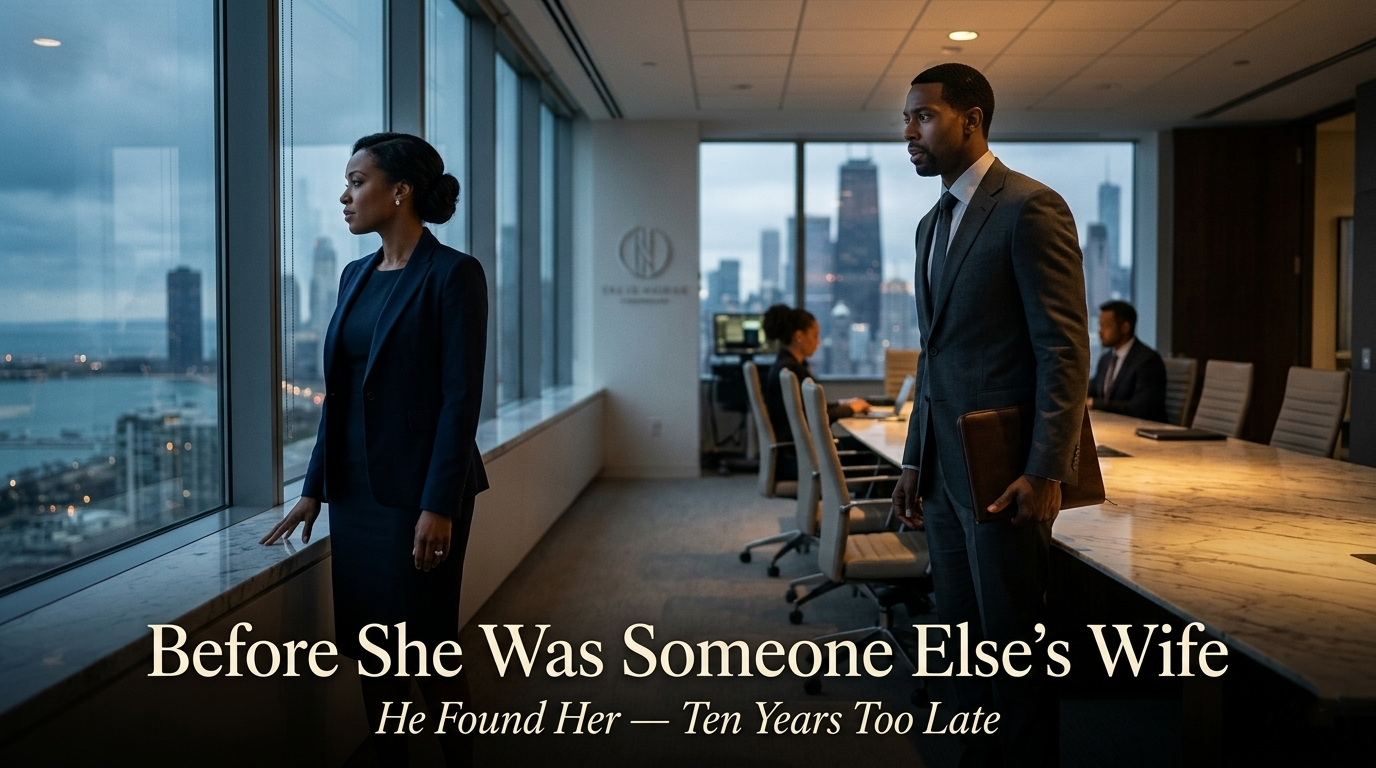
Before She Was Someone Else’s Wife ! He Found Her — Ten Years Too Late.
Part One — The Name on the File
Marcus hadn’t thought about Leila in a decade — until her name appeared on his client file.
She was successful, stunning, and engaged to someone else. He told himself it was just business. But the moment she walked through that boardroom door and their eyes met, every buried feeling came flooding back in a single heartbeat.
Some people leave your life quietly. Leila Carter had never been quiet about anything — including the way she’d walked out of his life ten years ago without a single explanation.
Now she was back. And she was wearing another man’s ring.
Part Two: Ten Years of Silence
Marcus Hale had built his life the way most men build walls — brick by brick, with purpose, with discipline, with zero room for cracks. At thirty-six, he was the youngest named partner at Hale & Donovan, a corporate consulting firm in downtown Chicago. His office had floor-to-ceiling windows that looked out over Lake Michigan. He drove a charcoal Audi he never had time to wash. He had a standing reservation at a table by the window at Oriole every Friday night — always for one.
People who didn’t know him called him impressive. People who did know him called him closed off. Both were right.
He hadn’t been in a real relationship since Leila. He’d been on dates — plenty of them — but they always ended the same way. Somewhere between the appetizers and dessert, he’d realize the woman across from him wasn’t saying anything that reached him. He’d smile. He’d pay the bill. He’d never call again.
His assistant, Dana, had started calling it “the Hale pattern.” He hadn’t corrected her.
* * *
Leila Carter had spent the last ten years becoming exactly the kind of woman she’d always told herself she would be. She’d finished her MBA at Northwestern, launched a boutique brand strategy firm in New York, and grown it from a two-person operation in her apartment to a twelve-member team in a Midtown office with potted olive trees in the lobby and a espresso machine that cost more than her first car.
Her name had appeared in Forbes Under 30 two years ago. She had been photographed at galas, quoted in magazines, and invited to panels she once sat in the audience of. She had a gorgeous apartment in the West Village with high ceilings and a reading nook she rarely had time to use.
She also had a fiancé named Daniel Ashford — a kind, handsome, perfectly decent architect who loved her in the uncomplicated way she had convinced herself she wanted. They had met at a mutual friend’s dinner party. He’d brought good wine. He’d called when he said he would. He had never once made her feel like she was too much — which was either the most romantic thing anyone had ever done for her, or a quiet warning she hadn’t let herself hear.
Their wedding was set for September. The venue was booked. The invitations had been ordered.
Everything was in place.
Everything was fine.
Part Three: The Boardroom
The meeting had been arranged three weeks in advance. Leila’s firm had been hired to rebrand a mid-size logistics company called Veridian — a new client of Hale & Donovan. Marcus was the account lead. He had reviewed the files, the financials, the brand deck. He had not reviewed the name of the consulting team lead on the other side of the table until seven minutes before the meeting started, when Dana slid the updated contact sheet across his desk.
He read the name once. Then again.
Leila M. Carter. Carter Brand Strategy. New York.
For a moment, the entire city outside his window went quiet.
“Mr. Hale?” Dana was looking at him from the doorway. “They’re ready in Conference Room B.”
He straightened his jacket. He picked up his folder. He told himself it meant nothing. Ten years was a long time. People changed. He had changed. This was a business meeting, and he was a professional, and whatever Leila Carter had meant to him at twenty-six was a different lifetime.
He believed all of that right up until he walked through the glass door and saw her standing at the window, looking out at the lake, her dark hair pulled back, wearing a deep navy blazer and a calm expression — and then she turned around.
She looked exactly the same and completely different all at once — the way a city looks when you return to it after years away and realize it never stopped moving without you.
For exactly three seconds, neither of them spoke.
Then Leila extended her hand and said, with a composure that impressed and wounded him simultaneously, “Marcus. It’s been a long time.”
“It has,” he said. He shook her hand. Her grip was firm. Her eyes gave nothing away.
And just like that, they were professionals.
* * *
The meeting lasted ninety minutes. Marcus presented. Leila countered. They disagreed on the repositioning strategy — her instinct was to go bold, his was to go precise — and the exchange was sharp and quick and quietly exhilarating in the way only conversations with someone who matches your intelligence can be.
He noticed the ring halfway through the second hour. A square-cut diamond on a thin gold band. Simple. Elegant. Wrong, said something in his chest that he told immediately to shut up.
When the meeting ended, the Veridian team filed out first. Marcus gathered his notes. Leila was speaking to one of her colleagues near the door. He was almost out of the room when she said his name.
“Marcus.”
He turned.
“It’s good to see you,” she said. And there it was — the first true thing either of them had said all morning. He could hear it in the way she dropped the professional polish for just a syllable, the way the words came out slightly softer than everything else.
“You too, Leila,” he said.
He meant it more than he was willing to admit.
Part Four: What Wasn’t Said
They worked together for six weeks on the Veridian account. Phone calls every Tuesday. Joint presentations every other Friday. Emails with attachments and tracked changes and perfectly measured professional language. He learned her schedule — she was always early, always prepared, always the sharpest person in any room she entered. She learned his — he worked late, kept his desk immaculate, and occasionally went entirely silent for thirty seconds in the middle of a sentence when he was thinking deeply, which she had apparently remembered, because on the third week she stopped filling those silences the way everyone else did.
That undid him more than anything else.
The shift happened on a Tuesday evening in week five. A scheduling conflict meant their call ran until almost nine p.m. Chicago time. When the work conversation exhausted itself, neither of them hung up immediately. There was a long pause — not uncomfortable, just real.
“How have you been?” he finally asked. “Actually.”
A beat of silence.
“Good,” she said. Then, quieter: “Mostly good.”
“Mostly.”
“Don’t read into it, Marcus.”
“I’m not,” he said. “I’m just listening.”
Another silence. Then she laughed softly — the real laugh, the one he remembered, the one that happened when she was caught off guard by something genuine — and said, “You always were annoyingly good at that.”
* * *
The following Friday, the Veridian presentation went perfectly. Afterward, the client team took everyone to dinner. Leila sat two seats away from Marcus. She was animated and funny and warm in the way she always was in rooms full of people, and he watched her from across the table and felt something that had no clean name — something that sat between admiration and grief and something reckless he refused to examine too closely.
At the end of the night, they shared a cab to the hotel. She had an early flight back to New York. He had no reason to be in the cab except that it was the most natural thing in the world and he had run out of excuses not to.
They sat in the back seat in the Chicago dark, the city lights sliding past the windows, and she said without looking at him, “Why did you never call me? After.”
His chest tightened. He knew exactly what “after” meant. There was only one “after” between them.
“I did call,” he said. “You didn’t answer.”
She turned to look at him then. And for a moment she looked twenty-five again — before the Forbes feature, before the Midtown office, before the fiancé with the good wine and the steady hands. She just looked like Leila. His Leila.
“I know,” she said quietly. “I know you did.”
The cab slowed. Her hotel appeared through the windshield. Neither of them moved to open the door.
“I was scared,” she admitted. “Of how much I felt. Of how much you made me feel. I didn’t know how to hold that much of something.”
“And now?” he asked. His voice was low.
She looked at him for a long moment. Then she looked down at her hand — at the ring.
“Now I’m engaged,” she said. It wasn’t an answer. They both knew it wasn’t an answer.
She opened the door. The cold air came in.
“Goodnight, Marcus,” she said.
“Goodnight, Leila.”
He watched her walk into the hotel. He didn’t look away until the doors closed behind her.
Part Five — Before September
She called him two weeks later. Not on a Tuesday. Not about work. Just his personal number, at seven in the morning, before the city had fully woken up.
“I need to tell you something,” she said when he answered. “And I need you to just listen. Don’t say anything until I’m done.”
“Okay,” he said.
She told him everything — the way she had never fully stopped thinking about him, the way she had compared every man she dated to the memory of what they’d had, the way she had buried it so deep it stopped feeling like grief and started feeling like a personality trait. She told him that Daniel was a wonderful man who deserved someone whose whole heart was present in the room. She told him she had sat on her apartment floor the night before for two hours and realized she couldn’t walk down an aisle toward someone while the truest part of herself was pulling in the opposite direction.
She told him she had returned the ring that morning.
Silence filled the line. His heart was doing something he had no clinical description for.
“I’m not calling because I think we just pick up where we left off,” she continued, her voice steady but thin at the edges. “I know ten years passed. I know things are complicated. I know I hurt you. But I’d rather stand in all that complication than walk into a lie.”
“Leila,” he said.
“You said you’d listen.”
“I listened. Now I’m talking.” He stood up from his desk and walked to the window. The lake was grey and quiet in the morning light. “I’m not going to pretend I don’t still feel what I feel. I never was very good at pretending. Not with you.”
She let out a long breath. He could hear it through the phone — the release of something she’d been holding for a very long time.
“What do we do now?” she asked.
“We start,” he said simply. “That’s all. We just start.”
She flew to Chicago that weekend. Not for a meeting. Not for a client. Just for coffee — real coffee, at a small place near the river he’d been meaning to try for months, with mismatched chairs and a playlist no algorithm had touched.
They sat across from each other in the morning light, two people who had wasted ten years being afraid of a feeling that had apparently never gone anywhere — and they talked. Really talked. The way they always had, when the world wasn’t watching and there was nothing to perform.
He reached across the table at some point and covered her hand with his. She didn’t pull away.
Outside, Chicago kept moving — the river glittering, the bridges opening for passing boats, the whole enormous city indifferent to the quiet miracle happening at a small table by the window.
September came and went. There was no wedding that month.
But there was a beginning.
And sometimes, that’s the braver thing.
— The End —